







Question: Answer A through G please! 2. Use the specific-factors model to answer question 2. Assume that there are two industries, food and cloth. The food
Answer "A" through "G" please! 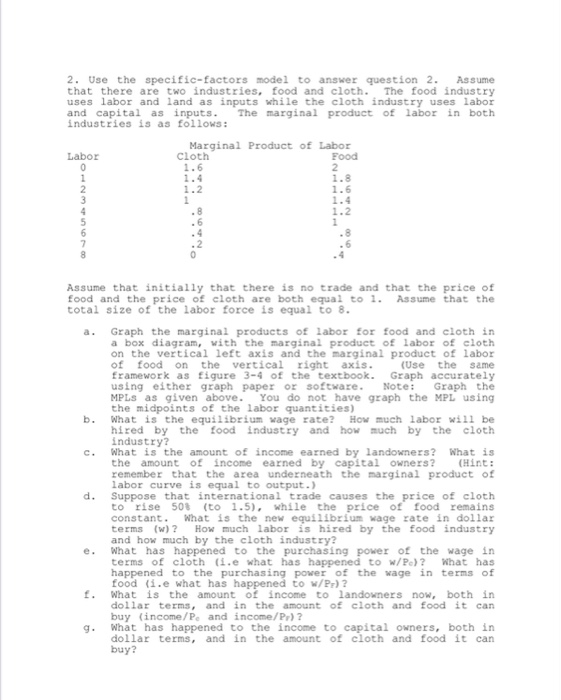
2. Use the specific-factors model to answer question 2. Assume that there are two industries, food and cloth. The food industry uses labor and land as inputs while the cloth industry uses labor and capital as inputs. The marginal product of labor in both industries is as follows: Marginal Product of Labor Labor Cloth Food 1.6 2 1.4 1.8 1.2 1.6 1 1.2 C. Assume that initially that there is no trade and that the price of food and the price of cloth are both equal to 1. Assume that the total size of the labor force is equal to 8. a. Graph the marginal products of labor for food and cloth in a box diagram, with the marginal product of labor of cloth on the vertical left axis and the marginal product of labor of food on the vertical right axis. (Use the same framework as figure 3-4 of the textbook. Graph accurately using either graph paper or software. Note: Graph the MPLS as given above. You do not have graph the MPL using the midpoints of the labor quantities) b. What is the equilibrium wage rate? How much labor will be hired by the food industry and how much by the cloth industry? What is the amount of income earned by landowners? What is the amount of income earned by capital owners? (Hint: remember that the area underneath the marginal product of labor curve is equal to output.) d. Suppose that international trade causes the price of cloth to rise 50% (to 1.5), while the price of food remains constant. What is the new equilibrium wage rate in dollar terms (w)? How much labor is hired by the food industry and how much by the cloth industry? What has happened to the purchasing power of the wage in terms of cloth (i.e what has happened to w/P.)? What has happened to the purchasing power of the wage in terms of food (i.e what has happened to w/P)? What is the amount of income to landowners now, both in dollar terms, and in the amount of cloth and food it can buy (income/P. and income/Pr)? g. What has happened to the income to capital owners, both in dollar terms, and in the amount of cloth and food it can buy? . 2. Use the specific-factors model to answer question 2. Assume that there are two industries, food and cloth. The food industry uses labor and land as inputs while the cloth industry uses labor and capital as inputs. The marginal product of labor in both industries is as follows: Marginal Product of Labor Labor Cloth Food 1.6 2 1.4 1.8 1.2 1.6 1 1.2 C. Assume that initially that there is no trade and that the price of food and the price of cloth are both equal to 1. Assume that the total size of the labor force is equal to 8. a. Graph the marginal products of labor for food and cloth in a box diagram, with the marginal product of labor of cloth on the vertical left axis and the marginal product of labor of food on the vertical right axis. (Use the same framework as figure 3-4 of the textbook. Graph accurately using either graph paper or software. Note: Graph the MPLS as given above. You do not have graph the MPL using the midpoints of the labor quantities) b. What is the equilibrium wage rate? How much labor will be hired by the food industry and how much by the cloth industry? What is the amount of income earned by landowners? What is the amount of income earned by capital owners? (Hint: remember that the area underneath the marginal product of labor curve is equal to output.) d. Suppose that international trade causes the price of cloth to rise 50% (to 1.5), while the price of food remains constant. What is the new equilibrium wage rate in dollar terms (w)? How much labor is hired by the food industry and how much by the cloth industry? What has happened to the purchasing power of the wage in terms of cloth (i.e what has happened to w/P.)? What has happened to the purchasing power of the wage in terms of food (i.e what has happened to w/P)? What is the amount of income to landowners now, both in dollar terms, and in the amount of cloth and food it can buy (income/P. and income/Pr)? g. What has happened to the income to capital owners, both in dollar terms, and in the amount of cloth and food it can buy
Step by Step Solution
There are 3 Steps involved in it

Get step-by-step solutions from verified subject matter experts
 Study Help