







Question: Answer all 8 questions please. 3.8. DES has a somewhat surprising property related to bitwise complements of its inputs and outputs. We investigate the property
Answer all 8 questions please.
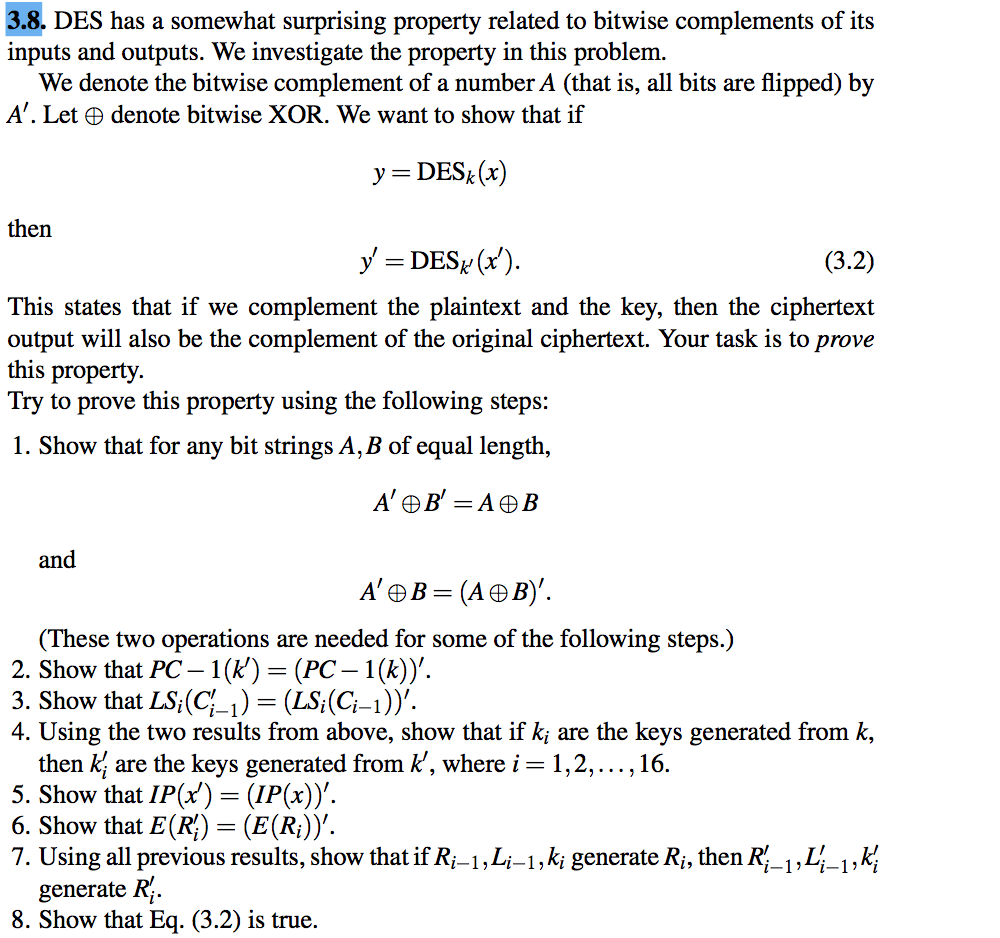
3.8. DES has a somewhat surprising property related to bitwise complements of its inputs and outputs. We investigate the property in this problem We denote the bitwise complement of a number A (that is, all bits are flipped) by A. Let denote bitwise XOR. We want to show that if then (3.2) This states that if we complement the plaintext and the key, then the ciphertext output will also be the complement of the original ciphertext. Your task is to prove this property Try to prove this property using the following steps: 1. Show that for any bit strings A,B of equal length an A'B (AB) (These two operations are needed for some of the following steps.) 2. Show that PC-1(k)- (PC-1(k))' 3. Show that LS(C-)(LS(C-1). 4. Using the two results from above, show that if ki are the keys generated from k then k, are the keys generated from k', where i-1,2,..., 16. 5. Show that IP(x)- (IP(x))' 6. Show that E(R (E(Ri)'. 7. Using all previous results, show that if Ri-i , Li-i , ki generate Ri, then R-1 ,L- generate R. 8. Show that Eq. (3.2) is true. 3.8. DES has a somewhat surprising property related to bitwise complements of its inputs and outputs. We investigate the property in this problem We denote the bitwise complement of a number A (that is, all bits are flipped) by A. Let denote bitwise XOR. We want to show that if then (3.2) This states that if we complement the plaintext and the key, then the ciphertext output will also be the complement of the original ciphertext. Your task is to prove this property Try to prove this property using the following steps: 1. Show that for any bit strings A,B of equal length an A'B (AB) (These two operations are needed for some of the following steps.) 2. Show that PC-1(k)- (PC-1(k))' 3. Show that LS(C-)(LS(C-1). 4. Using the two results from above, show that if ki are the keys generated from k then k, are the keys generated from k', where i-1,2,..., 16. 5. Show that IP(x)- (IP(x))' 6. Show that E(R (E(Ri)'. 7. Using all previous results, show that if Ri-i , Li-i , ki generate Ri, then R-1 ,L- generate R. 8. Show that Eq. (3.2) is true
Step by Step Solution
There are 3 Steps involved in it

Get step-by-step solutions from verified subject matter experts
 Study Help