







Question: Answer all: Marginal analysis and decision-making: Concept: The Fundamental Assumption of Economics All social phenomena emerge from the actions and interactions of individuals who are
Answer all: Marginal analysis and decision-making:
Concept: The Fundamental Assumption of Economics
All social phenomena emerge from the actions and interactions of individuals who are choosing in response to expected marginal benefits and expected marginal costs to themselves.
Definition: Marginal is additional or incremental (amount of increase) or decremental (amount of decrease).
Should I do (choose) activity x?
MC(x) = the additional costs of doing x
MB(x) = the additional benefits of doing x
Rule:
If Expected MB(x) > Expected MC(x), do x; otherwise don't.
Application:
Would an employer ever hire anyone if the expected additional cost of his or her employment were greater than the expected marginal/additional benefit? Of course not, to do so would be irrational.
Assumptions:
In economics, we assume rationality. No one would intentionally harm themselves.
Do businesses have the ability to measure costs? Marginal costs?
How would you use this concept to determine when to get married?
[3/26, 09:31] Festuh: Question:
Consider a family with a mother, father, and two children. Consider the following set of events: A1 = {mother has influenza}; A2 = {father has influenza}; A3 = {first child has influenza}; A4 = {second child has influenza}; B = {at least one child has influenza}; C = {at least one parent has influenza}; D = {at least one family member has influenza}. What does A1 A2 mean?
(a) Either the mother or the father has influenza (b) Both the mother and the father have influenza (c) Neither the mother nor the father has influenza (d) All the family members have influenza
2. Consider a family with a mother, father, and two children. Consider the following set of events: A1 = {mother has influenza}; A2 = {father has influenza}; A3 = {first child has influenza}; A4 = {second child has influenza}; B = {at least one child has influenza}; C = {at least one parent has influenza}; D = {at least one family member has influenza}. Are A3 and A4 mutually exclusive events? (a) Yes (b) No (c) Maybe
3. Consider a family with a mother, father, and two children. Consider the following set of events: A1 = {mother has influenza}; A2 = {father has influenza}; A3 = {first child has influenza}; A4 = {second child has influenza}; B = {at least one child has influenza}; C = {at least one parent has influenza}; D = {at least one family member has influenza}. Express D in terms of B and C (a) D = B or C (b) D = B & C (c) D does not equal B or C
4. Consider a family with a mother, father, and two children. Consider the following set of events: A1 = {mother has influenza}; A2 = {father has influenza}; A3 = {first child has influenza}; A4 = {second child has influenza}; B = {at least one child has influenza}; C = {at least one parent has influenza}; D = {at least one family member has influenza}.
Suppose an influenza epidemic strikes a city. In 10% of families, the mother has influenza. In 10% of families, the father has influenza. In 2% of families, both the mother and father have influenza. Furthermore, suppose each child has a 20% chance of contracting influenza and there is a 10% chance both children become diseased. What is the probability that at least one child will get influenza? (a) 0.1 (b) 0.2 (c) 0.3 (d) 0.4
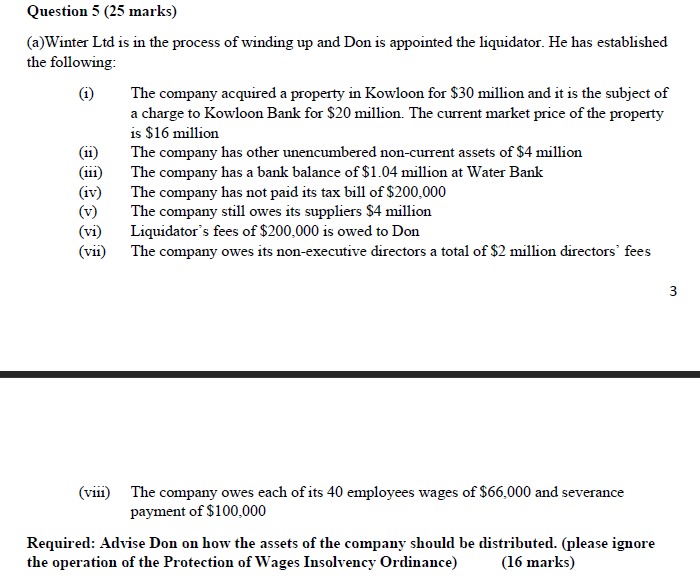
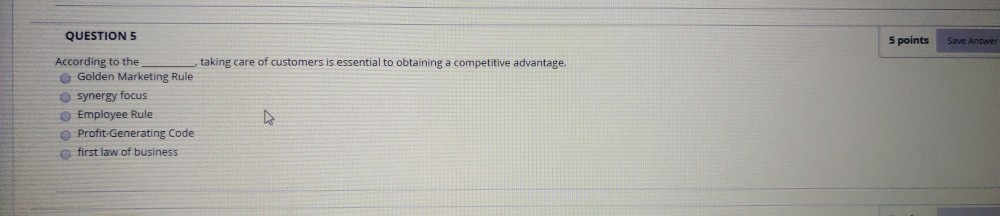
Question 5 {25 marks} (a)Winter Ltd is in the process of winding up and Don is appointed the liquidator. He has established the following: {i} The company acquired a property in Kowloon for $31) million and it is the subject of a charge to Kowloon Bank for $21] million. The current market price of the property is $l million (ii) The company has other unencumbered noncurrent assets of $4 million (iii) The company has a bank balance of$l .04 million at Water Bank (iv) The company has not paid its tax bill of $200,013} (V) The company still owes its suppliers $4 million (w) Liquidator's fees of $E, is owed to Don (Vii) The company owes its non-executive directors a total of $2 million directors' fees (viii) The company owes each of its 4'!) employees wages of $6633\") and severance payment of $l,DD Required: Advise Don on how the assets of the company should be distributed. (please ignore the operation of the Protection of Wages Insolyllcy Ordinance} (15 marks} QUESTION 5 5 points Save Answer According to the taking care of customers is essential to obtaining a competitive advantage. O Golden Marketing Rule O synergy focus Employee Rule Profit Generating Code first law of business
Step by Step Solution
There are 3 Steps involved in it

Get step-by-step solutions from verified subject matter experts
 Study Help