Question: Answer all problems 1-9 below. No books, notes or electronic devices are allowed. No other papers beyond what is provided may be used for answers.
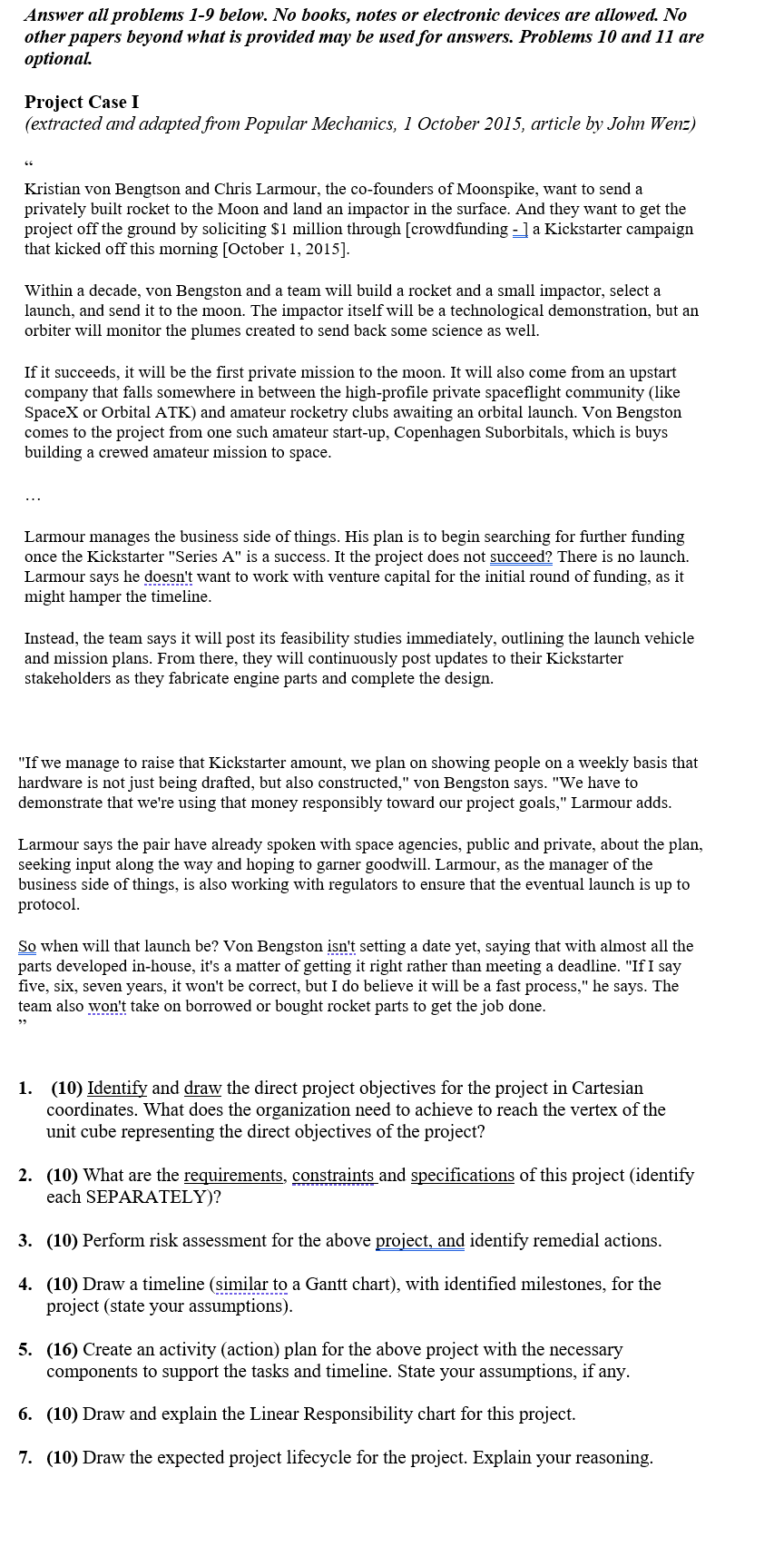
Answer all problems 1-9 below. No books, notes or electronic devices are allowed. No other papers beyond what is provided may be used for answers. Problems 10 and 11 are optional Project Case I (extracted and adapted from Popular Mechanics, 1 October 2015, article by John Wenz) Kristian von Bengtson and Chris Larmour, the co-founders of Moonspike, want to send a privately built rocket to the Moon and land an impactor in the surface. And they want to get the project off the ground by soliciting $1 million through crowdfunding - a Kickstarter campaign that kicked off this morning (October 1, 2015]. Within a decade, von Bengston and a team will build a rocket and a small impactor, select a launch, and send it to the moon. The impactor itself will be a technological demonstration, but an orbiter will monitor the plumes created to send back some science as well. If it succeeds, it will be the first private mission to the moon. It will also come from an upstart company that falls somewhere in between the high-profile private spaceflight community (like SpaceX or Orbital ATK) and amateur rocketry clubs awaiting an orbital launch. Von Bengston comes to the project from one such amateur start-up, Copenhagen Suborbitals, which is buys building a crewed amateur mission to space. Larmour manages the business side of things. His plan is to begin searching for further funding once the Kickstarter "Series A" is a success. It the project does not succeed? There is no launch. Larmour says he doesn't want to work with venture capital for the initial round of funding, as it might hamper the timeline. Instead, the team says it will post its feasibility studies immediately, outlining the launch vehicle and mission plans. From there, they will continuously post updates to their Kickstarter stakeholders as they fabricate engine parts and complete the design. "If we manage to raise that Kickstarter amount, we plan on showing people on a weekly basis that hardware is not just being drafted, but also constructed," von Bengston says. "We have to demonstrate that we're using that money responsibly toward our project goals," Larmour adds. Larmour says the pair have already spoken with space agencies, public and private, about the plan, seeking input along the way and hoping to garner goodwill. Larmour, as the manager of the business side of things, is also working with regulators to ensure that the eventual launch is up to protocol. So when will that launch be? Von Bengston isn't setting a date yet, saying that with almost all the parts developed in-house, it's a matter of getting it right rather than meeting a deadline. "If I say five, six, seven years, it won't be correct, but I do believe it will be a fast process," he says. The team also won't take on borrowed or bought rocket parts get the job done. 1. (10) Identify and draw the direct project objectives for the project in Cartesian coordinates. What does the organization need to achieve to reach the vertex of the unit cube representing the direct objectives of the project? 2. (10) What are the requirements, constraints and specifications of this project (identify each SEPARATELY)? 3. (10) Perform risk assessment for the above project, and identify remedial actions. 4. (10) Draw a timeline (similar to a Gantt chart), with identified milestones, for the project (state your assumptions). 5. (16) Create an activity (action) plan for the above project with the necessary components to support the tasks and timeline. State your assumptions, if any. 6. (10) Draw and explain the Linear Responsibility chart for this project. 7. (10) Draw the expected project lifecycle for the project. Explain your reasoning. Answer all problems 1-9 below. No books, notes or electronic devices are allowed. No other papers beyond what is provided may be used for answers. Problems 10 and 11 are optional Project Case I (extracted and adapted from Popular Mechanics, 1 October 2015, article by John Wenz) Kristian von Bengtson and Chris Larmour, the co-founders of Moonspike, want to send a privately built rocket to the Moon and land an impactor in the surface. And they want to get the project off the ground by soliciting $1 million through crowdfunding - a Kickstarter campaign that kicked off this morning (October 1, 2015]. Within a decade, von Bengston and a team will build a rocket and a small impactor, select a launch, and send it to the moon. The impactor itself will be a technological demonstration, but an orbiter will monitor the plumes created to send back some science as well. If it succeeds, it will be the first private mission to the moon. It will also come from an upstart company that falls somewhere in between the high-profile private spaceflight community (like SpaceX or Orbital ATK) and amateur rocketry clubs awaiting an orbital launch. Von Bengston comes to the project from one such amateur start-up, Copenhagen Suborbitals, which is buys building a crewed amateur mission to space. Larmour manages the business side of things. His plan is to begin searching for further funding once the Kickstarter "Series A" is a success. It the project does not succeed? There is no launch. Larmour says he doesn't want to work with venture capital for the initial round of funding, as it might hamper the timeline. Instead, the team says it will post its feasibility studies immediately, outlining the launch vehicle and mission plans. From there, they will continuously post updates to their Kickstarter stakeholders as they fabricate engine parts and complete the design. "If we manage to raise that Kickstarter amount, we plan on showing people on a weekly basis that hardware is not just being drafted, but also constructed," von Bengston says. "We have to demonstrate that we're using that money responsibly toward our project goals," Larmour adds. Larmour says the pair have already spoken with space agencies, public and private, about the plan, seeking input along the way and hoping to garner goodwill. Larmour, as the manager of the business side of things, is also working with regulators to ensure that the eventual launch is up to protocol. So when will that launch be? Von Bengston isn't setting a date yet, saying that with almost all the parts developed in-house, it's a matter of getting it right rather than meeting a deadline. "If I say five, six, seven years, it won't be correct, but I do believe it will be a fast process," he says. The team also won't take on borrowed or bought rocket parts get the job done. 1. (10) Identify and draw the direct project objectives for the project in Cartesian coordinates. What does the organization need to achieve to reach the vertex of the unit cube representing the direct objectives of the project? 2. (10) What are the requirements, constraints and specifications of this project (identify each SEPARATELY)? 3. (10) Perform risk assessment for the above project, and identify remedial actions. 4. (10) Draw a timeline (similar to a Gantt chart), with identified milestones, for the project (state your assumptions). 5. (16) Create an activity (action) plan for the above project with the necessary components to support the tasks and timeline. State your assumptions, if any. 6. (10) Draw and explain the Linear Responsibility chart for this project. 7. (10) Draw the expected project lifecycle for the project. Explain your reasoning









 Study Help