







Question: answer all question please Green Kitchen: Assembling the Right Team JOR CIRCULA He An Environment for Expansion Green Kitchen, based in Hamburg, Germany, produces a
answer all question please 
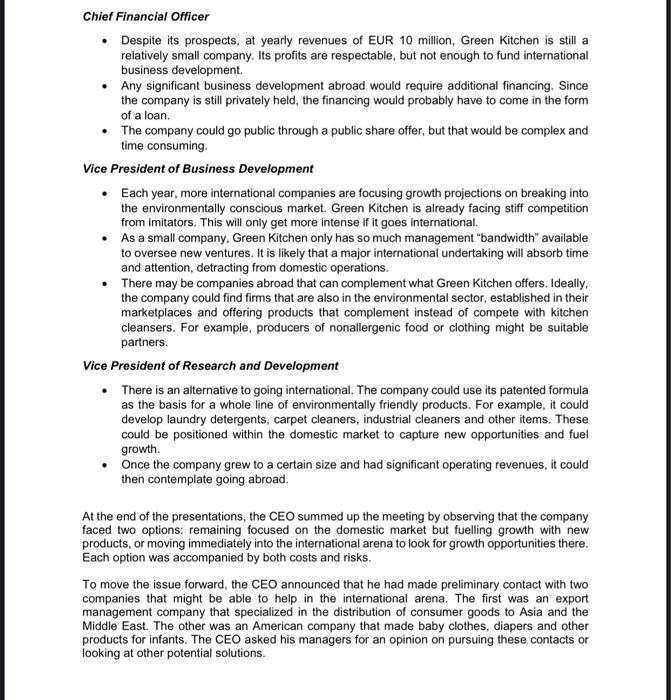
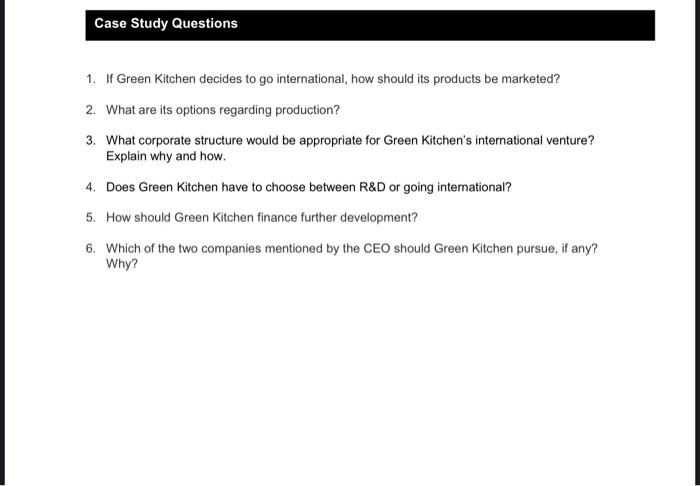
Green Kitchen: Assembling the Right Team JOR CIRCULA He An Environment for Expansion Green Kitchen, based in Hamburg, Germany, produces a wide range of kitchen cleaners based on a patented formula for an especially effective cleaning solution that is also environmentally friendly. Its products are slightly more expensive than conventional cleaners, but it has been successful in occupying a niche for environmentally responsible products, for which people are prepared to pay a small premium. The company has been in operation for a decade and currently has yearly revenues of about EUR 10 million. Given continued interest in environmentally safe products, Green Kitchen sees significant growth opportunities. Preliminary research has shown that a significant portion of its domestic market is receptive to converting to green products. That domestic market, however, is limited in size. The real opportunity is to tap into the global market for environmentally responsible products, a market that is many times larger and growing rapidly. The senior management of Green Kitchen has gathered for a planning retreat. Its objective is to develop a preliminary strategy for going international. There is a consensus among managers about targeting international markets. The real issue is how to do this in a way that is effective, profitable, and manageable in terms of risk. Before beginning work on the strategy, senior managers were offered presentations by several of the company's officers. The key points they made are summarized below. Vice President of Marketing Kitchen practices are among the most culturally determined of human activities. How people prepare food and how they think about cleanliness are very much determined by their cultural assumptions. A marketing strategy that is effective in one market may not work in another. Marketing must target those who make decisions about the kitchen, and in most societies, that means women. Chief Financial Officer Despite its prospects, at yearly revenues of EUR 10 million, Green Kitchen is still a relatively small company. Its profits are respectable, but not enough to fund international business development. Any significant business development abroad would require additional financing. Since the company is still privately held, the financing would probably have to come in the form of a loan. The company could go public through a public share offer, but that would be complex and time consuming. Vice President of Business Development Each year, more international companies are focusing growth projections on breaking into the environmentally conscious market. Green Kitchen is already facing stiff competition from imitators. This will only get more intense if it goes international. As a small company, Green Kitchen only has so much management "bandwidth" available to oversee new ventures. It is likely that a major international undertaking will absorb time and attention, detracting from domestic operations. There may be companies abroad that can complement what Green Kitchen offers. Ideally, the company could find firms that are also in the environmental sector, established in their marketplaces and offering products that complement instead of compete with kitchen cleansers. For example, producers of nonallergenic food or clothing might be suitable partners. Vice President of Research and Development There is an alternative to going international. The company could use its patented formula as the basis for a whole line of environmentally friendly products. For example, it could develop laundry detergents, carpet cleaners, industrial cleaners and other items. These could be positioned within the domestic market to capture new opportunities and fuel growth Once the company grew to a certain size and had significant operating revenues, it could then contemplate going abroad. At the end of the presentations, the CEO summed up the meeting by observing that the company faced two options: remaining focused on the domestic market but fuelling growth with new products, or moving immediately into the international arena to look for growth opportunities there. Each option was accompanied by both costs and risks. To move the issue forward, the CEO announced that he had made preliminary contact with two companies that might be able to help in the international arena. The first was an export management company that specialized in the distribution of consumer goods to Asia and the Middle East. The other was an American company that made baby clothes, diapers and other products for infants. The CEO asked his managers for an opinion on pursuing these contacts or looking at other potential solutions. Case Study Questions 1. If Green Kitchen decides to go international, how should its products be marketed? 2. What are its options regarding production? 3. What corporate structure would be appropriate for Green Kitchen's international venture? Explain why and how 4. Does Green Kitchen have to choose between R&D or going international? 5. How should Green Kitchen finance further development? 6. Which of the two companies mentioned by the CEO should Green Kitchen pursue, if any? Why Step by Step Solution
There are 3 Steps involved in it
1 Expert Approved Answer
Step: 1 Unlock

Question Has Been Solved by an Expert!
Get step-by-step solutions from verified subject matter experts
Step: 2 Unlock
Step: 3 Unlock
 Study Help