







Question: Answer all questions (4x7.5-30 Marks) MILLWORD BROWN-OPTIMISING A DRAMATIC PERFORMANCE An automotive marketing team needed guidance on how their new, dramatic 60 second TV ad
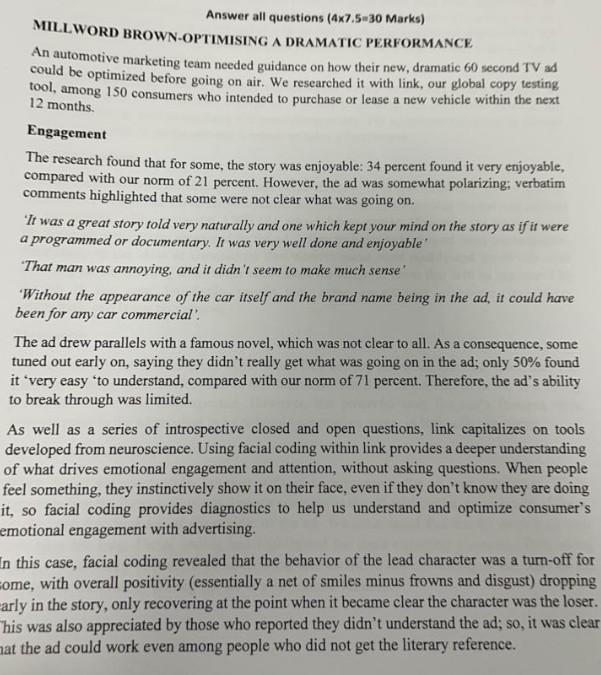
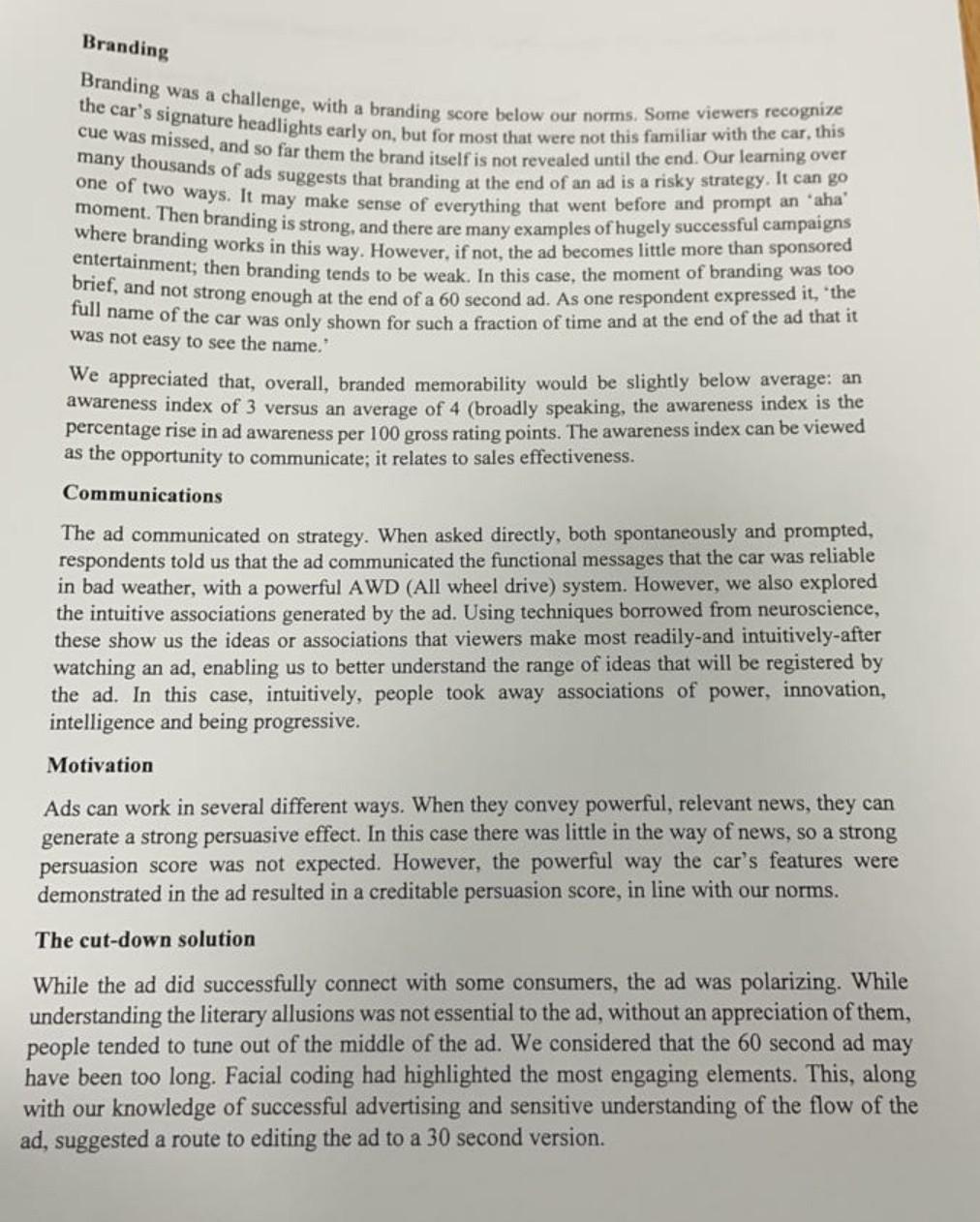
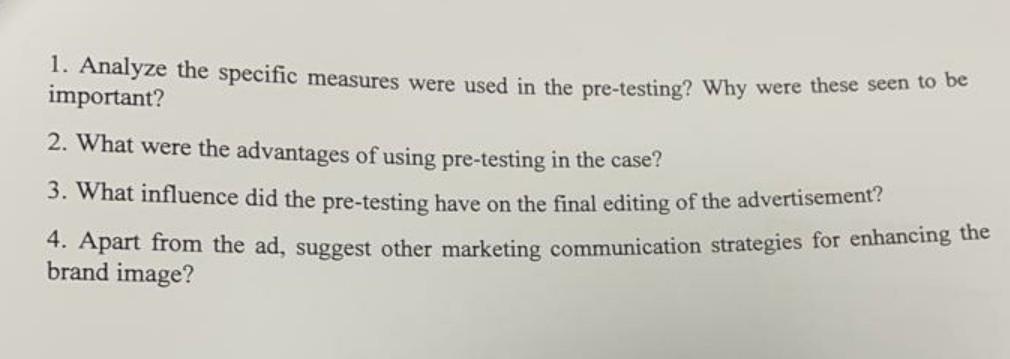
Answer all questions (4x7.5-30 Marks) MILLWORD BROWN-OPTIMISING A DRAMATIC PERFORMANCE An automotive marketing team needed guidance on how their new, dramatic 60 second TV ad could be optimized before going on air. We researched it with link, our global copy testing, tool, among 150 consumers who intended to purchase or lease a new vehicle within the next 12 months. Engagement The research found that for some, the story was enjoyable: 34 percent found it very enjoyable, compared with our norm of 21 percent. However, the ad was somewhat polarizing: verbatim comments highlighted that some were not clear what was going on. It was a great story told very naturally and one which kept your mind on the story as if it were a programmed or documentary. It was very well done and enjoyable *That man was annoying, and it didn't seem to make much sense 'Without the appearance of the car itself and the brand name being in the ad, it could have been for any car commercial The ad drew parallels with a famous novel, which was not clear to all. As a consequence, some tuned out early on, saying they didn't really get what was going on in the ad; only 50% found it very easy to understand, compared with our norm of 71 percent. Therefore, the ad's ability to break through was limited. As well as a series of introspective closed and open questions, link capitalizes on tools developed from neuroscience. Using facial coding within link provides a deeper understanding of what drives emotional engagement and attention, without asking questions. When people feel something, they instinctively show it on their face, even if they don't know they are doing it, so facial coding provides diagnostics to help us understand and optimize consumer's emotional engagement with advertising. In this case, facial coding revealed that the behavior of the lead character was a turn-off for come, with overall positivity (essentially a net of smiles minus frowns and disgust) dropping early in the story, only recovering at the point when it became clear the character was the loser. This was also appreciated by those who reported they didn't understand the ad; so, it was clear mat the ad could work even among people who did not get the literary reference. Branding Branding was a challenge, with a branding score below our norms. Some viewers recognize the car's signature headlights early on, but for most that were not this familiar with the car, this cue was missed, and so far them the brand itself is not revealed until the end. Our learning over many thousands of ads suggests that branding at the end of an ad is a risky strategy. It can go one of two ways. It may make sense of everything that went before and prompt an "aha" moment. Then branding is strong, and there are many examples of hugely successful campaigns where branding works in this way. However, if not, the ad becomes little more than sponsored entertainment, then branding tends to be weak. In this case, the moment of branding was too brief, and not strong enough at the end of a 60 second ad. As one respondent expressed it, "the full name of the car was only shown for such a fraction of time and at the end of the ad that it was not easy to see the name. We appreciated that, overall, branded memorability would be slightly below average: an awareness index of 3 versus an average of 4 (broadly speaking, the awareness index is the percentage rise in ad awareness per 100 gross rating points. The awareness index can be viewed as the opportunity to communicate; it relates to sales effectiveness. Communications The ad communicated on strategy. When asked directly, both spontaneously and prompted, respondents told us that the ad communicated the functional messages that the car was reliable in bad weather, with a powerful AWD (All wheel drive) system. However, we also explored the intuitive associations generated by the ad. Using techniques borrowed from neuroscience, these show us the ideas or associations that viewers make most readily and intuitively-after watching an ad, enabling us to better understand the range of ideas that will be registered by the ad. In this case, intuitively, people took away associations of power, innovation, intelligence and being progressive. Motivation Ads can work in several different ways. When they convey powerful, relevant news, they can generate a strong persuasive effect. In this case there was little in the way of news, so a strong persuasion score was not expected. However, the powerful way the car's features were demonstrated in the ad resulted in a creditable persuasion score, in line with our norms. The cut-down solution While the ad did successfully connect with some consumers, the ad was polarizing. While understanding the literary allusions was not essential to the ad, without an appreciation of them, people tended to tune out of the middle of the ad. We considered that the 60 second ad may have been too long. Facial coding had highlighted the most engaging elements. This, along with our knowledge of successful advertising and sensitive understanding of the flow of the ad, suggested a route to editing the ad to a 30 second version. 1. Analyze the specific measures were used in the pre-testing? Why were these seen to be important? 2. What were the advantages of using pre-testing in the case? 3. What influence did the pre-testing have on the final editing of the advertisement? 4. Apart from the ad, suggest other marketing communication strategies for enhancing the brand image
Step by Step Solution
There are 3 Steps involved in it
1 Expert Approved Answer
Step: 1 Unlock

Question Has Been Solved by an Expert!
Get step-by-step solutions from verified subject matter experts
Step: 2 Unlock
Step: 3 Unlock
 Study Help