







Question: Answer All Questions Case Study: Procter & Gamble Acquires Gillette Procter & Gamble Company (P&G) announced, on January 28, 2005, an agreement to buy Gillette
Answer All Questions
Case Study: Procter & Gamble Acquires Gillette
Procter & Gamble Company (P&G) announced, on January 28, 2005, an agreement to buy Gillette Company (Gillette) in a share-for-share exchange valued at $55.6 billion. This represented an 18 percent premium over Gillettes preannouncement share price. P&G also announced a stock buyback of $18 to $22 billion, funded largely by issuing new debt. The combined companies would retain the P&G name and have annual 2005 revenue of more than
$60 billion. Half of the new firms product portfolio would consist of personal care, health-care, and beauty products, with the remainder consisting of razors and blades and batteries. The deal would be expected to dilute P&Gs 2006 earnings by about 15 cents per share. To gain regulatory approval, the two firms would have to divest overlapping operations, such as deodorants and oral care. P&G is often viewed as a premier marketing and product innovator. Consequently, some of P&Gs R&D and marketing skills in developing and promoting womens personal care products could be used to enhance and promote Gillettes womens razors. Gillette is best known for its ability to sell an inexpensive product (e.g., razors) and hook customers to a lifetime of refills (e.g., razor blades). Although Gillette is the number 1 and number 2 supplier in the lucrative toothbrush and mens deodorant markets, respectively, it has been much less successful in improving the profitability of its Duracell battery brand.
Despite its number 1 market share position, it has been beset by intense price competition from Energizer and Rayovac Corp., which generally sell for less than Duracell batteries. Suppliers such as P&G and Gillette have been under considerable pressure from the continuing consolidation in the retail industry due to the ongoing growth of Walmart and industry mergers, such as Sears and Kmart. About 17 percent of P&Gs $51 billion in 2005 revenues and 13 percent of Gillettes $9 billion annual revenue came from sales to Walmart. Moreover, the sales of both Gillette and P&G to Walmart have grown much faster than sales to other retailers. The new company would have more negotiating leverage with retailers for shelf space and in determining selling prices, as well as with its own suppliers, such as advertisers and media companies.
The broad geographic presence of P&G would facilitate the marketing of such products as razors and batteries in huge developing markets, such as China and India. Cumulative cost cutting was expected to reach $16 billion, including layoffs of about 4 percent of the new companys workforce of 140,000. Such cost reductions would be likely to be realized by integrating Gillettes deodorant products into P&Gs structure as quickly as possible. Other Gillette product lines, such as the razor and battery businesses, would be expected to remain intact. P&Gs corporate culture is often described as conservative, with a promote-fromwithin philosophy. While Gillettes CEO would become vice chairman of the new company, it is unclear what would happen to other Gillette senior managers in view of the perception that P&G is laden with highly talented top management. Obtaining regulatory approval requires divesting certain Gillette businesses that, in combination with P&Gs current businesses, could have given the new firm dominant market positions in certain markets.
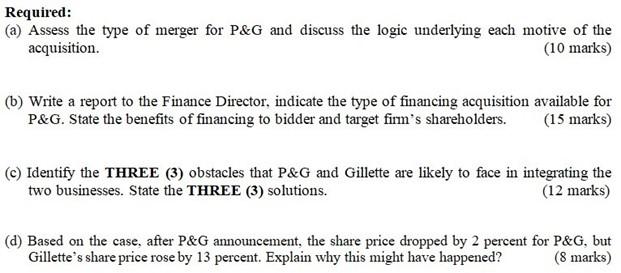
Required: (a) Assess the type of merger for P&G and discuss the logic underlying each motive of the acquisition. (10 marks) (b) Write a report to the Finance Director, indicate the type of financing acquisition available for P&G. State the benefits of financing to bidder and target firm's shareholders. (15 marks) (C) Identify the THREE (3) obstacles that P&G and Gillette are likely to face in integrating the two businesses. State the THREE (3) solutions. (12 marks) (d) Based on the case, after P&G announcement, the share price dropped by 2 percent for P&G, but Gillette's share price rose by 13 percent. Explain why this might have happened? (8 marks) Required: (a) Assess the type of merger for P&G and discuss the logic underlying each motive of the acquisition. (10 marks) (b) Write a report to the Finance Director, indicate the type of financing acquisition available for P&G. State the benefits of financing to bidder and target firm's shareholders. (15 marks) (C) Identify the THREE (3) obstacles that P&G and Gillette are likely to face in integrating the two businesses. State the THREE (3) solutions. (12 marks) (d) Based on the case, after P&G announcement, the share price dropped by 2 percent for P&G, but Gillette's share price rose by 13 percent. Explain why this might have happened? (8 marks)
Step by Step Solution
There are 3 Steps involved in it

Get step-by-step solutions from verified subject matter experts
 Study Help