



Question: answer all questions DISCUSSION CASE: Freedom of Expression at Work O n August 7, 2017, James Damore was fired from his job as an engineer
answer all questions 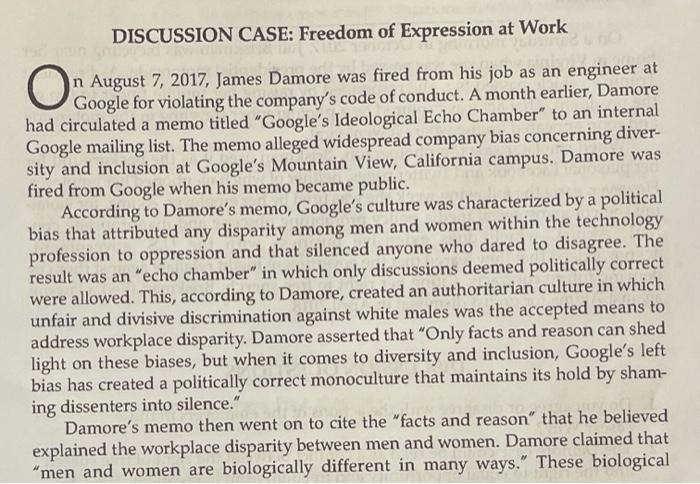
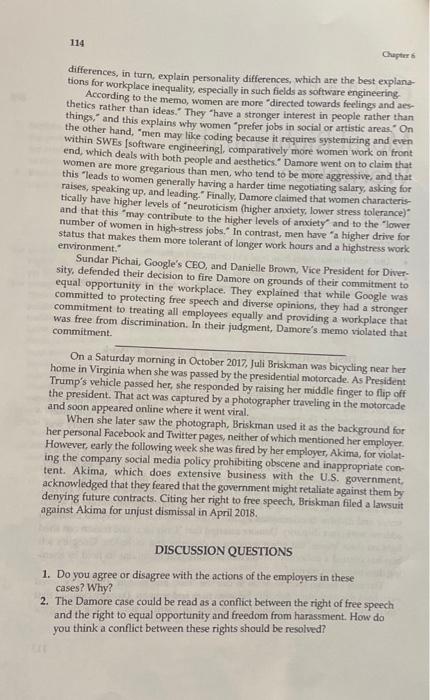
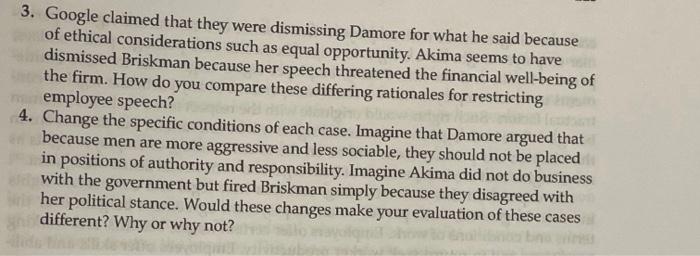
DISCUSSION CASE: Freedom of Expression at Work O n August 7, 2017, James Damore was fired from his job as an engineer at Google for violating the company's code of conduct. A month earlier, Damore had circulated a memo titled "Google's Ideological Echo Chamber" to an internal Google mailing list. The memo alleged widespread company bias concerning diver- sity and inclusion at Google's Mountain View, California campus. Damore was fired from Google when his memo became public. According to Damore's memo, Google's culture was characterized by a political bias that attributed any disparity among men and women within the technology profession to oppression and that silenced anyone who dared to disagree. The result was an "echo chamber" in which only discussions deemed politically correct were allowed. This, according to Damore, created an authoritarian culture in which unfair and divisive discrimination against white males was the accepted means to address workplace disparity. Damore asserted that "Only facts and reason can shed light on these biases, but when it comes to diversity and inclusion, Google's left bias has created a politically correct monoculture that maintains its hold by sham- ing dissenters into silence." Damore's memo then went on to cite the "facts and reason that he believed explained the workplace disparity between men and women. Damore claimed that men and women are biologically different in many ways." These biological 114 Chapter differences, in turn, explain personality differences, which are the best explana- tions for workplace inequality, especially in such fields as software engineering According to the memo, women are more directed towards feelings and aes thetics rather than ideas. They have a stronger interest in people rather than things, and this explains why women'prefer jobs in social or artistic areas. On the other hand, men may like coding because it requires systemiring and even within SWEs (software engineeringl. comparatively more women work on front end, which deals with both people and aesthetics Damore went on to claim that women are more gregarious than men, who tend to be more aggressive, and that this leads to women generally having a harder time negotiating salary, asking for raises, speaking up, and leading. Finally, Damore claimed that women characteris tically have higher levels of 'neuroticism (higher amciety, lower stress tolerance) and that this may contribute to the higher levels of anxiety and to the lower number of women in high-stress jobs. In contrast, men have a higher drive for status that makes them more tolerant of longer work hours and a highstress work environment." Sundar Pichai, Google's CEO, and Danielle Brown, Vice President for Diver sity, defended their decision to fire Damore on grounds of their commitment to equal opportunity in the workplace. They explained that while Google was committed to protecting free speech and diverse opinions, they had a stronger commitment to treating all employees equally and providing a workplace that was free from discrimination. In their judgment, Damore's memo violated that commitment. On a Saturday morning in October 2017 Juli Briskman was bicycling near her home in Virginia when she was passed by the presidential motorcade. As President Trump's vehicle passed her, she responded by raising her middle finger to flip off the president. That act was captured by a photographer traveling in the motorcade and soon appeared online where it went viral. When she later saw the photograph, Briskman used it as the background for her personal Facebook and Twitter pages, neither of which mentioned her employer. However, early the following week she was fired by her employer, Akima, for violat- ing the company social media policy prohibiting obscene and inappropriate con tent. Akima, which does extensive business with the U.S. government acknowledged that they feared that the government might retaliate against them by denying future contracts. Citing her right to free speech, Briskman filed a lawsuit against Akima for unjust dismissal in April 2018. DISCUSSION QUESTIONS 1. Do you agree or disagree with the actions of the employers in these cases? Why? 2. The Damore case could be read as a conflict between the right of free speech and the right to equal opportunity and freedom from harassment. How do you think a conflict between these rights should be resolved? 3. Google claimed that they were dismissing Damore for what he said because of ethical considerations such as equal opportunity. Akima seems to have dismissed Briskman because her speech threatened the financial well-being of the firm. How do you compare these differing rationales for restricting employee speech? 4. Change the specific conditions of each case. Imagine that Damore argued that because men are more aggressive and less sociable, they should not be placed in positions of authority and responsibility. Imagine Akima did not do business with the government but fired Briskman simply because they disagreed with her political stance. Would these changes make your evaluation of these cases different? Why or why not Step by Step Solution
There are 3 Steps involved in it
1 Expert Approved Answer
Step: 1 Unlock

Question Has Been Solved by an Expert!
Get step-by-step solutions from verified subject matter experts
Step: 2 Unlock
Step: 3 Unlock