







Question: Answer all questions fully (no discontinuous fragments), in sequential order. Explain all answers: show all computations, proofs, analyses. decisions, steps, and programs. Best of prospects.
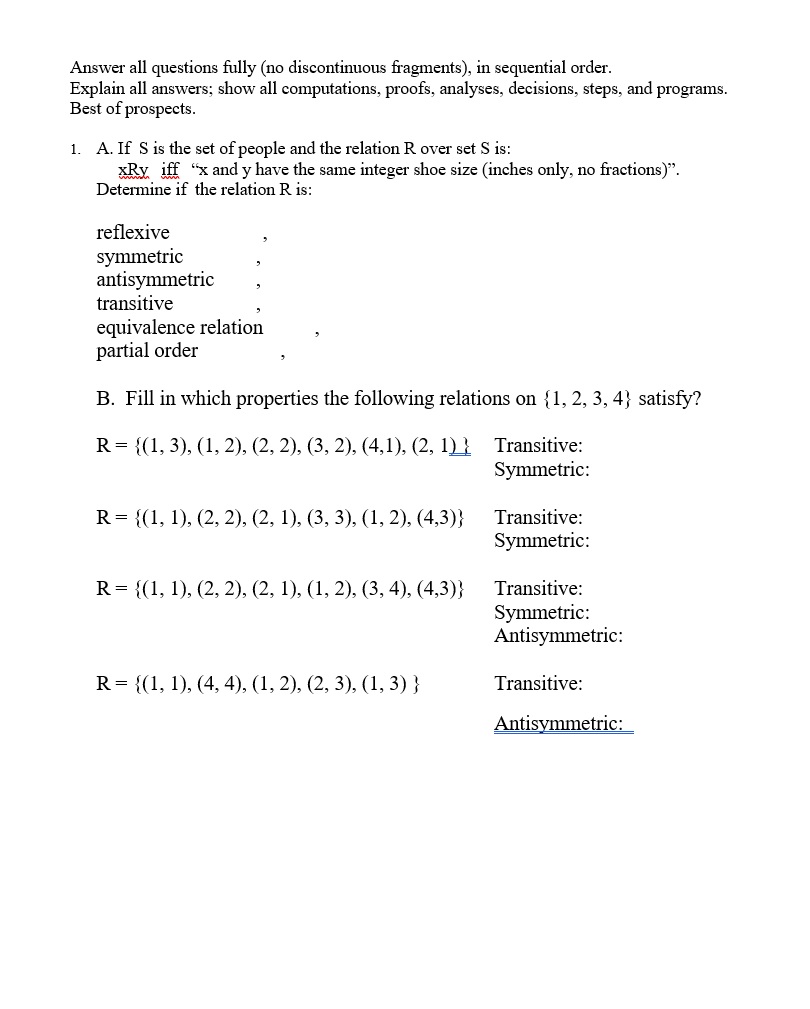
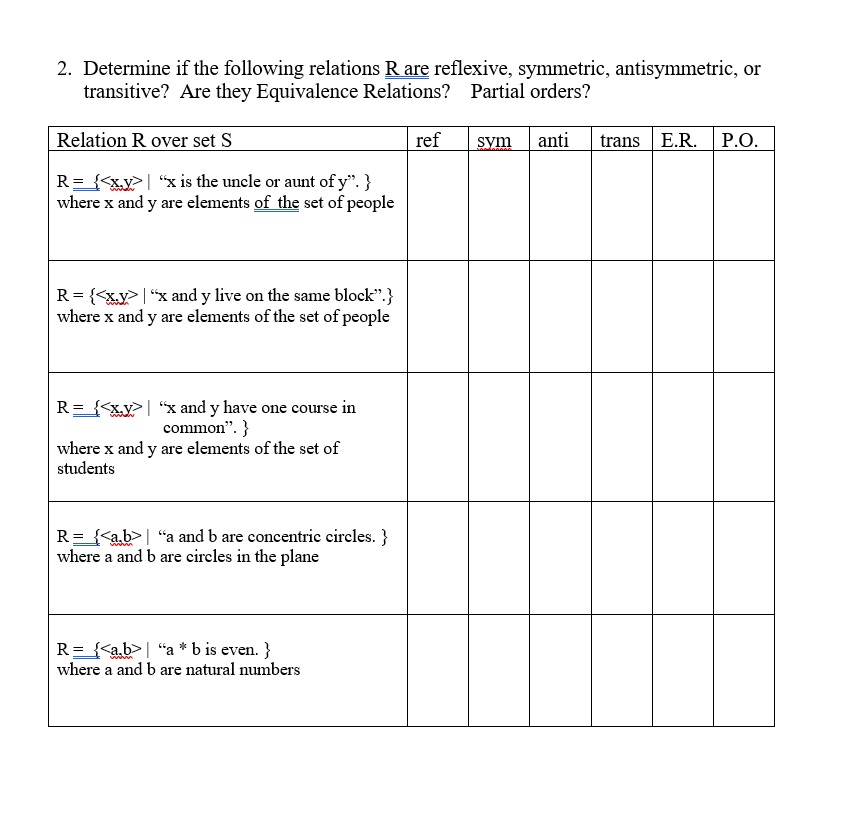
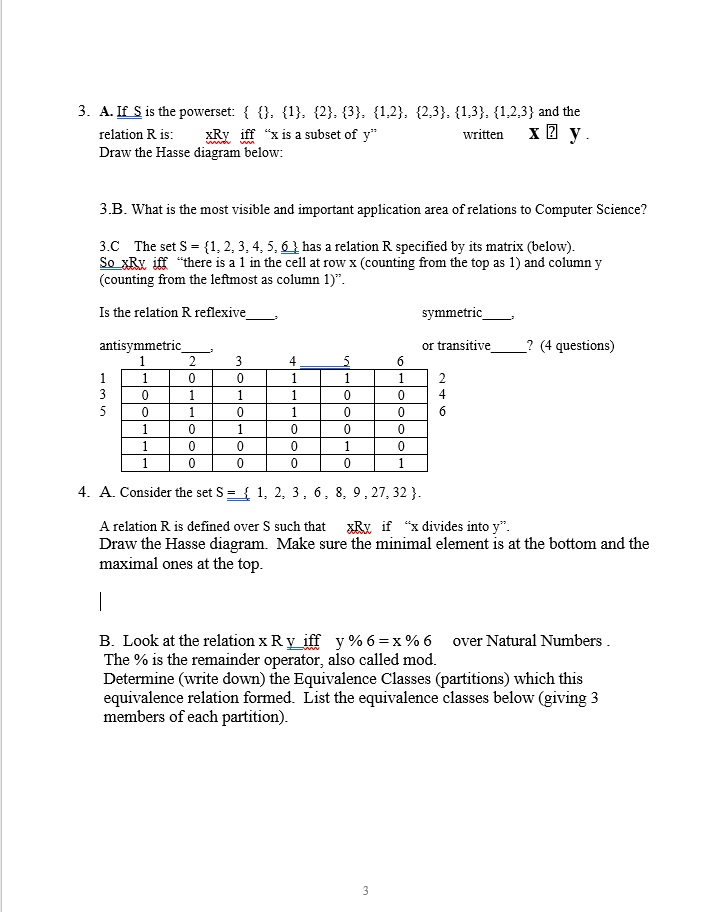
Answer all questions fully (no discontinuous fragments), in sequential order. Explain all answers: show all computations, proofs, analyses. decisions, steps, and programs. Best of prospects. 1. A. If S is the set of people and the relation R over set S is: 733$ 5ft '5; and y have the same integer shoe size (inches only. no fractions)\". Determine if the relation R is: reexive , symmetric , antisymmetric , transitive , equivalence relation , partial order , B. Fill in which properties the following relations on {1, 2, 3, 4} satisfy? R = {(1, 3'), (1, 2), (2, 2), (3, 2'), (4.11), (2, 1LL TraSitivei Symmetric: R: {(1, 1), (2, 2), (2, 1), (3, 3'),(1.. 2), (4:3)} TfaSitivei Symmetric: R: {(1. 1), (2. 2), (2, 1), (1.. 2M3, 4), (4,3)} Transitive: Symmetric: Antisymmetric: R= {(1, l), (4, 4), (1, 2), (2, 3'), (1, 3) } Transitive: Anti symmetric: 2. Determine if the following relations R are reflexive, symmetric, antisymmetric, or transitive? Are they Equivalence Relations? Partial orders? Relation R over set S ref sym anti trans E.R. P.O. R= { xy> | "x is the uncle or aunt of y". } where x and y are elements of the set of people R = {
Step by Step Solution
There are 3 Steps involved in it
1 A Determine the properties of the relation R The relation R over set S is defined as x and y have the same integer shoe size inches only no fraction... View full answer

Get step-by-step solutions from verified subject matter experts
 Study Help