



Question: Answer ALL questions, numbers 14.31 through 14.51 14.31 Explain why there is a concern for pits in the floor of a factory served by an
Answer ALL questions, numbers 14.31 through 14.51
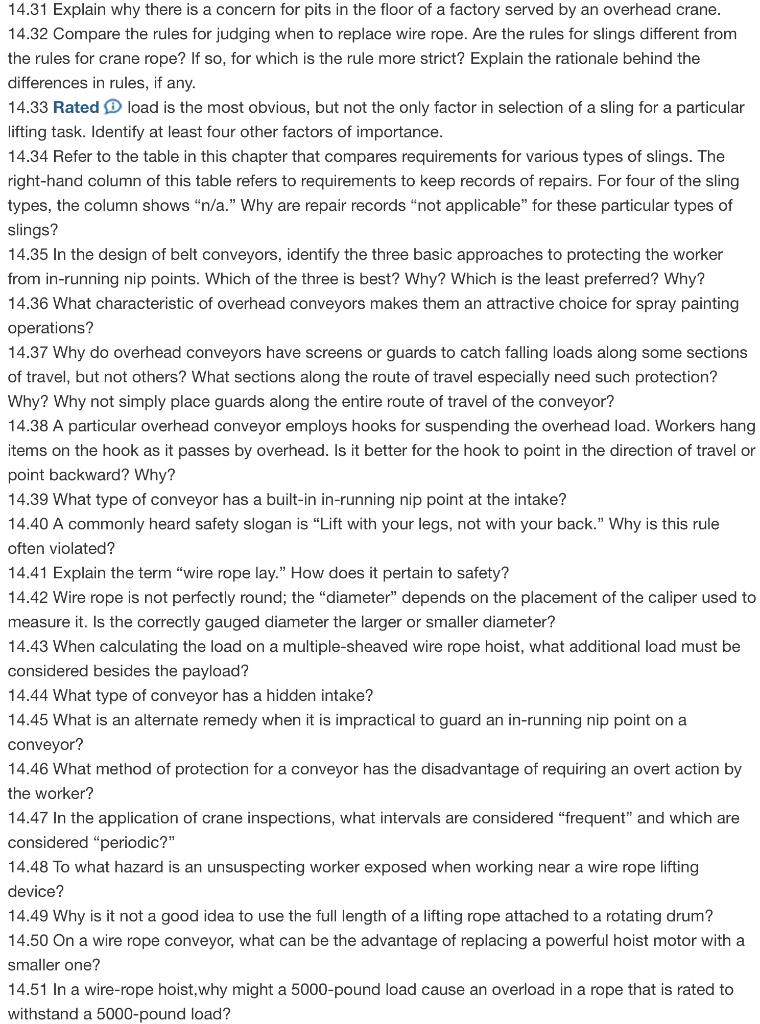
14.31 Explain why there is a concern for pits in the floor of a factory served by an overhead crane. 14.32 Compare the rules for judging when to replace wire rope. Are the rules for slings different from the rules for crane rope? If so, for which is the rule more strict? Explain the rationale behind the differences in rules, if any. 14.33 Rated (i) load is the most obvious, but not the only factor in selection of a sling for a particular lifting task. Identify at least four other factors of importance. 14.34 Refer to the table in this chapter that compares requirements for various types of slings. The right-hand column of this table refers to requirements to keep records of repairs. For four of the sling types, the column shows " n/a." Why are repair records "not applicable" for these particular types of slings? 14.35 In the design of belt conveyors, identify the three basic approaches to protecting the worker from in-running nip points. Which of the three is best? Why? Which is the least preferred? Why? 14.36 What characteristic of overhead conveyors makes them an attractive choice for spray painting operations? 14.37 Why do overhead conveyors have screens or guards to catch falling loads along some sections of travel, but not others? What sections along the route of travel especially need such protection? Why? Why not simply place guards along the entire route of travel of the conveyor? 14.38 A particular overhead conveyor employs hooks for suspending the overhead load. Workers hang items on the hook as it passes by overhead. Is it better for the hook to point in the direction of travel or point backward? Why? 14.39 What type of conveyor has a built-in in-running nip point at the intake? 14.40 A commonly heard safety slogan is "Lift with your legs, not with your back." Why is this rule often violated? 14.41 Explain the term "wire rope lay." How does it pertain to safety? 14.42 Wire rope is not perfectly round; the "diameter" depends on the placement of the caliper used to measure it. Is the correctly gauged diameter the larger or smaller diameter? 14.43 When calculating the load on a multiple-sheaved wire rope hoist, what additional load must be considered besides the payload? 14.44 What type of conveyor has a hidden intake? 14.45 What is an alternate remedy when it is impractical to guard an in-running nip point on a conveyor? 14.46 What method of protection for a conveyor has the disadvantage of requiring an overt action by the worker? 14.47 In the application of crane inspections, what intervals are considered "frequent" and which are considered "periodic?" 14.48 To what hazard is an unsuspecting worker exposed when working near a wire rope lifting device? 14.49 Why is it not a good idea to use the full length of a lifting rope attached to a rotating drum? 14.50 On a wire rope conveyor, what can be the advantage of replacing a powerful hoist motor with a smaller one? 14.51 In a wire-rope hoist, why might a 5000-pound load cause an overload in a rope that is rated to withstand a 5000 -pound load
Step by Step Solution
There are 3 Steps involved in it

Get step-by-step solutions from verified subject matter experts