







Question: Answer all questions. Or I will dislike your answer 1. What are the basic assumptions in linear programming? 2. Why is it called 'linear' programming?
Answer all questions. Or I will dislike your answer
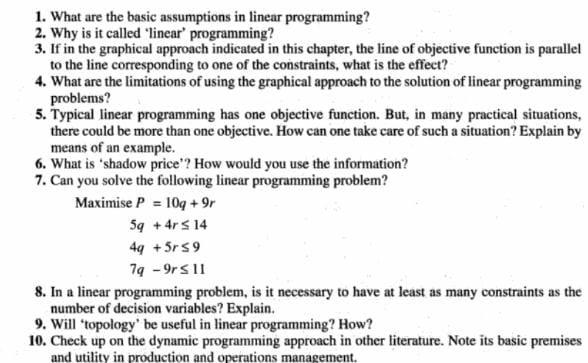
1. What are the basic assumptions in linear programming? 2. Why is it called 'linear' programming? 3. If in the graphical approach indicated in this chapter, the line of objective function is parallel to the line corresponding to one of the constraints, what is the effect? 4. What are the limitations of using the graphical approach to the solution of linear programming problems? 5. Typical linear programming has one objective function. But, in many practical situations, there could be more than one objective. How can one take care of such a situation? Explain by means of an example. 6. What is "shadow price'? How would you use the information? 7. Can you solve the following linear programming problem? Maximise P = 104 +9r 59 +4rs 14 49 +5r 59 79 -9rs 11 8. In a linear programming problem, is it necessary to have at least as many constraints as the number of decision variables? Explain. 9. Will topology be useful in linear programming? How? 10. Check up on the dynamic programming approach in other literature. Note its basic premises and utility in production and operations management. 1. What are the basic assumptions in linear programming? 2. Why is it called 'linear' programming? 3. If in the graphical approach indicated in this chapter, the line of objective function is parallel to the line corresponding to one of the constraints, what is the effect? 4. What are the limitations of using the graphical approach to the solution of linear programming problems? 5. Typical linear programming has one objective function. But, in many practical situations, there could be more than one objective. How can one take care of such a situation? Explain by means of an example. 6. What is "shadow price'? How would you use the information? 7. Can you solve the following linear programming problem? Maximise P = 104 +9r 59 +4rs 14 49 +5r 59 79 -9rs 11 8. In a linear programming problem, is it necessary to have at least as many constraints as the number of decision variables? Explain. 9. Will topology be useful in linear programming? How? 10. Check up on the dynamic programming approach in other literature. Note its basic premises and utility in production and operations management
Step by Step Solution
There are 3 Steps involved in it
1 Expert Approved Answer
Step: 1 Unlock

Question Has Been Solved by an Expert!
Get step-by-step solutions from verified subject matter experts
Step: 2 Unlock
Step: 3 Unlock
 Study Help