







Question: Answer ALL questions. Question 1 Read below case study 1 on international knowledge transfer: The Company: Alpha Beta Company ( ABC ) is a medium
Answer ALL questions.
Question
Read below case study on international knowledge transfer:
The Company:
Alpha Beta Company ABC is a mediumsized Swedish company with about employees at its headquarters. The firm is specialized in office appliance manufacturing, and is a market leader in its industry in Europe. ABC owns several subsidiary companies in other countries, one of which is in China. This Chinese branch is located in Shanghai, one of the fastest developing regions in China, and has about employees. The Shanghai branch previously was a stateowned factory, and had a good reputation in the local office appliance industry. Back in when the Swedish company bought share of the Chinese company, it became a SinoSwedish joint venture. Later, in the Chinese subsidiary was totally bought out by the Swedish company and became a wholly owned foreign enterprise.
In Sweden:
It is : am on Monday in Sweden. The technical product manager of ABC sent an email about the new design of a product to its subsidiary company in China. He would like to have a production ready model of the new design by Friday, when he flies to China. An email came on Thursday saying that there was a mm error in the product the Chinese subsidiary made, and asking the manager what they should do The product manager finds himself confused: Do they need to ask such a question? They could simply adjust the error and give me the model on Friday. Why are they waiting for orders instead of taking initiatives?
In China:
It is : Monday in Shanghai. The Chinese R&D manager in Shanghai received an email from the parent company in Sweden. The parent company asked for a production ready model of the latest design in five days. The R&D manager called the production manager immediately, and days later he got the new model but with a mm error. He knew it would be better to provide a standard model, but nevertheless decided to notify the Swedish manager first and let him to decide what to do It is after all, the Chinese way of showing respect to their superior by asking the latters opinion on everything.C COMMUNICATION SYSTEM
Low context communication demands explicit
and clear expression: namely, say what you
mean.
Communication manifests firm and formal
expression; there is an outspoken preference for
certainties and rigidity in communication,
though it is often expressed indirectly.
High hierarchy is present, with strict topdown
communication.
Relationship orientation and cyclical time
approach illustrate a dominant future focus,
while respecting history and traditions.
Individualistic orientation with clear and
outspoken opinions and ideas is the foundation
of lowcontext communication.
Communication derives meaning from
nonverbal cues and a shared context;
expression is formal and indirect; due to high
uncertainty avoidance, there is a preference for
clear topdown instructions.
Informality, empathy and flexibility permeate
the communication; adaptivity and flexibility
are a way of dealing with surprises.
Flat hierarchal levels stimulate communication
across the organization; subordinates' opinions
are not considered less important or less
valuable than superiors'.
Shared context and meaning provide the
background for highcontext communication.
Task orientation and linear time approach
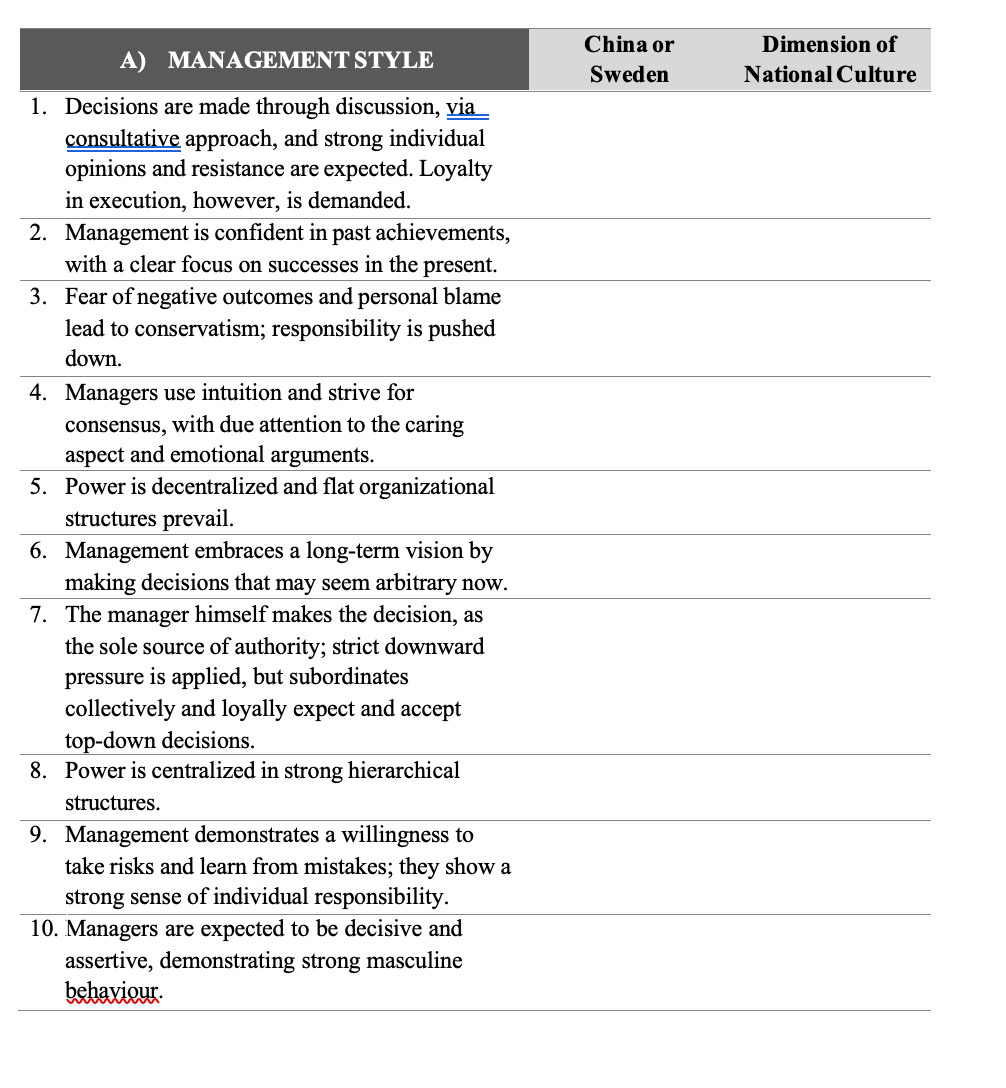
reflect a strong focus on the present.A MANAGEMENT STYLE
Decisions are made through discussion, via
consultative approach, and strong individual
opinions and resistance are expected. Loyalty
in execution, however, is demanded.
Management is confident in past achievements,
with a clear focus on successes in the present.
Fear of negative outcomes and personal blame
lead to conservatism; responsibility is pushed
down.
Managers use intuition and strive for
consensus, with due attention to the caring
aspect and emotional arguments.
Power is decentralized and flat organizational
structures prevail.
Management embraces a longterm vision by
making decisions that may seem arbitrary now.
The manager himself makes the decision, as
the sole source of authority; strict downward
pressure is applied, but subordinates
collectively and loyally expect and accept
topdown decisions.
Power is centralized in strong hierarchical
structures.
Management demonstrates a willingness to
take risks and learn from mistakes; they show a
strong sense of individual responsibility.
Managers are expected to be decisive and
assertive, demonstrating strong masculine
behaviour.
Step by Step Solution
There are 3 Steps involved in it
1 Expert Approved Answer
Step: 1 Unlock

Question Has Been Solved by an Expert!
Get step-by-step solutions from verified subject matter experts
Step: 2 Unlock
Step: 3 Unlock
 Study Help