







Question: answer all questions t'l' .13 Problem 2 [Total 24 points} Consider the following capital budgeting problem: We have a set ofsix possible investments with the
answer all questions
![= the. = 1.;r5 = 11 and .135 = E]. Its objective](https://s3.amazonaws.com/si.experts.images/answers/2024/06/666b502536c0b_901666b502510739.jpg)
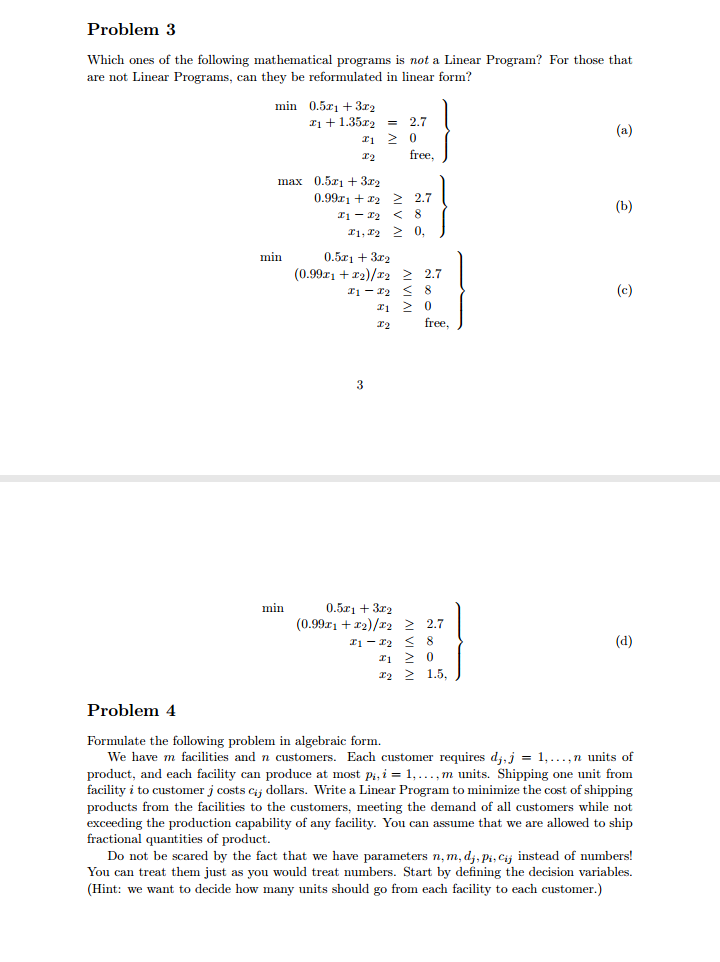
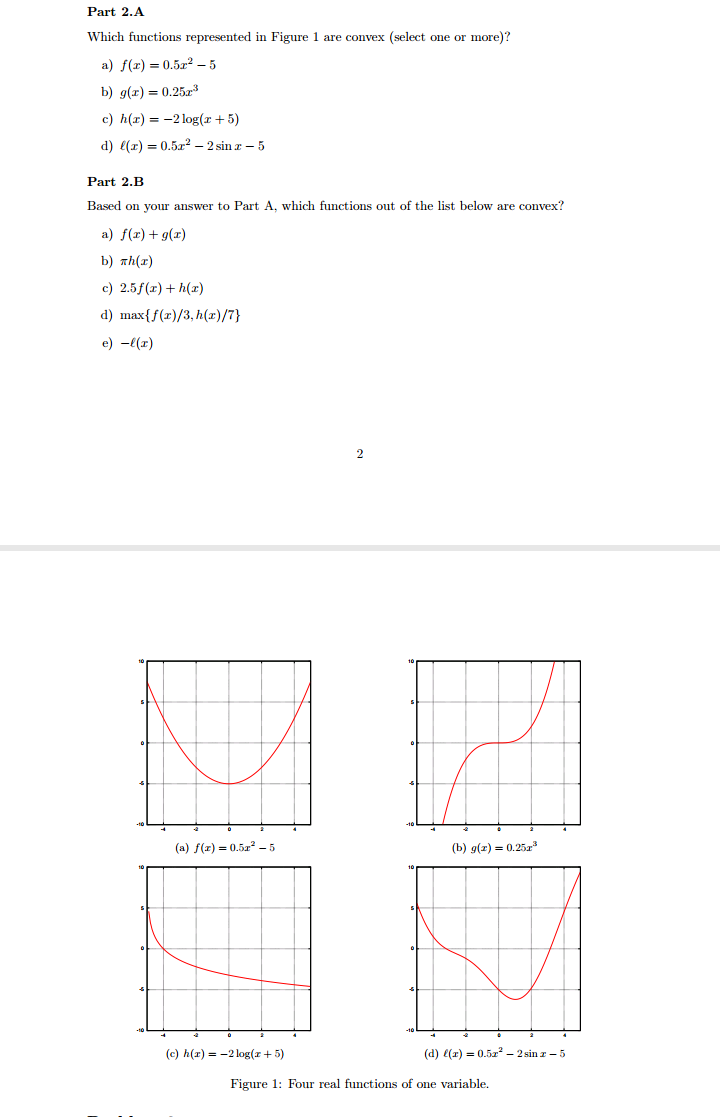
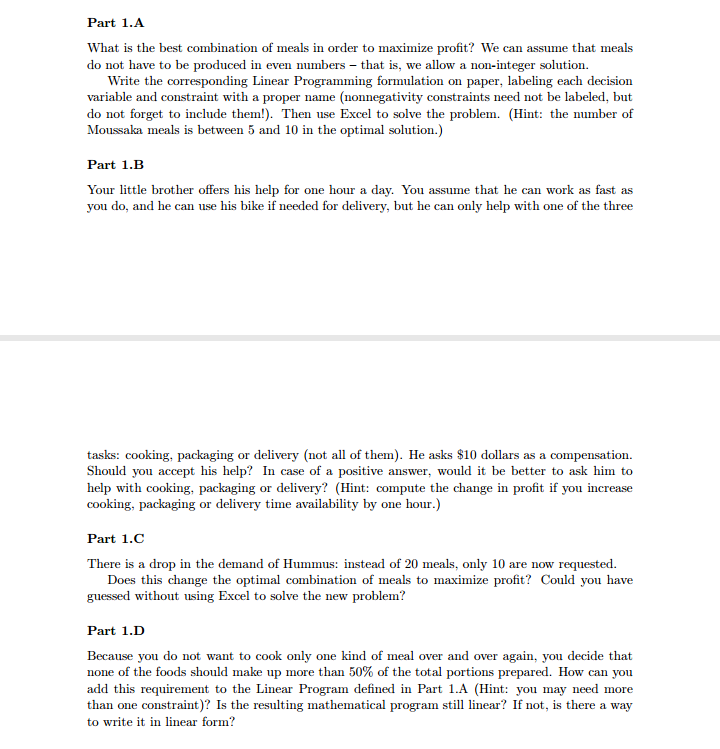
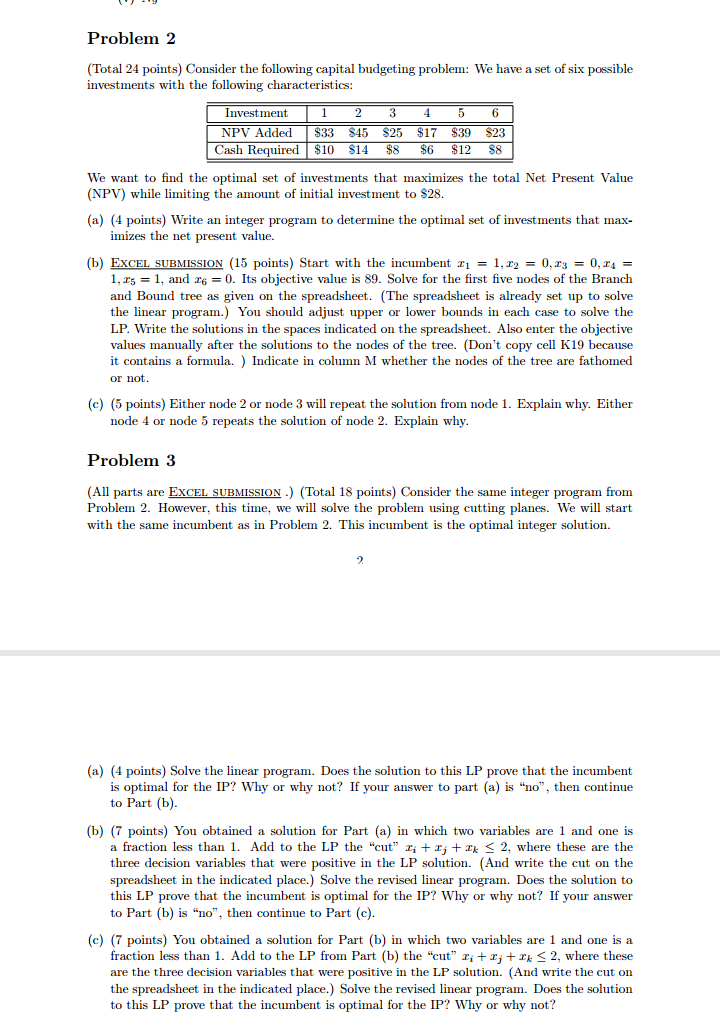
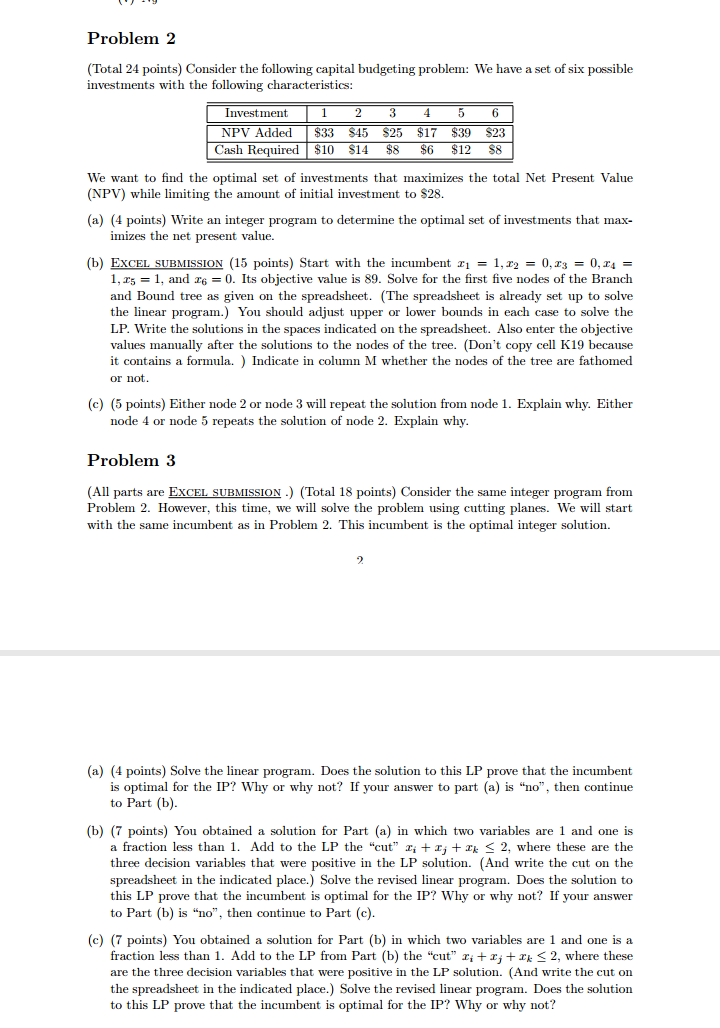
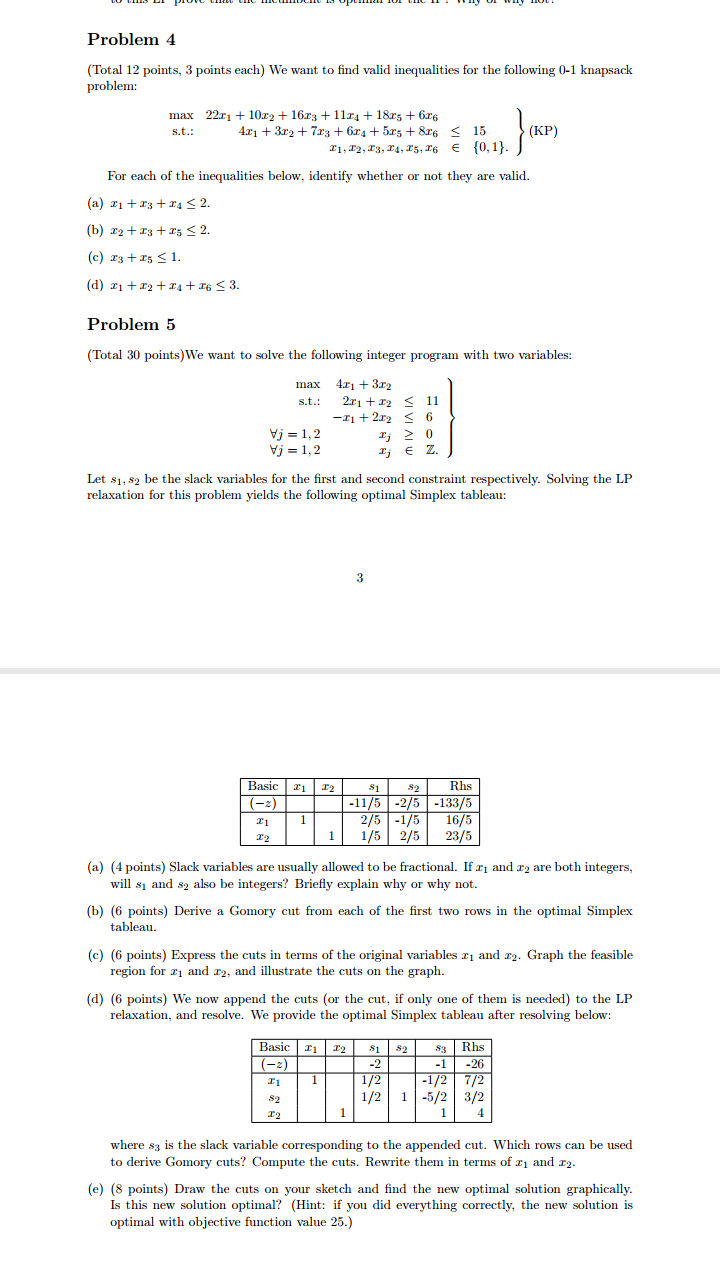
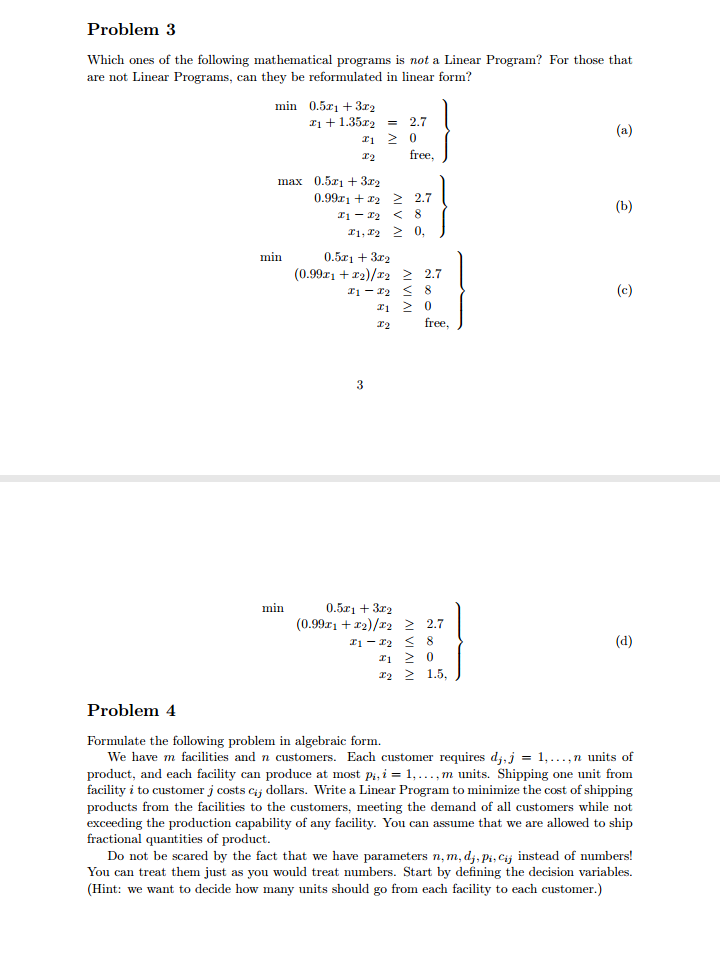
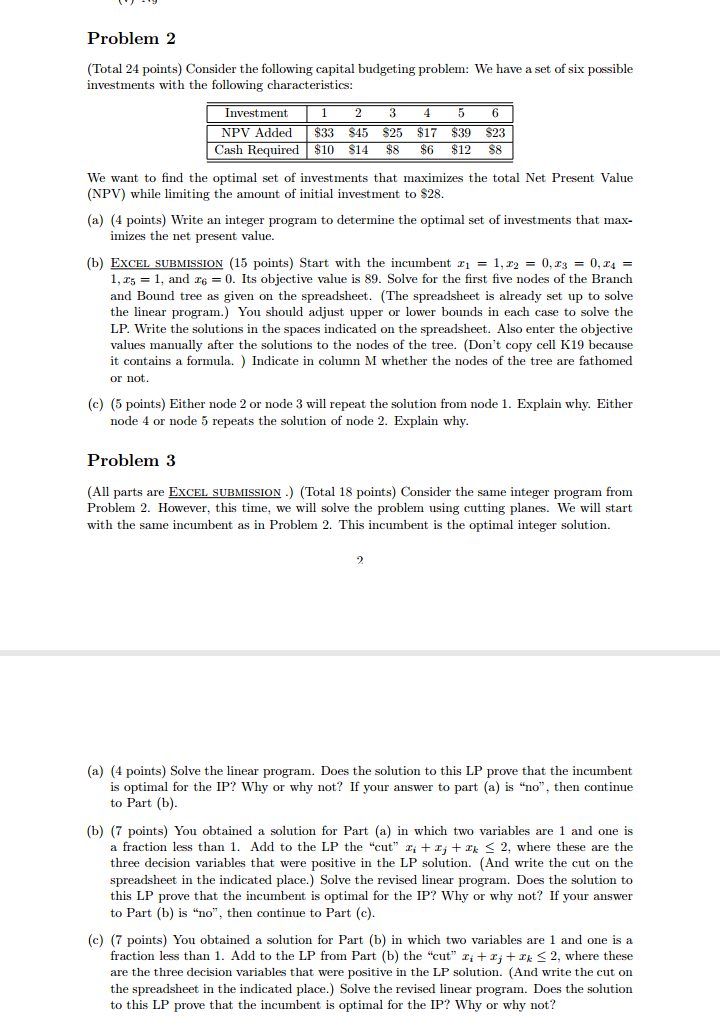
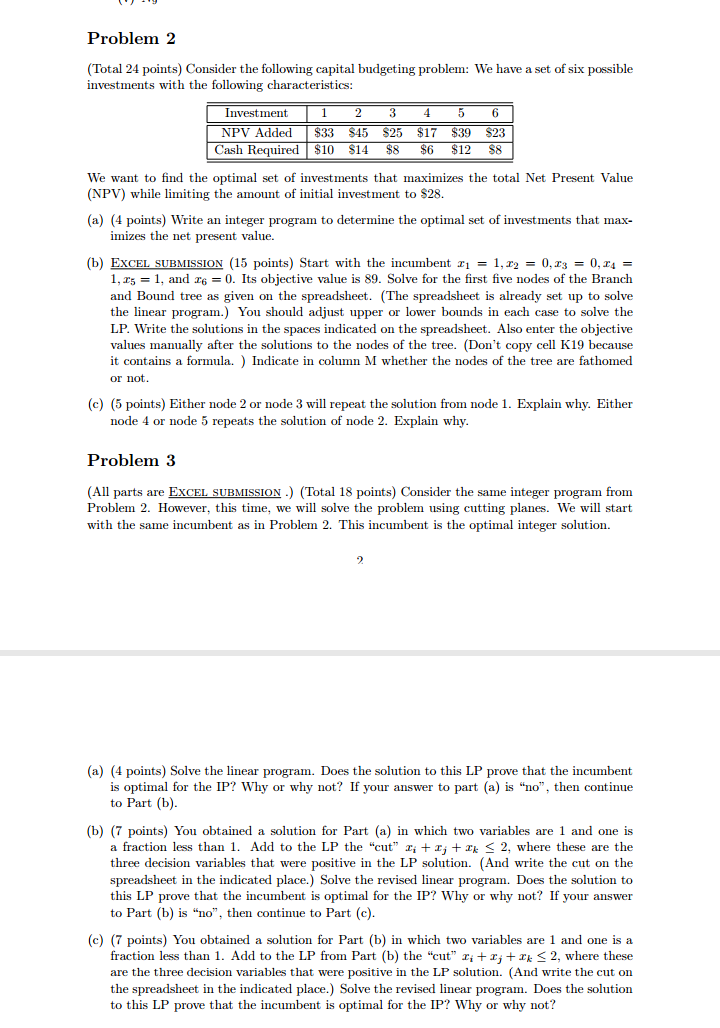
t'l' .13 Problem 2 [Total 24 points} Consider the following capital budgeting problem: We have a set ofsix possible investments with the following characteristim: Investment 1 '2 3 4 5 '5 333 343 335 313 333 $23 $10 314 33 33' 312 33 We want to nd the optimal set of investments that maximizes the total Net Present Value [I'IPW while limiting the amount of initial investment to $23. {a} {4 points} 1lfrite an integer program to determine the optimal set of investments that max- imizes the net present value. {b} EXCEL sosmssmN [15 points} Start with the incumbent :1 = Leg = [1.33 = the. = 1.;r5 = 11 and .135 = E]. Its objective value is 39. Solve for the rst ve nodes of the Branch and Bound tree as given on the spreadsheet. {The spreadsheet is already set up to solve the linear program.) You should adjust upper or lower bounds in each case to solve the LP. Write the solutions in the spaces indicated on the spreadsheet. Also enter the objective values manually after the solutions to the nodes of the tree. {Don't cop},r cell K19 because it contains a formula. } Indicate in column M whether the nodes of the tree are fathomed or not. {c} {5 points} Either node 2 or node 3 will repeat the solution from node 1. Ehcplain why. Either node 4 or node 5 repeats the solution of node 2. Ehcplain why. Problem 3 [All parts are EXCEL SUBMISSION .} ['Ibtal 13 points]I Consider the same integer program from Problem 2. However, this time1 we will solve the problem using cutting planes. We will start with the same incumbent as in Problem 2. This incumbent is the optimal integer solution. '5'. {a} {4 points} Solve the linear program. Does the solution to this LP prove that the incumbent is optimal for the If"?I Why,r or why not? Ifyour answer to part {a} is \"no", then continue to Part {b}. {b} {'F points] You obtained a solution for Part {a} in which two variables are l and one is a fraction less than 1. Add to the LP the I'cut':I at; + 233- +3:' 5 2. where these are the three decision variables that were pcsitive in the LP solution. {And write the cut on the spreadsheet in the indicated place} Solve the revised linear program. Does the solution to this LP prove that the incumbent is optimal for the IP? Why or why not? If your answer to Part {b} is \"no", then continue to Part {c}. [c] {'F points} You obtained a solution for Part {h} in which two variables are 1 and one is a fraction less than 1. Add to the LP from Part {b} the "'cut"I z; + z} + I; 5 2. where these are the three decision variables that were positive in the LP solution. {And write the cut on the spreadsheet in the indicated place.) Solve the revised linear program. Does the solution to this LP prove that the incumbent is optimal for the IP'? 1Why or why not? t'l' .13 Problem 2 [Total 24 points} Consider the following capital budgeting problem: We have a set ofsix possible investments with the following characteristim: Investment 1 '2 3 4 5 '5 333 343 335 313 333 $23 $10 314 33 33' 312 33 We want to nd the optimal set of investments that maximizes the total Net Present Value [I'IPW while limiting the amount of initial investment to $23. {a} {4 points} 1lfrite an integer program to determine the optimal set of investments that max- imizes the net present value. {b} EXCEL sosmssmN [15 points} Start with the incumbent :1 = Leg = [1.33 = the. = 1.;r5 = 11 and .135 = E]. Its objective value is 39. Solve for the rst ve nodes of the Branch and Bound tree as given on the spreadsheet. {The spreadsheet is already set up to solve the linear program.) You should adjust upper or lower bounds in each case to solve the LP. Write the solutions in the spaces indicated on the spreadsheet. Also enter the objective values manually after the solutions to the nodes of the tree. {Don't cop},r cell K19 because it contains a formula. } Indicate in column M whether the nodes of the tree are fathomed or not. {c} {5 points} Either node 2 or node 3 will repeat the solution from node 1. Ehcplain why. Either node 4 or node 5 repeats the solution of node 2. Ehcplain why. Problem 3 [All parts are EXCEL SUBMISSION .} ['Ibtal 13 points]I Consider the same integer program from Problem 2. However, this time1 we will solve the problem using cutting planes. We will start with the same incumbent as in Problem 2. This incumbent is the optimal integer solution. '5'. {a} {4 points} Solve the linear program. Does the solution to this LP prove that the incumbent is optimal for the If"?I Why,r or why not? Ifyour answer to part {a} is \"no", then continue to Part {b}. {b} {'F points] You obtained a solution for Part {a} in which two variables are l and one is a fraction less than 1. Add to the LP the I'cut':I at; + 233- +3:' 5 2. where these are the three decision variables that were pcsitive in the LP solution. {And write the cut on the spreadsheet in the indicated place} Solve the revised linear program. Does the solution to this LP prove that the incumbent is optimal for the IP? Why or why not? If your answer to Part {b} is \"no", then continue to Part {c}. [c] {'F points} You obtained a solution for Part {h} in which two variables are 1 and one is a fraction less than 1. Add to the LP from Part {b} the "'cut"I z; + z} + I; 5 2. where these are the three decision variables that were positive in the LP solution. {And write the cut on the spreadsheet in the indicated place.) Solve the revised linear program. Does the solution to this LP prove that the incumbent is optimal for the IP'? 1Why or why not? Problem 4 "Total 12 points, 3 points each) We want to find valid inequalities for the following 0-1 knapsack problem: max 22r1 + 1012 + 16x3 + 11x4 + 18x5 + 6x6 s.t.: 4x1 + 3x2 + 7x3 + 6x4 + 5rs + 86 : 15 ( KP ) T1, 12, 13, TA, T5, 16 E {0, 1 }. For each of the inequalities below, identify whether or not they are valid. (a) rites + ra S 2. (b) rat ry t r; $ 2. (c) 23 + 25 5 1. (d) 21 + x2 + ra + 16 3. Problem 5 (Total 30 points) We want to solve the following integer program with two variables: max 4x1 + 3.12 s.t.: 2x1 + 12 1 -x1 + 212 LIVIAIA Z'T = CA NOD Let $1, $2 be the slack variables for the first and second constraint respectively. Solving the LP relaxation for this problem yields the following optimal Simplex tableau: Basic $1 Rhs (-2) -11/5 -2/5 -133/5 2/5 -1/5 16/5 1/5 2/5 23/5 (a) (4 points) Slack variables are usually allowed to be fractional. If r, and r2 are both integers, will s, and s2 also be integers? Briefly explain why or why not. (b) (6 points) Derive a Gomory cut from each of the first two rows in the optimal Simplex tableau. (c) (6 points) Express the cuts in terms of the original variables z1 and 12. Graph the feasible region for 21 and 12, and illustrate the cuts on the graph. (d) (6 points) We now append the cuts (or the cut, if only one of them is needed) to the LP relaxation, and resolve. We provide the optimal Simplex tableau after resolving below: Basic $1 X2 $1 $2 $3 Rhs (-2) -2 -26 1/2 -1/2 7/2 1/2 -5/2 3/2 where s3 is the slack variable corresponding to the appended cut. Which rows can be used to derive Gomory cuts? Compute the cuts. Rewrite them in terms of 21 and 12. (e) (8 points) Draw the cuts on your sketch and find the new optimal solution graphically. Is this new solution optimal? (Hint: if you did everything correctly, the new solution is optimal with objective function value 25.)Problem 3 Which ones of the following mathematical programs is not a Linear Program? For those that are not Linear Programs, can they be reformulated in linear form? min 0.51 + 3x2 C1 + 1.35x2 = 2.7 0 (a) free max 0.521 + 312 0.9911 + 12 2 2.7
Step by Step Solution
There are 3 Steps involved in it

Get step-by-step solutions from verified subject matter experts
 Study Help