







Question: answer all questions with detailed explanation 5. A study was performed among patients with piriformissyndrome (PS), a pelvic condition that involves malfunction of the piriformis
answer all questions with detailed explanation
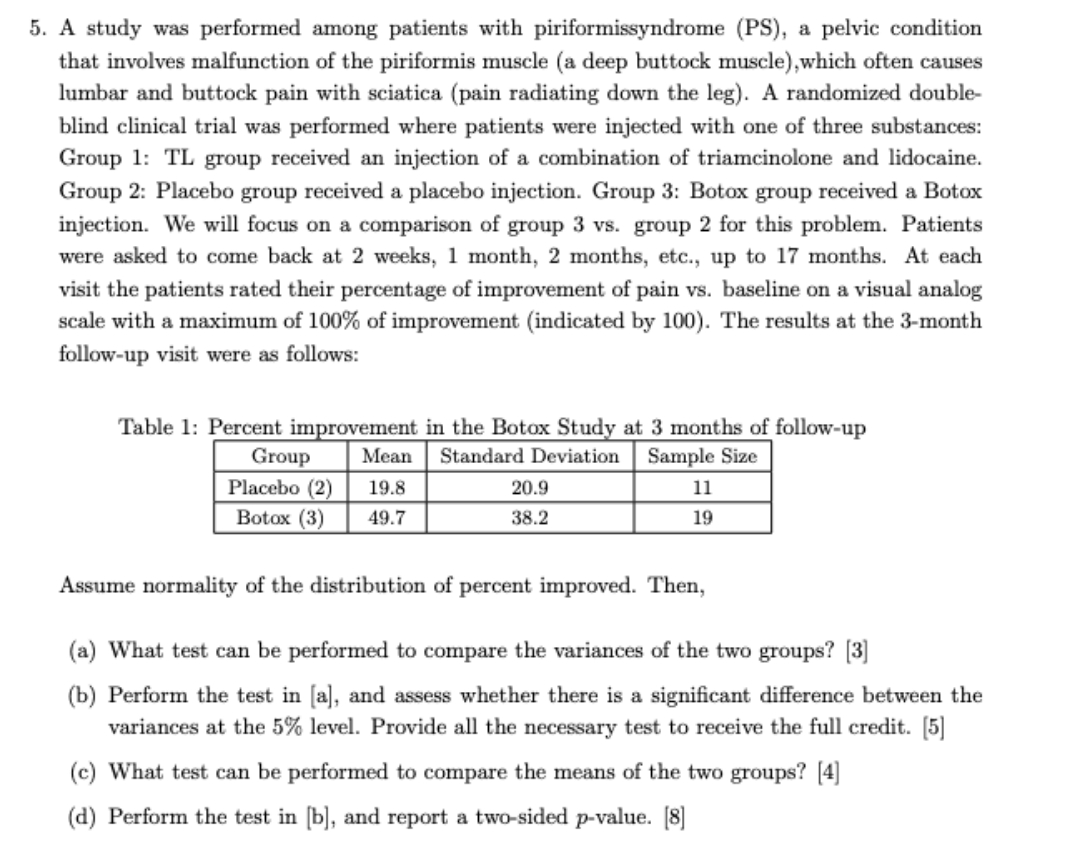
5. A study was performed among patients with piriformissyndrome (PS), a pelvic condition that involves malfunction of the piriformis muscle (a deep buttock muscle), which often causes lumbar and buttock pain with sciatica (pain radiating down the leg). A randomized double- blind clinical trial was performed where patients were injected with one of three substances: Group 1: TL group received an injection of a combination of triamcinolone and lidocaine. Group 2: Placebo group received a placebo injection. Group 3: Botox group received a Botox injection. We will focus on a comparison of group 3 vs. group 2 for this problem. Patients were asked to come back at 2 weeks, 1 month, 2 months, etc., up to 17 months. At each visit the patients rated their percentage of improvement of pain vs. baseline on a visual analog scale with a maximum of 100% of improvement (indicated by 100). The results at the 3-month follow-up visit were as follows: Table 1: Percent improvement in the Botox Study at 3 months of follow-up Group Mean Standard Deviation Sample Size Placebo (2) 19.8 20.9 11 Botox (3) 49.7 38.2 19 Assume normality of the distribution of percent improved. Then, (a) What test can be performed to compare the variances of the two groups? [3] (b) Perform the test in [a], and assess whether there is a significant difference between the variances at the 5% level. Provide all the necessary test to receive the full credit. [5] (c) What test can be performed to compare the means of the two groups? [4] (d) Perform the test in [b], and report a two-sided p-value. [8]
Step by Step Solution
There are 3 Steps involved in it

Get step-by-step solutions from verified subject matter experts
 Study Help