







Question: Answer all the parts: An elastic spring has a spring constant of 17.3 N/cm. It hangs vertically at rest from a hook affixed to the
Answer all the parts:
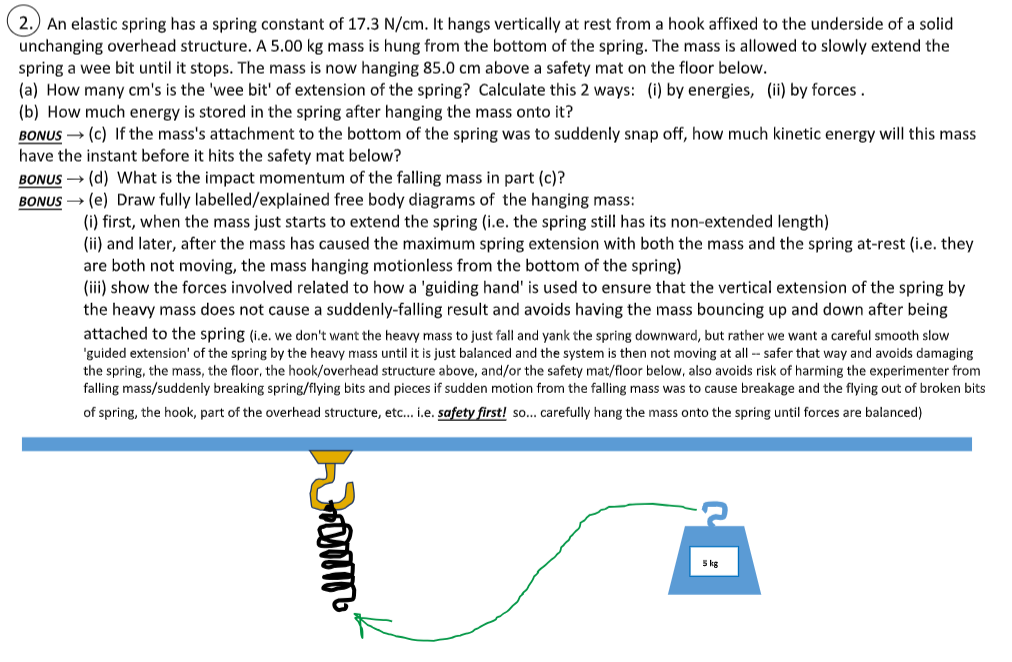
An elastic spring has a spring constant of 17.3 N/cm. It hangs vertically at rest from a hook affixed to the underside of a solid unchanging overhead structure. A 5.00 kg mass is hung from the bottom of the spring. The mass is allowed to slowly extend the spring a wee bit until it stops. The mass is now hanging 85.0 cm above a safety mat on the floor below. (a) How many em's is the 'wee bit' of extension of the spring? Calculate this 2 ways: (i) by energies, (ii) by forces . (b) How much energy is stored in the spring after hanging the mass onto it? sonus (c) If the mass's attachment to the bottom of the spring was to suddenly snap off, how much kinetic energy will this mass have the instant before it hits the safety mat below? sonus (d) What is the impact momentum of the falling mass in part (c)? sonus (e) Draw fully labelled/explained free body diagrams of the hanging mass: (i) first, when the mass just starts to extend the spring (i.e. the spring still has its non-extended length) (i) and later, after the mass has caused the maximum spring extension with both the mass and the spring at-rest (i.e. they are both not moving, the mass hanging motionless from the bottom of the spring) (iii) show the forces involved related to how a 'guiding hand' is used to ensure that the vertical extension of the spring by the heavy mass does not cause a suddenly-falling result and avoids having the mass bouncing up and down after being attached to the spring (i.e. we don't want the heavy mass to just fall and yank the spring downward, but rather we want a careful smooth slow 'guided extension' of the spring by the heavy mass until it is just balanced and the system is then not moving at all - safer that way and avoids damaging the spring, the mass, the floor, the hook/overhead structure above, and/or the safety mat/floor below, also avoids risk of harming the experimenter from falling mass/suddenly breaking spring/flying bits and pieces if sudden motion from the falling mass was to cause breakage and the flying out of broken bits of spring, the hook, part of the overhead structure, etc... i.e. sa rst! so... carefully hang the mass onto the spring until forces are balanced)
Step by Step Solution
There are 3 Steps involved in it

Get step-by-step solutions from verified subject matter experts
 Study Help