







Question: Answer all the questions below 1) What do you think about the way the preparation for the training was carried out? Justify your answer. 2)As
Answer all the questions below
1) What do you think about the way the preparation for the training was carried out? Justify your answer.
2)As a result of the discussion, what would you do in Amandas place now?
3) As a member of the senior management committee, what would you propose in order to rectify the situation?
4) Discuss the challenges of diversity management training that the team members brought to Amandas attention.
5) Analyze the stances of every member according to their cultural background and how their positions were influenced by characteristics of their respective national cultures based on Hofstedes cultural model and dimensions (collectivism vs. individualism; uncertainty avoidance; power distance; and masculinity vs. femininity).as well as other cultural dimensions and cross-cultural models.
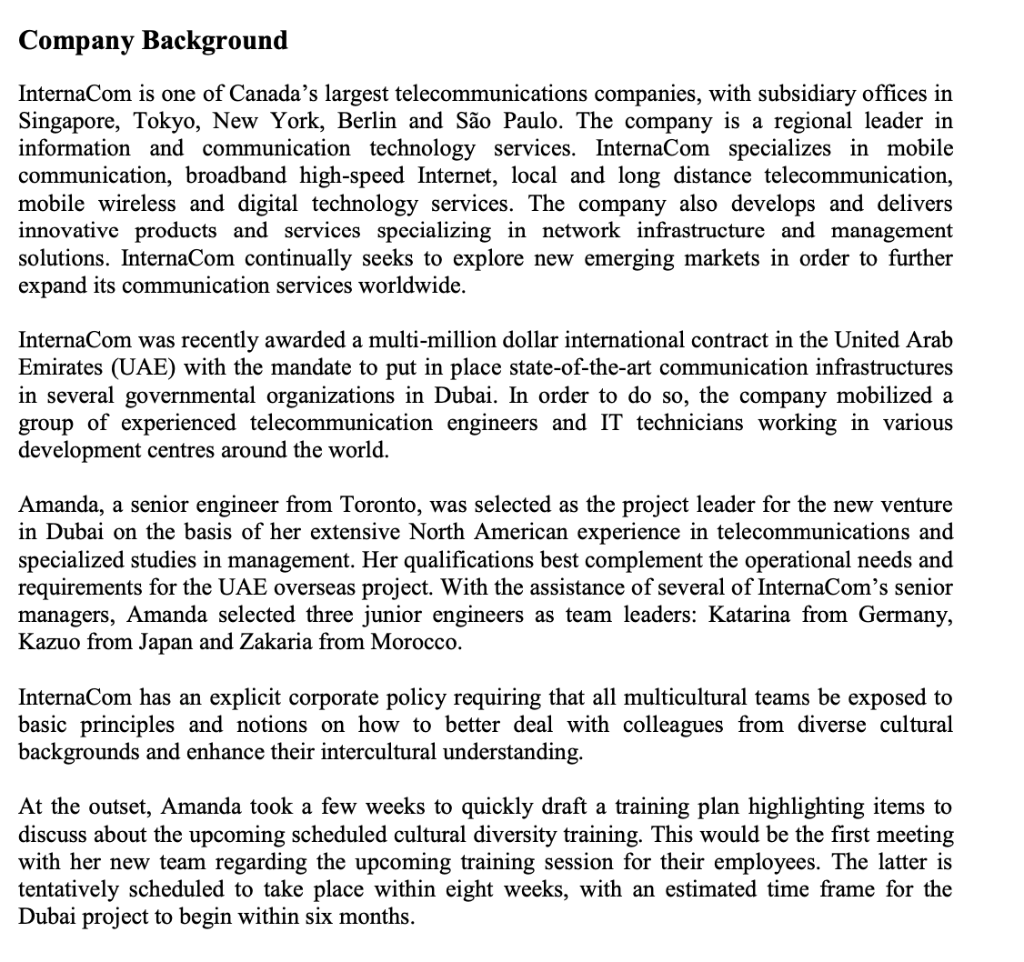
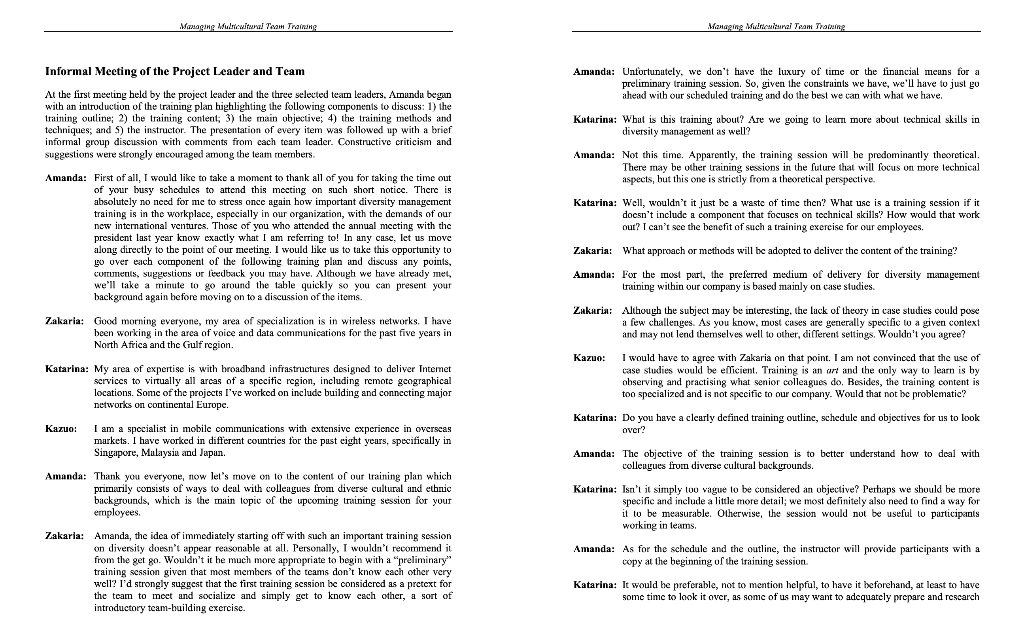
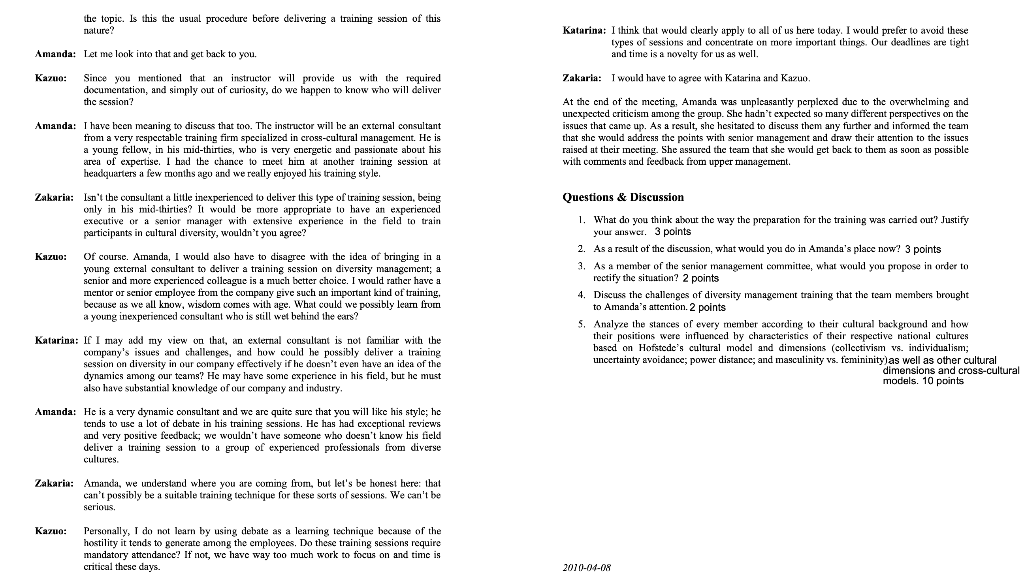
Company Background InternaCom is one of Canada's largest telecommunications companies, with subsidiary offices in Singapore, Tokyo, New York, Berlin and So Paulo. The company is a regional leader in information and communication technology services. InternaCom specializes in mobile communication, broadband high-speed Internet, local and long distance telecommunication, mobile wireless and digital technology services. The company also develops and delivers innovative products and services specializing in network infrastructure and management solutions. InternaCom continually seeks to explore new emerging markets in order to further expand its communication services worldwide. InternaCom was recently awarded a multi-million dollar international contract in the United Arab Emirates (UAE) with the mandate to put in place state-of-the-art communication infrastructures in several governmental organizations in Dubai. In order to do so, the company mobilized a group of experienced telecommunication engineers and IT technicians working in various development centres around the world. Amanda, a senior engineer from Toronto, was selected as the project leader for the new venture in Dubai on the basis of her extensive North American experience in telecommunications and specialized studies in management. Her qualifications best complement the operational needs and requirements for the UAE overseas project. With the assistance of several of InternaCom's senior managers, Amanda selected three junior engineers as team leaders: Katarina from Germany, Kazuo from Japan and Zakaria from Morocco. InternaCom has an explicit corporate policy requiring that all multicultural teams be exposed to basic principles and notions on how to better deal with colleagues from diverse cultural backgrounds and enhance their intercultural understanding. At the outset, Amanda took a few weeks to quickly draft a training plan highlighting items to discuss about the upcoming scheduled cultural diversity training. This would be the first meeting with her new team regarding the upcoming training session for their employees. The latter is tentatively scheduled to take place within eight weeks, with an estimated time frame for the Dubai project to begin within six months. Informal Mecting of the Project Leader and Team Amanda: Unfortunately, we don't have the luxury of time or the finuncial meuns for a preliminary training session. So, given the constraints we have, we'll have to just go At the first meeting held by the project leader and the three selected team leaders, Amunda began ahead with our scheduled training and do the best we can with what we have. with in introduction of the training plan highlighting the following components to discuss: 1) the training oulline; 2) the training content; 3) the main objective; 4) the training methods and Katarina: What is this training about? Are we going to learn mure about technical skills in techniques; and 5) the instructor. The presentation of every item was followed up with a brief diversity management as well? informal group discussion with comments from cach team leader. Constructive criticism and suggestions were strongly encouraged among the leam members. Amanda: Not this time. Apparently, the training session will be predominantly theoretical. Amanda: First of all, I would like to take a moment to thank all of you for taking the time out There may be other training sessions in the future that will focus on more technical of your busy schodules to attend this mecting on such short notice. There is aspects, but this one is strictly from a theoretical perspective. absolutely no need for me to stress once again how important diversity management Katarina: Well, wouldn't it just be a waste of time then? What use is a training session if it training is in the workplace, especially in our organization, with the demands of our docsn't include a component that focuses on technical skills? How would that work new international ventures. Those of you who attended the annual meeting with the out? I can't see the benefit of such a training exercise for our employees. president last year know exactly what I am referring to! In any case, let us move along directly to the point of our meeting. I would like us to take this opportunity to go over each component of the following training plan and discuss any points, conuments, suggestions or feedback you maiy bave. Although we bave already meh, we'll take a minute to go around the table quickly so you can present your background again before moving on to a discussion of the items. Zakaria: What approach or methods will be adopted to deliver the content of the training? Amanda: For the most part, the preferrod medium of delivery for diversity manugement training within our company is based mainly on case studies. Zakaria: Although the subject may be interesting, the lack of theory in case studies could pose Zakaria: Good morning everyone, my area of specialization is in wireless networks. I have a few challenges. As you know, most cases are generally specific to a given context been working in the area of voice and data communications for the past five years in and may not lend themselves well to other, different settings. Wouldn't you agree? North Africa and the Gulf region. Kazuo: I would have to agree with Zakaria on that point. I am not convinoed that the use of Katarina: My area of expertise is with broadband infrastructures designed to deliver Intemet case studies would be efficient. Training is an art and the only way to learn is by services to virtually all areas of a specific region, including remote gengraphical observing and practising what senior colleagues do. Besides, the training content is locations. Some of the projects I've worked on include building and connecting major too specializod and is not specific to our company. Would that not be problematic? networks on continental Europe. Katarina: Do you have a clearly defined training outline, schedule and objectives for us to look Kazuo: I am a specialist in mobile communications with extensive experience in overseas over? markets. I have worked in different countries for the past eight years, specifically in Singapore, Mulaysia and Jupan. Amanda: The objective of the training session is to better understand how to deal with colleagues from diverse cultural buckgrounds. Amanda: Thank you everyone, now let's move on to the content of our training plan which primarily consists of ways to deal with colleagues from diverse cultural and ethnic Katarina: Isn't it simply too vague to be considered an objective? Perthaps we should be more backgrounds, which is the main topic of the upcoming training session for your specific and include a little more detail; we most definitely also need to find a way for employees. it to be measurable. Otherwise, the session would not be useful to participants working in leams. Zakaria: Amanda, the idea of immediately starting off with such an important training session on diversity doesn't appear reasonable at all. Personally, I wouldn't recommend it from the get go. Wouldn't it be much more appropriate to begin with a "preliminary" Amanda: As for the schedule and the outline, the instructor will provide participants with a training session given that most members of the teams don't know each other very copy at the beginning of the training session. well? I'd strongly suggest that the first training session be considered as a pretext for the team to meet and socialize and simply get to know each other, a sort of Katarina: It would be preferable, not to mention helpful, to have it beforehand, at least to have introductory team-building exercise. some time to look it over, as some of us may want to adequately prepare and rescarch the topic. Is this the usual procedure before delivering a training session of this nature? Katarina: I think that would clearly apply to all of us here today. I would prefer to avoid these types of sessions and concentrate on more important things. Our deadlines are tight Amanda: Let me look into that and get back to you. and time is a novelty for us as well. Kazuo: Since you mentioned that an instructor will provide us with the required Zakaria: I would have to agree with Katarina and Kazuo. documentation, and simply out of curiosity, do we happen to know who will deliver the scssion? At the end of the mecting, Amanda was unpleasantly perplexed due to the overwhelming and uncxpected criticism among the group. She hadn't expected so many different perspectives on the Amanda: I have been meaning to discuss that too. The instructor will be an external consultant issues that came up. As a result, she hesitated to diseuss them any further and informed the team from a very respectable training firm specialized in cross-cultural management. He is that she would address the points with senior managenent and draw their attention to the issues a young fellow, in his mid-thirties, who is very energetic and passionate about his raised at their meeting. She assured the team that she would get back to them as soon as possible area of expertise. I had the chance to meet him at another training session at with comments and feecibuck from upper munagement. headguarters a few months ago and we really enjoyed his training style. Zakaria: Isn't the consultant a little inexperienced to deliver this type of training session, being Questions \& Discussion only in his mid-thirties? It would be more appropriate to bave an experienced 1. What do you think about the way the preparation for the training was carried out? Justify participants in cultural diversity, wouldn't you agree? your answer. 3 points Kazuo: Of course. Amanda, I would also have to disagree with the idea of bringing in a 2. As a result of the discussion, what would you do in Amanda's place now? 3 points young external consultant to deliver a training session on diversity management; a 3. As a member of the senior management committee, what would you propose in order to senior and more experienced colleague is a much better choice. I would rather have a rectify the situation? 2 points mentor or senior employee from the company give such an important kind of training, 4. Discuss the challenges of diversity management training that the team members brought because as we all know, wisdom comes with age. What could we possibly leum from to Amanda's attention. 2 points a young inexperienced consultant who is still wet behind the ears? 5. Analyze the stances of every member according to their cultural background and how Katarina: If I may add my view on that, an external consultant is not familiar with the their positions were influenced by characteristics of their respective national cultures company's issues and challenges, and how could be possibly deliver a training based on Hofstede's cultural model and dimensions (collectivism vs. individualism; session on diversity in our company effectively if he doesn't even have an idea of the uncertainty avoidance; power distance; and masculinity vs. femininity)as well as other cultural dynamics among our teams? He may have some experience in his field, but he must dimensions and cross-culture also have substantial knowledge of our company and industry. models. 10 points Amanda: He is a very dynamic consultant and we are quite sure that you will like his style; he tends to use a lot of debate in his training sessions. He has had exceptional reviews and very positive feedback; we wouldn't have someone who doesn't know his field deliver a truining session to a group of experienced professionals from diverse cultures. Zakaria: Amanda, we understand where you are coming from, but let's be honest here: that can't possibly be a suitable training technique for these sorts of sessions. We can't be serious. Kazuo: Personally, I do not learn by using debate as a learning technique because of the hostility it tends to generate among the employees. Do these training sessions require mandatory attendance? If not, we have way too much work to focus on and time is critical these days. 20100408
Step by Step Solution
There are 3 Steps involved in it

Get step-by-step solutions from verified subject matter experts
 Study Help