Question: answer all the questions needed please Distinguishable and Cyclic Permutation Example #1 - Distinguishable Permutation How many ways can we arrange the letters in the
answer all the questions needed please
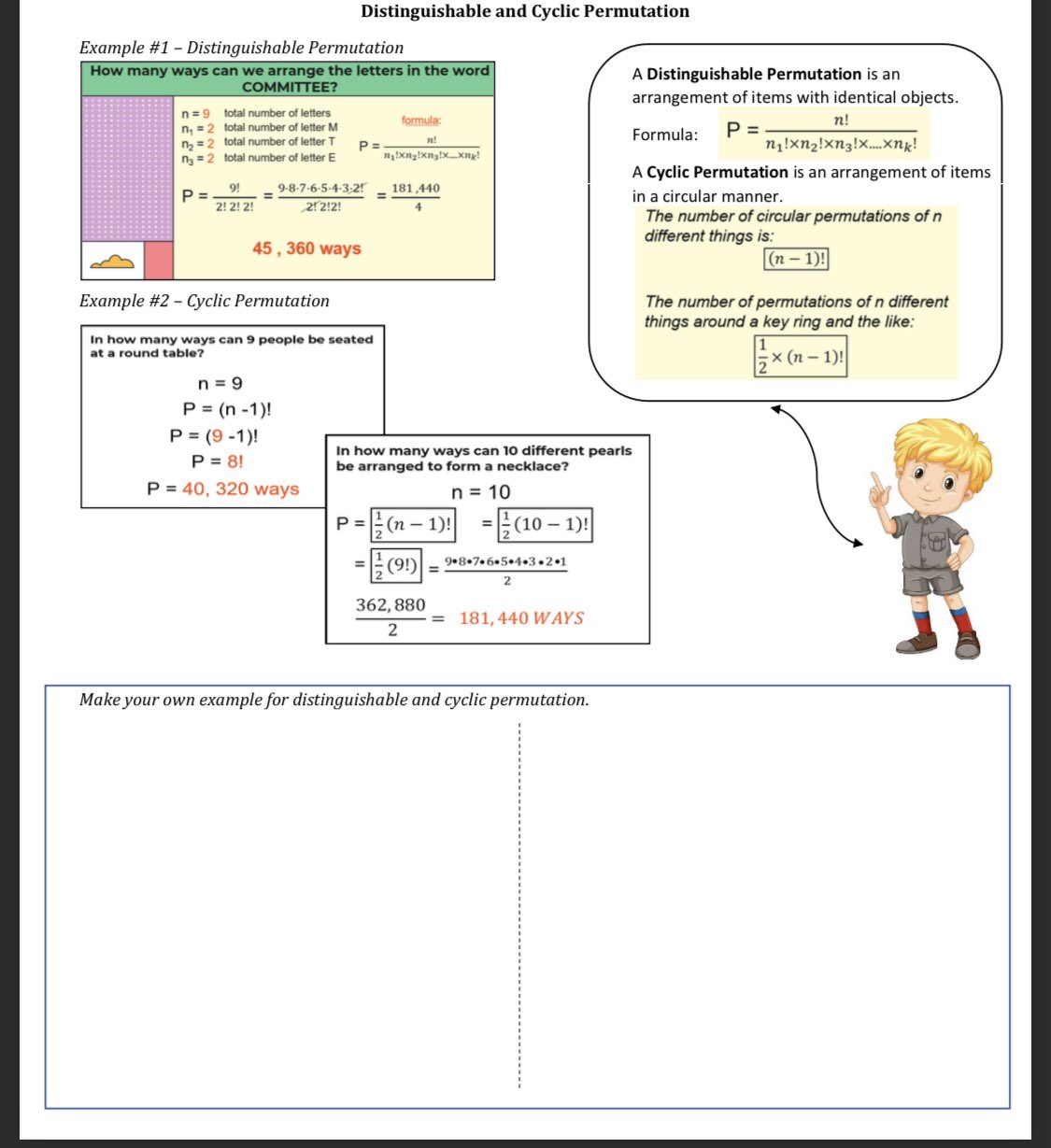
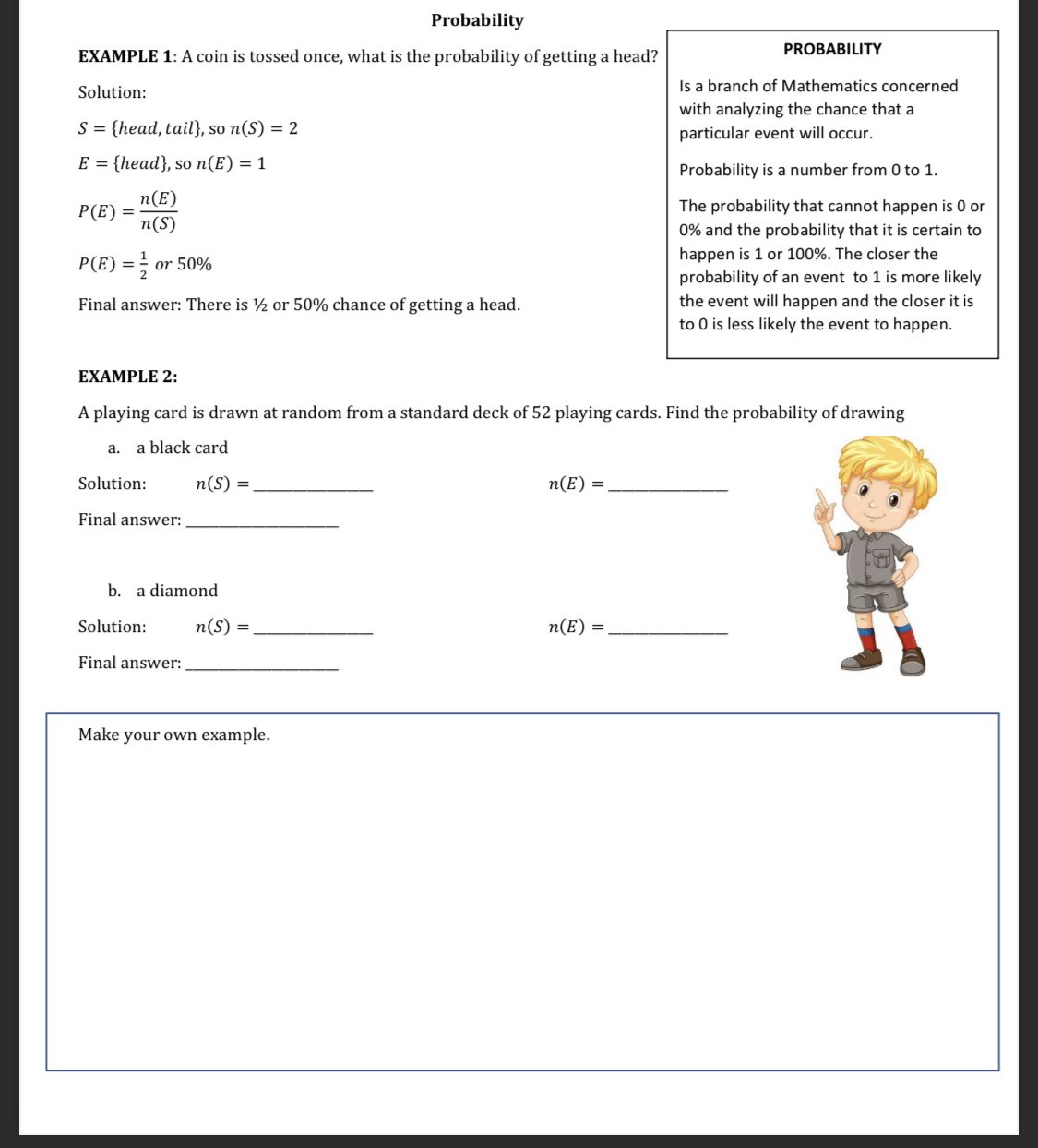
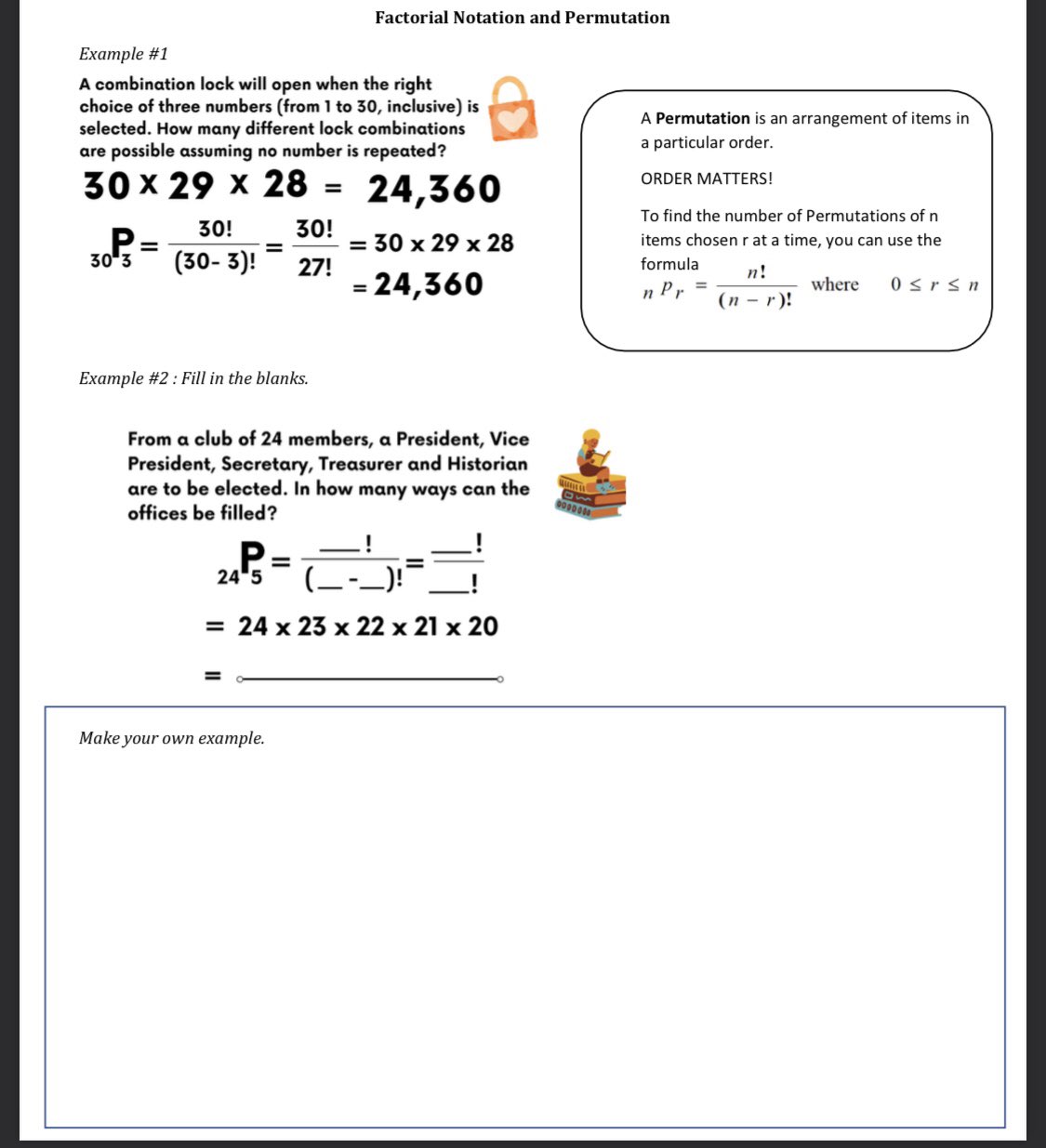
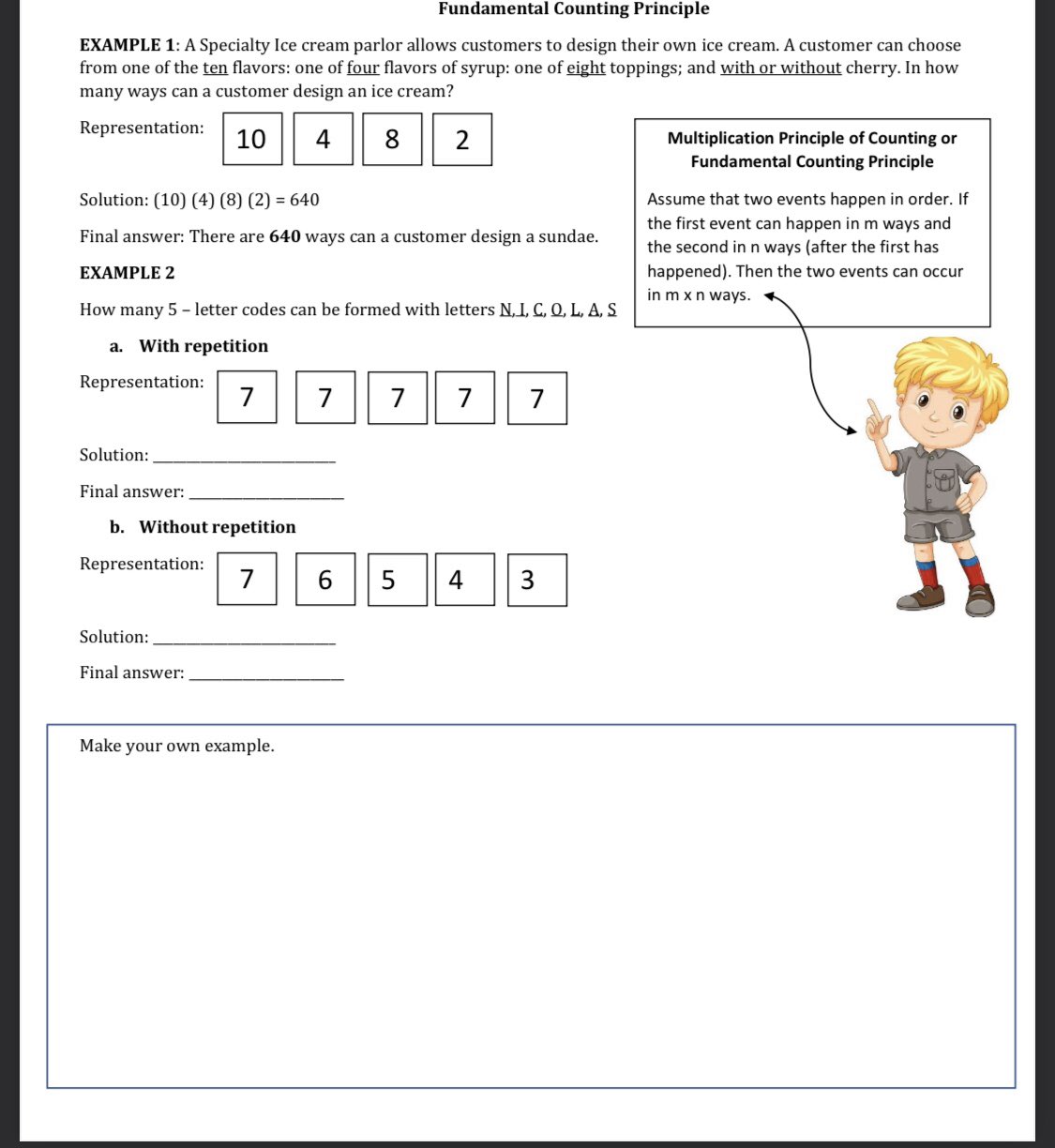
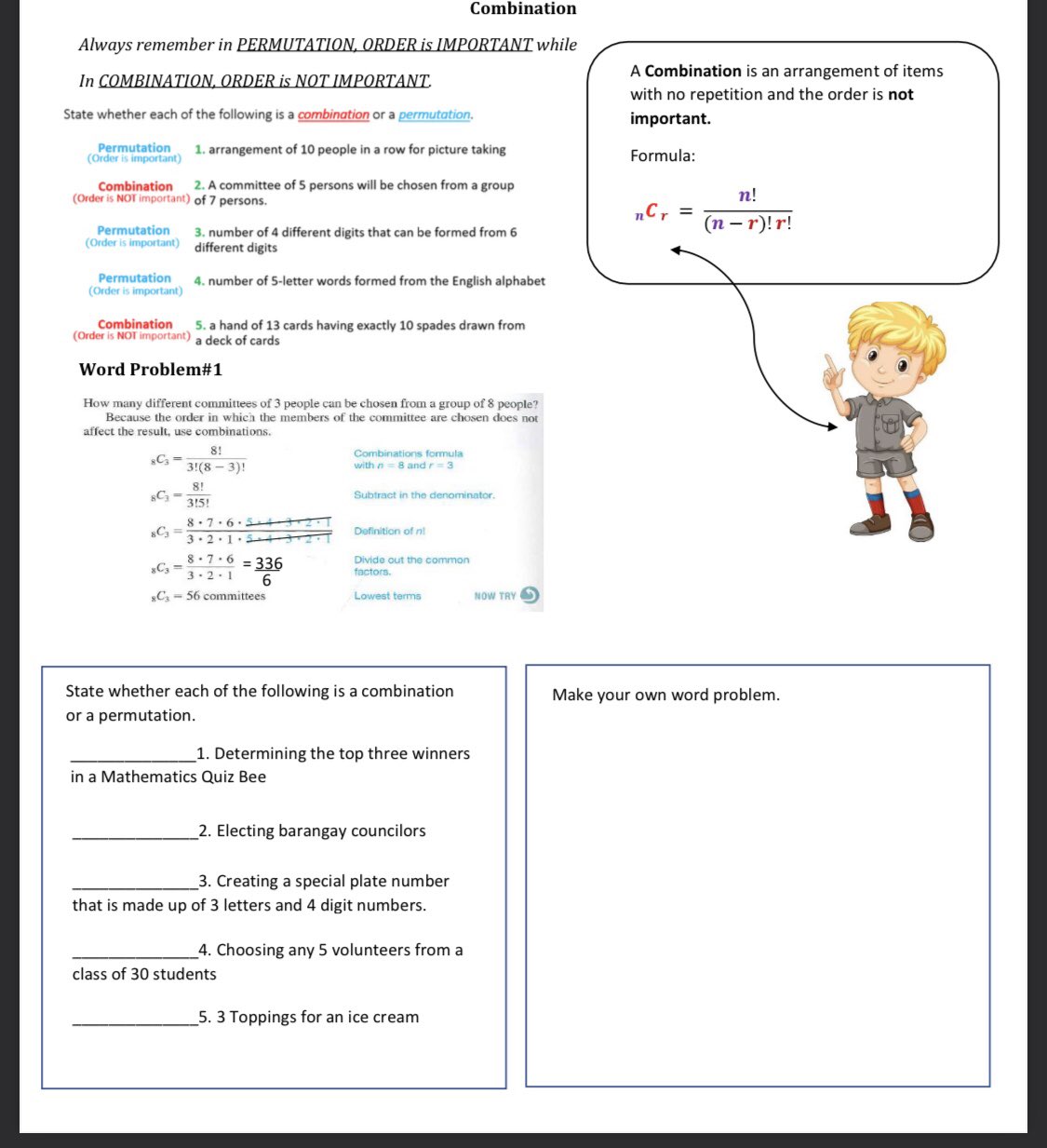
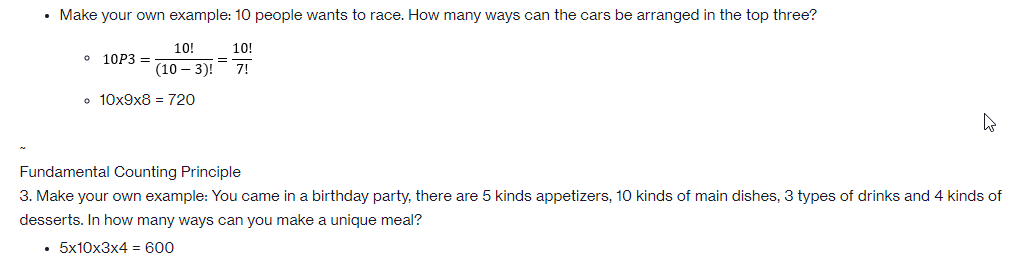
Distinguishable and Cyclic Permutation Example #1 - Distinguishable Permutation How many ways can we arrange the letters in the word A Distinguishable Permutation is an COMMITTEE? arrangement of items with identical objects. n = 9 total number of letters n, = 2 total number of letter M formula n! P = - n2 = 2 total number of letter T P = n! Formula: n1!Xn2!Xn3!X..xnk! na = 2 total number of letter E mixnz!Xna!x_xux! A Cyclic Permutation is an arrangement of items P= - 9! 9-8-7-6.5-4-3-2! 181,440 2! 2! 2! in a circular manner. 21 212! The number of circular permutations of n different things is: 45 , 360 ways (n - 1)! Example #2 - Cyclic Permutation The number of permutations of n different things around a key ring and the like: In how many ways can 9 people be seated at a round table? 5x (n - 1)! n = 9 P = (n-1)! P = (9 -1)! P = 8! In how many ways can 10 different pearls be arranged to form a necklace? P = 40, 320 ways n = 10 P = = (n -1)! (10 -1)! (9!) 9.8-7-6.5-4-3.2-1 362, 880 181, 440 WAYS 2 Make your own example for distinguishable and cyclic permutation.Probability EXAMPLE 1: A coin is tossed once, what is the probability of getting a head? PROBABILITY Solution: Is a branch of Mathematics concerned with analyzing the chance that a S = {head, tail}, so n(S) = 2 particular event will occur. E = {head], so n(E) = 1 Probability is a number from 0 to 1. P(E) = n (E) The probability that cannot happen is 0 or n(S) 0% and the probability that it is certain to P(E) = = or 50% happen is 1 or 100%. The closer the probability of an event to 1 is more likely Final answer: There is 1/2 or 50% chance of getting a head. the event will happen and the closer it is to O is less likely the event to happen. EXAMPLE 2: A playing card is drawn at random from a standard deck of 52 playing cards. Find the probability of drawing a. a black card Solution: n (S) = n(E) = Final answer: b. a diamond Solution: n(S) = n(E) = Final answer: Make your own example.Factorial Notation and Permutation Example #1 A combination lock will open when the right choice of three numbers (from i to 50, inclusive] is i " 1 selected. How many different lock combinations -4 are possible assuming no number is repeated? 50x29 X 28 = 24,560 ORDERMATrERS! A Permutation is an arrangement of items in a particular order. 50| 50' To find the number of Permutations of n 30P = = 30 x 29 x 28 items chosen r at a time, you can use the (30 3M: 27! formula = 24,560 Example #2:}3'1'1'." in the blanks From a club o1'24 members, a President, Vice President, Secretary, Treasurer and Historian are to be elected. In how many ways can the offices be filled? 24P5=_ (_ -_)!= _ = 24x23x22x2'lx20 Make your own example. Fundamental Counting Principle EXAMPLE 1: A Specialty Ice cream parlor allows customers to design their own ice cream. A customer can choose from one of the ten flavors: one of four flavors of syrup: one of eight toppings; and with or without cherry. In how many ways can a customer design an ice cream? Representation: 10 4 8 2 Multiplication Principle of Counting or Fundamental Counting Principle Solution: (10) (4) (8) (2) = 640 Assume that two events happen in order. If the first event can happen in m ways and Final answer: There are 640 ways can a customer design a sundae. the second in n ways (after the first has EXAMPLE 2 happened). Then the two events can occur in m x n ways. How many 5 - letter codes can be formed with letters N. I, C, Q, L, A, S a. With repetition Representation: 7 7 7 7 7 Solution: Final answer: b. Without repetition Representation: 7 6 5 4 3 Solution: Final answer: Make your own example.Combination Always remember in PERMUTATION, ORDER is IMPORTANT while In COMBINATION, ORDER is NOT IMPORTANT A Combination is an arrangement of items with no repetition and the order is not State whether each of the following is a combination or a permutation. important. Permutation (Order is important) 1. arrangement of 10 people in a row for picture taking Formula: Combination 2. A committee of 5 persons will be chosen from a group (Order is NOT important) of 7 persons. n! nCr = Permutation 3. number of 4 different digits that can be formed from 6 (n-r)!r! (Order is important) different digits Permutation 4. number of 5-letter words formed from the English alphabet Order is important) Combination 5. a hand of 13 cards having exactly 10 spades drawn from (Order is NOT important) a deck of cards Word Problem#1 How many different committees of 3 people can be chosen from a group of 8 people? Because the order in which the members of the committee are chosen does not affect the result, use combinations. 8! Combinations formula 3!(8 - 3)! with a = 8 and r = 3 8! 3!5! Subtract in the denominator. 8 . 7 . 6 . 5. 3 . 2 . 1 . 54 Definition of nt * C3 = S 8 . 7 . 6 = 336 Divide out the common 3 . 2 . 1 factors. 6 Ca = 56 committees Lowest terms NOW TRY State whether each of the following is a combination Make your own word problem. or a permutation. 1. Determining the top three winners in a Mathematics Quiz Bee 2. Electing barangay councilors 3. Creating a special plate number that is made up of 3 letters and 4 digit numbers. 4. Choosing any 5 volunteers from a class of 30 students 5. 3 Toppings for an ice cream12! 12! 12C5 = = 792 12 - 5)! x 5! 7! x 5!. Make your own example: 10 people wants to race. How many ways can the cars be arranged in the top three? 10! 10! mpg 21:1035? o 'leQXB = 720 Fundamental Counting Principle 3. Make your own example: You came in a birthday party: there are 5 kinds appetizers, 10 kinds of main dishes: 3 types of drinks and 4 kinds of desserts. In how many ways can you make a unique meal? . 5X10X3x4 = 600
Step by Step Solution
There are 3 Steps involved in it
1 Expert Approved Answer
Step: 1 Unlock
Question Has Been Solved by an Expert!
Get step-by-step solutions from verified subject matter experts
Step: 2 Unlock
Step: 3 Unlock
Students Have Also Explored These Related Mathematics Questions!










 Study Help