







Question: Answer all the questions please 9. Question 9: Consider a computer system that contains an I/O module controlling a simple keyboard/printer teletype. The following registers

Answer all the questions please
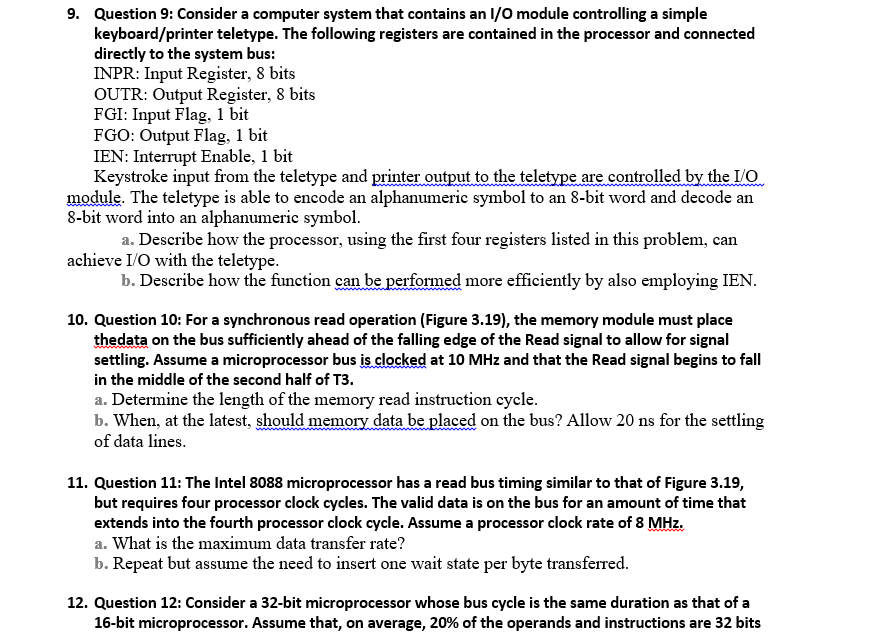
9. Question 9: Consider a computer system that contains an I/O module controlling a simple keyboard/printer teletype. The following registers are contained in the processor and connected directly to the system bus: INPR: Input Register, 8 bits OUTR: Output Register, 8 bits FGI: Input Flag, 1 bit FGO: Output Flag, 1 bit IEN: Interrupt Enable, 1 bit Keystroke input from the teletype and printer output to the teletype are controlled by the I/O module. The teletype is able to encode an alphanumeric symbol to an 8-bit word and decode an 8-bit word into an alphanumeric symbol. a. Describe how the processor, using the first four registers listed in this problem, can achieve I/O with the teletype. b. Describe how the function can be performed more efficiently by also employing IEN. 10. Question 10: For a synchronous read operation (Figure 3.19), the memory module must place thedata on the bus sufficiently ahead of the falling edge of the Read signal to allow for signal settling. Assume a microprocessor bus is clocked at 10 MHz and that the Read signal begins to fall in the middle of the second half of T3. a. Determine the length of the memory read instruction cycle. b. When, at the latest, should memory data be placed on the bus? Allow 20 ns for the settling of data lines. 11. Question 11: The Intel 8088 microprocessor has a read bus timing similar to that of Figure 3.19, but requires four processor clock cycles. The valid data is on the bus for an amount of time that extends into the fourth processor clock cycle. Assume a processor clock rate of 8 MHz. a. What is the maximum data transfer rate? b. Repeat but assume the need to insert one wait state per byte transferred. 12. Question 12: Consider a 32-bit microprocessor whose bus cycle is the same duration as that of a 16-bit microprocessor. Assume that, on average, 20% of the operands and instructions are 32 bits long, 40% are 16 bits long, and 40% are only 8 bits long. Calculate the improvement achieved when fetching instructions and operands with the 32-bit microprocessor. 13. Question 13: The microprocessor of Problem 3.14 initiates the fetch operand stage of the increment memory direct instruction at the same time that a keyboard actives an interrupt request line. After how long does the processor enter the interrupt processing cycle? Assume a bus clocking rate of 10 MHz
Step by Step Solution
There are 3 Steps involved in it

Get step-by-step solutions from verified subject matter experts
 Study Help