







Question: Answer all three parts correct with all steps with handwritten calculations only on page, do not use EXCEL. And must be correct solution or please
Answer all three parts correct with all steps with handwritten calculations only on page, do not use EXCEL. And must be correct solution or please don't attempt.
CASE:
Jack Berrigan is a graduate of UM Flint and has started his own company that produces and sells costumes online. Jack is trying to determine how many costumes to order for a new droid that showed up in the new Star Wars sequel this year. The droid seemed to be fan favorite judging my movie reviews, but the droid was also very round, and Jack knew that people did not often like very round costumes. This was a tough problem.
Jacks supplier accepts orders in dozens. Jack expects that if sales are low, he will be able to sell 25 dozen, if the sales are medium he will be able to sell 60 dozen and if the sales are high he will be able to sell 130 dozen of the costumes.
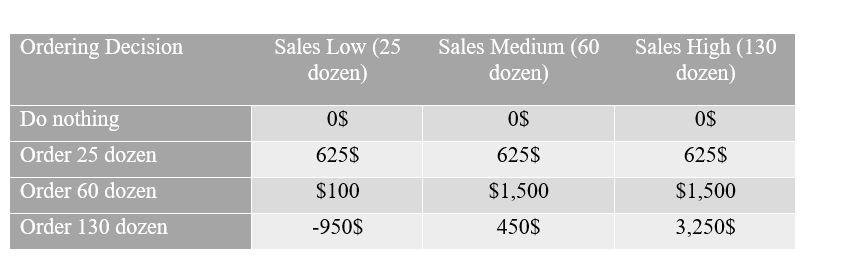
His options are: do nothing (do not place an order), order 25 dozen, order 60 dozen or order 130 dozen. His payoffs for each ordering option and subsequent sales level are given below.
Pay-off table: Amount given are profit earned (revenues minus cost of procurement). Negative amounts denote a loss.
A) What should Jack order under Maximin criteria?
| 25 dozen | ||
| 50 dozen | ||
| 130 dozen | ||
| 60 dozen |
B) What should Jack order under Minimax Regret criteria?
| 60 dozen | ||
| 25 dozen | ||
| 130 dozen | ||
| 50 dozen |
C) Under Minimax Regret criteria, what is the maximum regret if Jack orders 60 dozen?
Ordering Decision Sales Low (25 dozen) Sales Medium (60 dozen) Sales High (130 dozen) OS 0$ OS 625$ 625$ 625$ Do nothing Order 25 dozen Order 60 dozen Order 130 dozen $100 $1,500 $1,500 -950$ 450$ 3,250$Step by Step Solution
There are 3 Steps involved in it

Get step-by-step solutions from verified subject matter experts
 Study Help