







Question: answer all three questions with explanations Question 1: Define a discrete random variable X. The outcome of the random variable is x.x can be equal
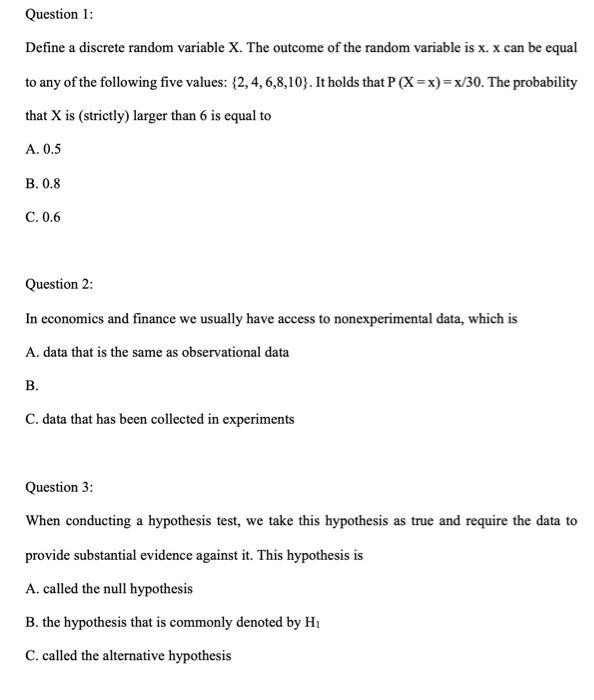
Question 1: Define a discrete random variable X. The outcome of the random variable is x.x can be equal to any of the following five values: {2,4,6,8,10}. It holds that P(X=x)=x/30. The probability that X is (strictly) larger than 6 is equal to A. 0.5 B. 0.8 C. 0.6 Question 2: In economics and finance we usually have access to nonexperimental data, which is A. data that is the same as observational data B. C. data that has been collected in experiments Question 3: When conducting a hypothesis test, we take this hypothesis as true and require the data to provide substantial evidence against it. This hypothesis is A. called the null hypothesis B. the hypothesis that is commonly denoted by H1 C. called the alternative hypothesis
Step by Step Solution
There are 3 Steps involved in it

Get step-by-step solutions from verified subject matter experts
 Study Help