Question: answer all thx. Ifs a case study. Menggi was a full time PhD student. He was starting his first year of study. In the previous
 answer all thx. Ifs a case study.
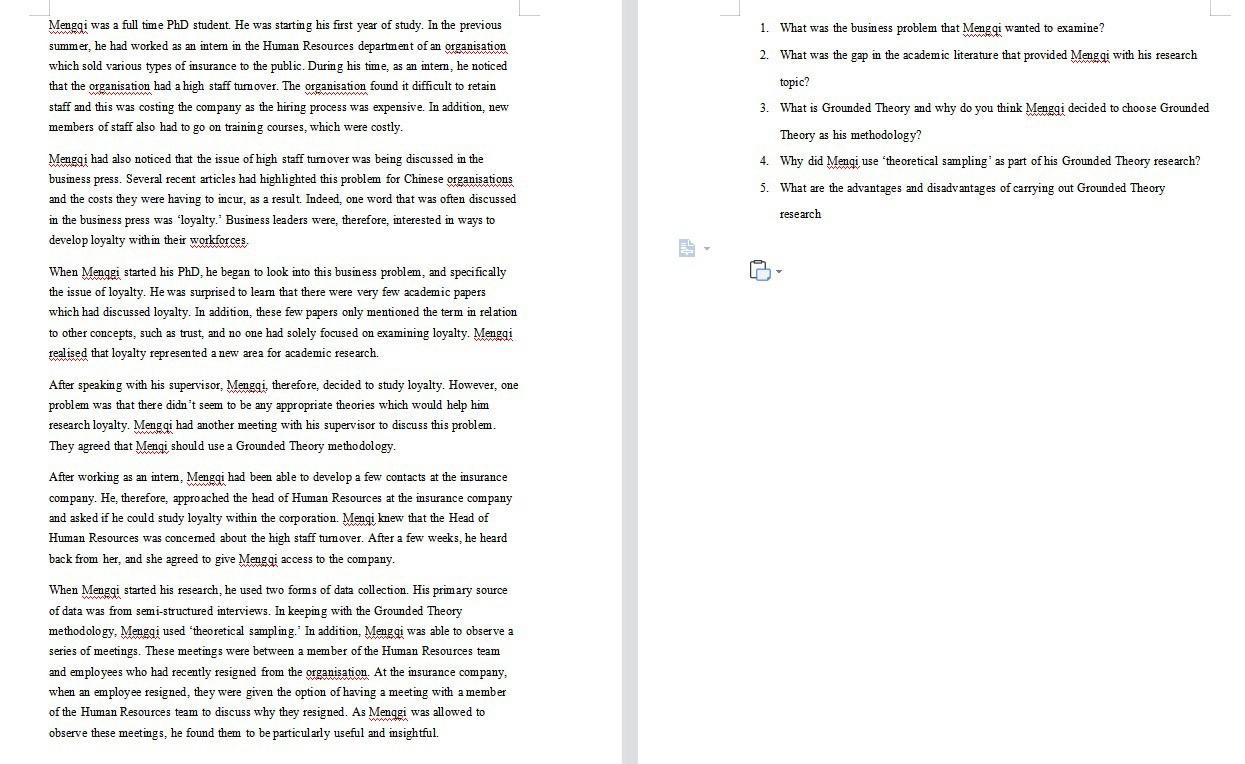
Menggi was a full time PhD student. He was starting his first year of study. In the previous 1. What was the business problem that Mengqi wanted to examine? summer, he had worked as an intern in the Human Resources department of an organisation 2. What was the gap in the academic literature that provided Menggi with his research which sold various types of insurance to the public. During his time, as an intern, he noticed topic? that the organisation had a high staff tumover. The organisation found it difficult to retain 3. What is Grounded Theory and why do you think Menggi decided to choose Grounded staff and this was costing the company as the hiring process was expensive. In addition, new Theory as his methodology? Mengqi had also noticed that the issue of high staff tumover was being discussed in the 4. Why did Mengi use 'theoretical sampling' as part of his Grounded Theory research? business press. Several recent articles had highlighted this problem for Chinese organisations 5. What are the advantages and disadvantages of carrying out Grounded Theory and the costs they were having to incur, as a result. Indeed, one word that was often discussed in the business press was 'loyalty.' Business leaders were, therefore, interested in ways to research develop loyalty with in their workforces. When Menggi started his PhD, he began to look into this business problem, and specifically the issue of loyalty. He was surprised to leam that there were very few academic papers which had discussed loyalty. In addition, these few papers only mentioned the term in relation to other concepts, such as trust, and no one had solely focused on examining loyalty. Mengqi real ised that loyalty represented a new area for academic research. After speaking with his supervisor, Mengqi, therefore, decided to study loyalty. However, one problem was that there didn't seem to be any appropriate theories which would help him research loyalty. Meng gi had another meeting with his supervisor to discuss this problem. They agreed that Mengi should use a Grounded Theory methodology. After working as an intem, Mengqi had been able to develop a few contacts at the insurance company. He, therefore, approached the head of Human Resources at the insurance company and asked if he could study loyalty within the corporation. Mengi knew that the Head of Human Resources was concemed about the high staff tumover. After a few weeks, he heard back from her, and she agreed to give Mengqi access to the company. When Mengqi started his research, he used two forms of data collection. His primary source of data was from semi-structured interviews. In keeping with the Grounded Theory methodology, Mengqi used 'theoretical sampling.' In addition, Mengqi was able to observe a series of meetings. These meetings were between a member of the Human Resources team and employees who had recently resigned from the organisation. At the insurance company, when an employee resigned, they were given the option of having a meeting with a member of the Human Resources team to discuss why they resigned. As Menggi was allowed to observe these meetings, he found them to be particularly useful and insightful









 Study Help