







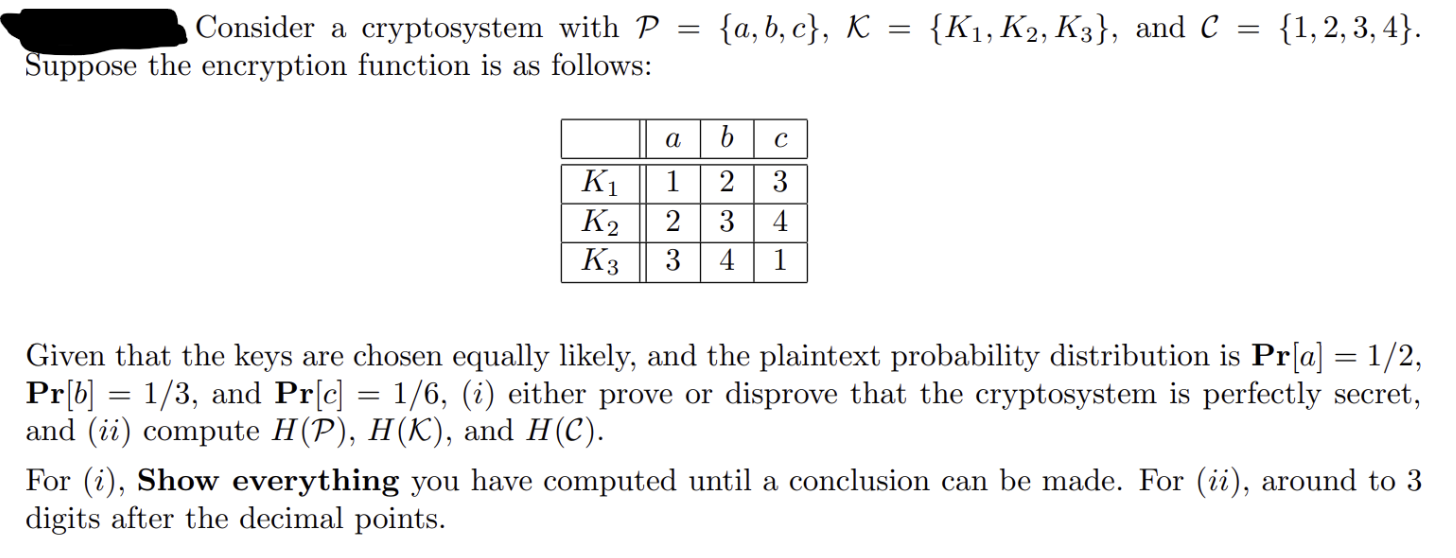
Question: answer and explain this problem Consider a cryptosystem with P={a,b,c},K={K1,K2,K3}, and C={1,2,3,4}. Suppose the encryption function is as follows: Given that the keys are chosen
 answer and explain this problem
Consider a cryptosystem with P={a,b,c},K={K1,K2,K3}, and C={1,2,3,4}. Suppose the encryption function is as follows: Given that the keys are chosen equally likely, and the plaintext probability distribution is Pr[a]=1/2, Pr[b]=1/3, and Pr[c]=1/6,(i) either prove or disprove that the cryptosystem is perfectly secret, and (ii) compute H(P),H(K), and H(C). For (i), Show everything you have computed until a conclusion can be made. For (ii), around to 3 digits after the decimal points
Step by Step Solution
There are 3 Steps involved in it
1 Expert Approved Answer
Step: 1 Unlock

Question Has Been Solved by an Expert!
Get step-by-step solutions from verified subject matter experts
Step: 2 Unlock
Step: 3 Unlock
 Study Help