



Question: answer any 4 Consider the following Ramsey model. There is an infinitely-lived representative house- hold that maximises U olog C, with parameter 3 (0, 1)
answer any 4
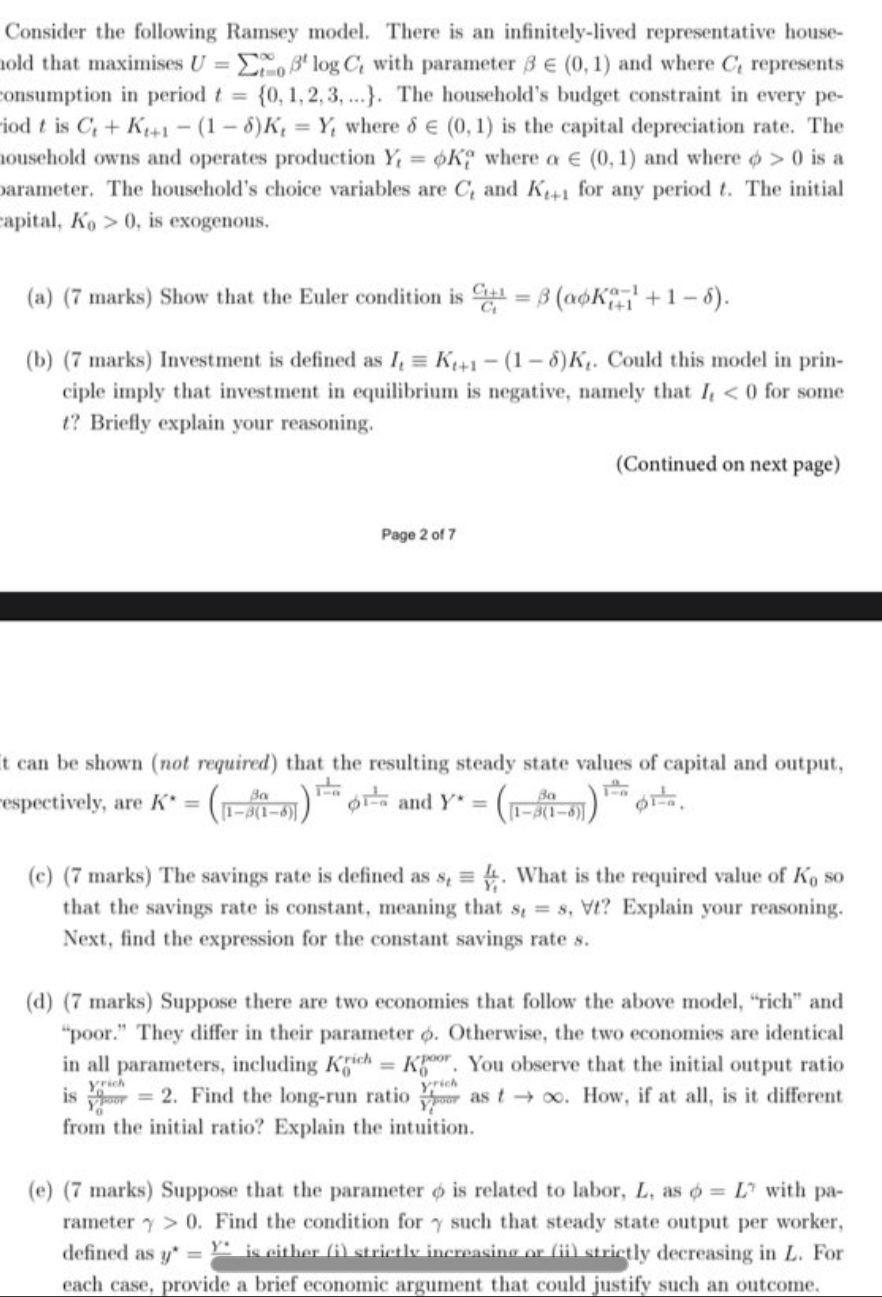
Consider the following Ramsey model. There is an infinitely-lived representative house- hold that maximises U olog C, with parameter 3 (0, 1) and where C, represents consumption in period t = {0, 1,2,3,...). The household's budget constraint in every pe- iod t is C + K+1-(1-8)K, Y, where & (0, 1) is the capital depreciation rate. The household owns and operates production Y, OK? where a (0, 1) and where > 0 is a parameter. The household's choice variables are C, and K+ for any period t. The initial capital, Ko> 0, is exogenous. = (a) (7 marks) Show that the Euler condition is 8 (ook +1-6). (b) (7 marks) Investment is defined as I = K+1-(1-6)K,. Could this model in prin- ciple imply that investment in equilibrium is negative, namely that I, 0. Find the condition for y such that steady state output per worker, defined as y'= Y is either (i) strictly increasing or (ii) strictly decreasing in L. For each case, provide a brief economic argument that could justify such an outcome. Consider the following Ramsey model. There is an infinitely-lived representative house- hold that maximises U olog C, with parameter 3 (0, 1) and where C, represents consumption in period t = {0, 1,2,3,...). The household's budget constraint in every pe- iod t is C + K+1-(1-8)K, Y, where & (0, 1) is the capital depreciation rate. The household owns and operates production Y, OK? where a (0, 1) and where > 0 is a parameter. The household's choice variables are C, and K+ for any period t. The initial capital, Ko> 0, is exogenous. = (a) (7 marks) Show that the Euler condition is 8 (ook +1-6). (b) (7 marks) Investment is defined as I = K+1-(1-6)K,. Could this model in prin- ciple imply that investment in equilibrium is negative, namely that I, 0. Find the condition for y such that steady state output per worker, defined as y'= Y is either (i) strictly increasing or (ii) strictly decreasing in L. For each case, provide a brief economic argument that could justify such an outcome
Step by Step Solution
There are 3 Steps involved in it

Get step-by-step solutions from verified subject matter experts