







Question: Answer appropriately!!! A process that polishes a mirrored surface leaves an average of 3 small flaws per 8 m2 of surface. The number of flaws
Answer appropriately!!! A process that polishes a mirrored surface leaves an average of 3 small flaws per 8 m2 of surface. The number of flaws on an area of surface follows a Poisson distribution.
a) What is the probability that a surface with area 3 m 5 m will contain more than 5 flaws?
b) What is the probability that a surface with area 2 m 3 m will contain no flaws?


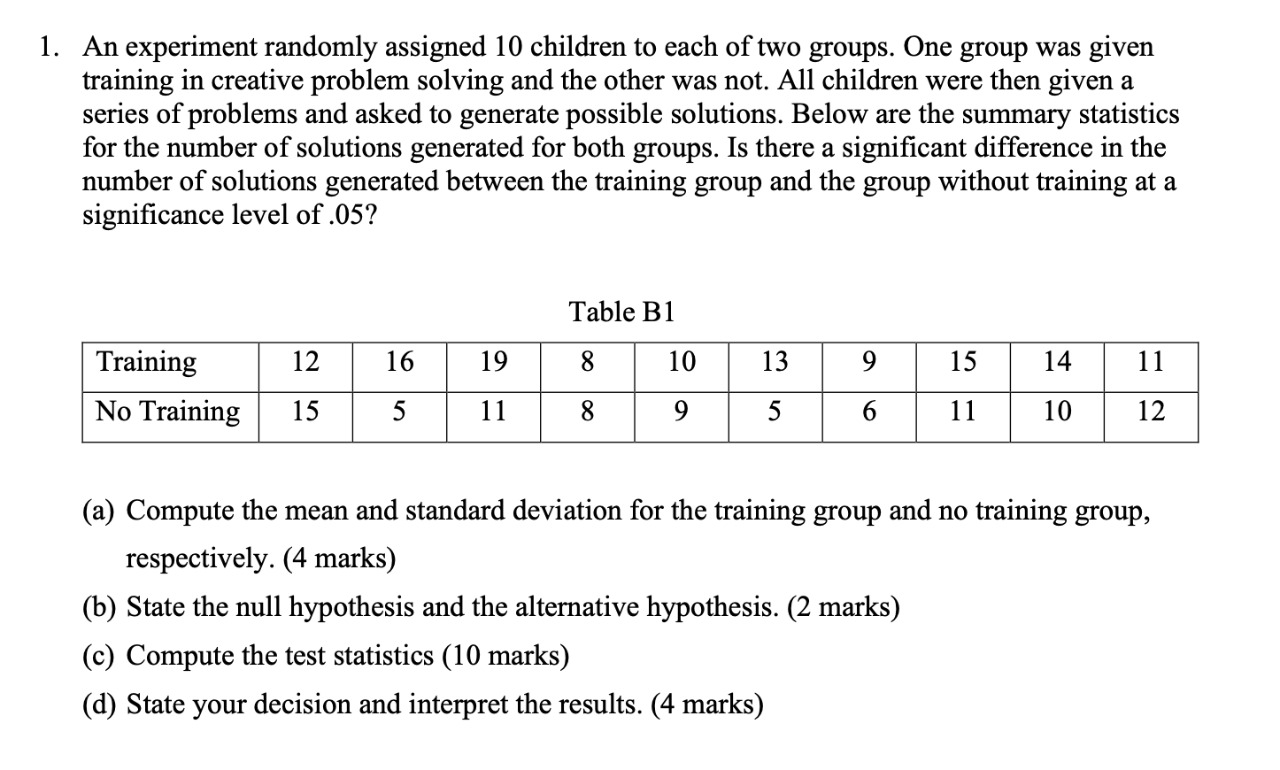
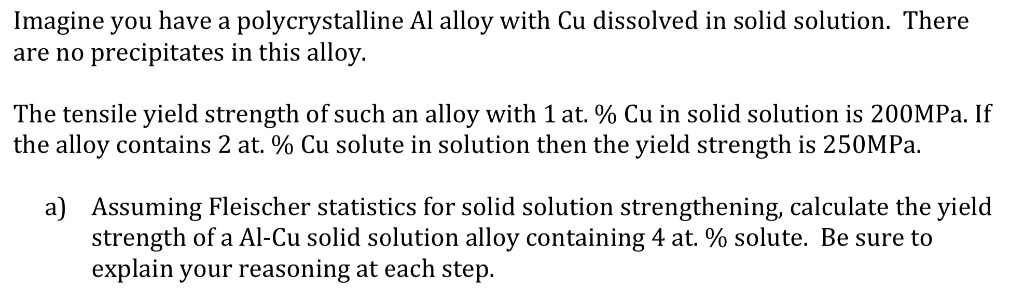
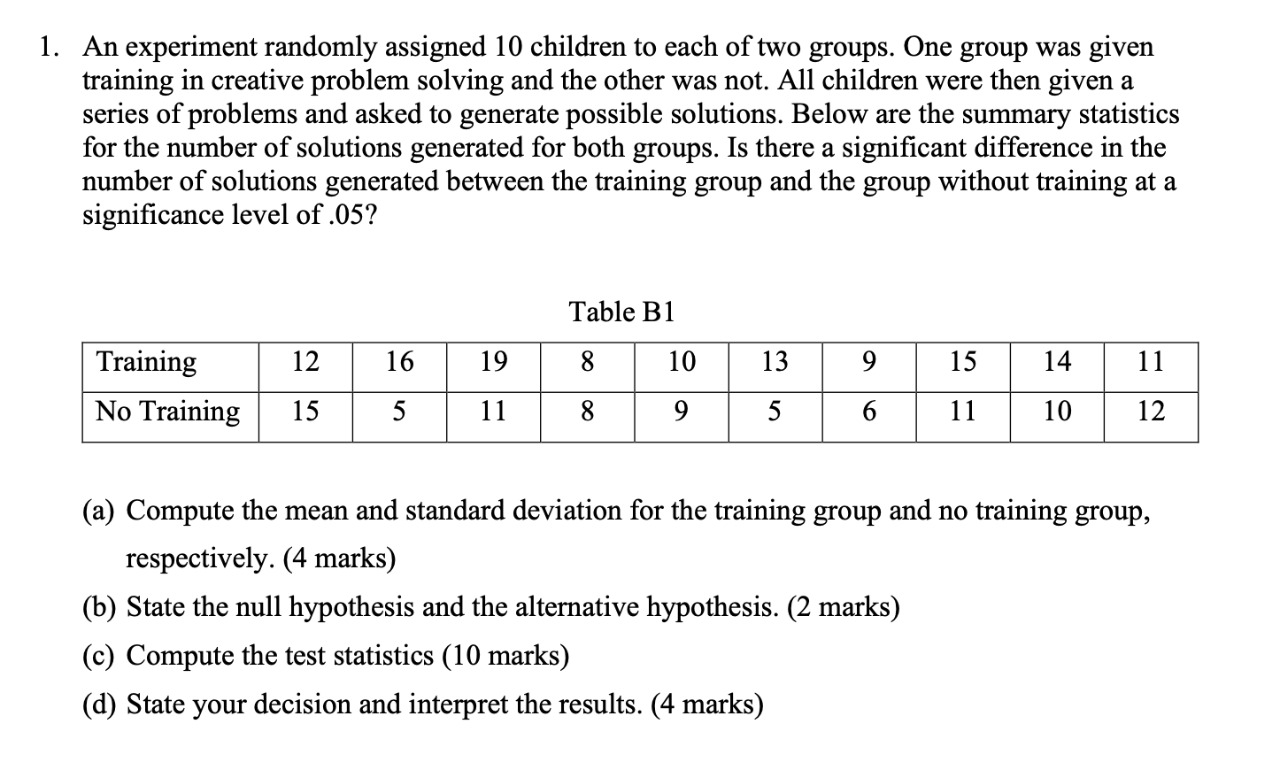
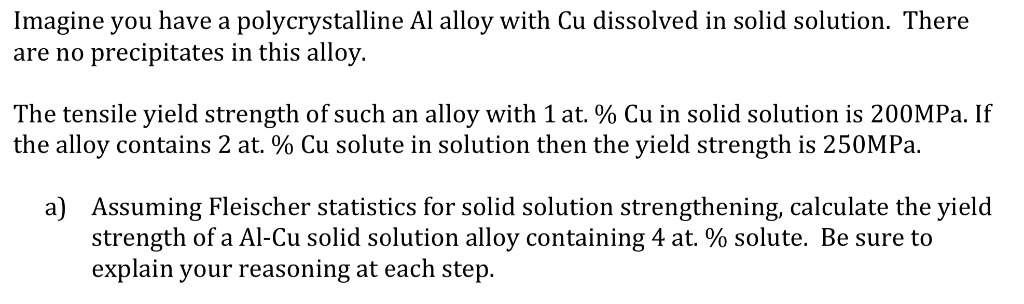
Question 4 In the new 20th century physics, O Newtonian physics could still explain the structure of atoms. O Bohr used Planck's quantum theory to propose that electrons could jump between allowed orbits. O electrons could be anywhere in relation to an atom's nucleus. O the use of statistics in theories was thought to be ultimately worthless.QUESTION 5 The concept of a sampling distribution Is essential for drawing conclusions about a population from the results of a sample. Is related to the use of probability theory in inferential statistics. Helps us use statistics to estimate the corresponding true values in the population. All of the above.1. An experiment randomly assigned 10 children to each of two groups. One group was given training in creative problem solving and the other was not. All children were then given a series of problems and asked to generate possible solutions. Below are the summary statistics for the number of solutions generated for both groups. Is there a signicant difference in the number of solutions generated between the training group and the group without training at a signicance level of .05? Table B1 mun\" "manna\" (a) Compute the mean and standard deviation for the training group and no training group, respectively. (4 marks) (b) State the null hypothesis and the alternative hypothesis. (2 marks) (c) Compute the test statistics (10 marks) (d) State your decision and interpret the results. (4 marks) Imagine you have a polycrystalline Al alloy with Cu dissolved in solid solution. There are no precipitates in this alloy. The tensile yield strength of such an alloy with 1 at. % Cu in solid solution is ZOOMPa. If the alloy contains 2 at. % Cu solute in solution then the yield strength is ZSOMPa. a) Assuming Fleischer statistics for solid solution strengthening, calculate the yield strength of a Al-Cu solid solution alloy containing 4 at. % solute. Be sure to explain your reasoning at each step
Step by Step Solution
There are 3 Steps involved in it

Get step-by-step solutions from verified subject matter experts
 Study Help