







Question: answer asap Extend Surestep's original (no backlogping) aggregate planning model from four to six monthis. Given the file p14_, 30 xisx, add a forecasted demand
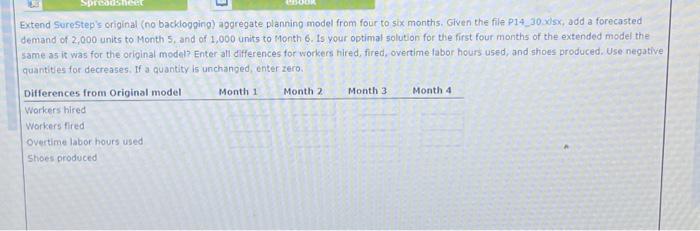
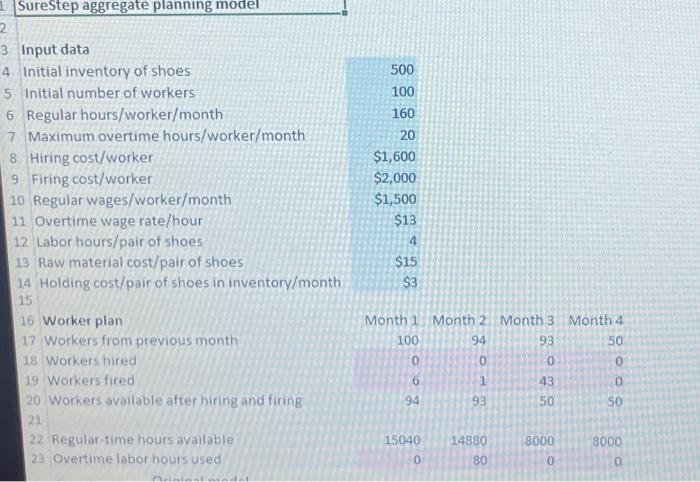
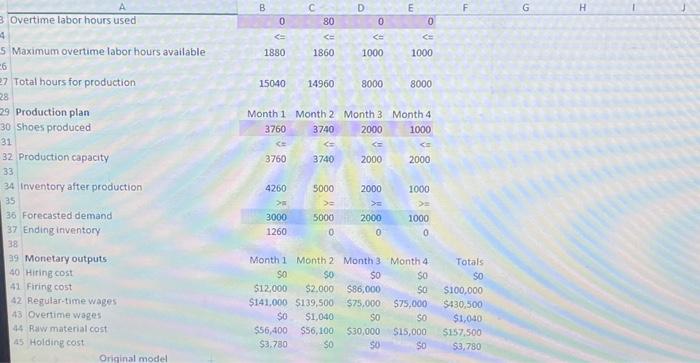
Extend Surestep's original (no backlogping) aggregate planning model from four to six monthis. Given the file p14_, 30 xisx, add a forecasted demand of 2,000 units to Month 5 , and of 1,000 units to Month 6 , Is your optimat solution for the first four months of the extended model the same as it was for the original model? Enter all differences for workers hired, fired, overtime fabor hours used, and shioes produced. Use negative quantites for decreases, If a quantity is unchanged, enter zero. 3 Input data 4 Initial inventory of shoes 5 Initial number of workers 6 Regular hours/worker/month 7 Maximum overtime hours/worker/month 500 100 160 20 $1,600 $2,000 $1,500 $13 4 $15 $3 8 Hiring cost/worker 9 Firing cost/worker 10 Regularwages/worker/month 11 Overtime wage rate/hour 12 Labor hours/pair of shoes 13 Raw material cost/pair of shoes 14 Holding cost/pair of shoes in inventory/month 15 16 Worker plan Month1 Month 2 Month 3 Month 4 17 Workers from previous month 18 Workers hired 19 Workers fired 20 Workers avallable after hiring and firing 21 22 Regular-time hours avallable 23 Overtime labor hours used 100 0 6 94 94 0 1 93 15040 14880 8000 8000 0 80 0 0 Extend Surestep's original (no backlogping) aggregate planning model from four to six monthis. Given the file p14_, 30 xisx, add a forecasted demand of 2,000 units to Month 5 , and of 1,000 units to Month 6 , Is your optimat solution for the first four months of the extended model the same as it was for the original model? Enter all differences for workers hired, fired, overtime fabor hours used, and shioes produced. Use negative quantites for decreases, If a quantity is unchanged, enter zero. 3 Input data 4 Initial inventory of shoes 5 Initial number of workers 6 Regular hours/worker/month 7 Maximum overtime hours/worker/month 500 100 160 20 $1,600 $2,000 $1,500 $13 4 $15 $3 8 Hiring cost/worker 9 Firing cost/worker 10 Regularwages/worker/month 11 Overtime wage rate/hour 12 Labor hours/pair of shoes 13 Raw material cost/pair of shoes 14 Holding cost/pair of shoes in inventory/month 15 16 Worker plan Month1 Month 2 Month 3 Month 4 17 Workers from previous month 18 Workers hired 19 Workers fired 20 Workers avallable after hiring and firing 21 22 Regular-time hours avallable 23 Overtime labor hours used 100 0 6 94 94 0 1 93 15040 14880 8000 8000 0 80 0 0
Step by Step Solution
There are 3 Steps involved in it

Get step-by-step solutions from verified subject matter experts
 Study Help