



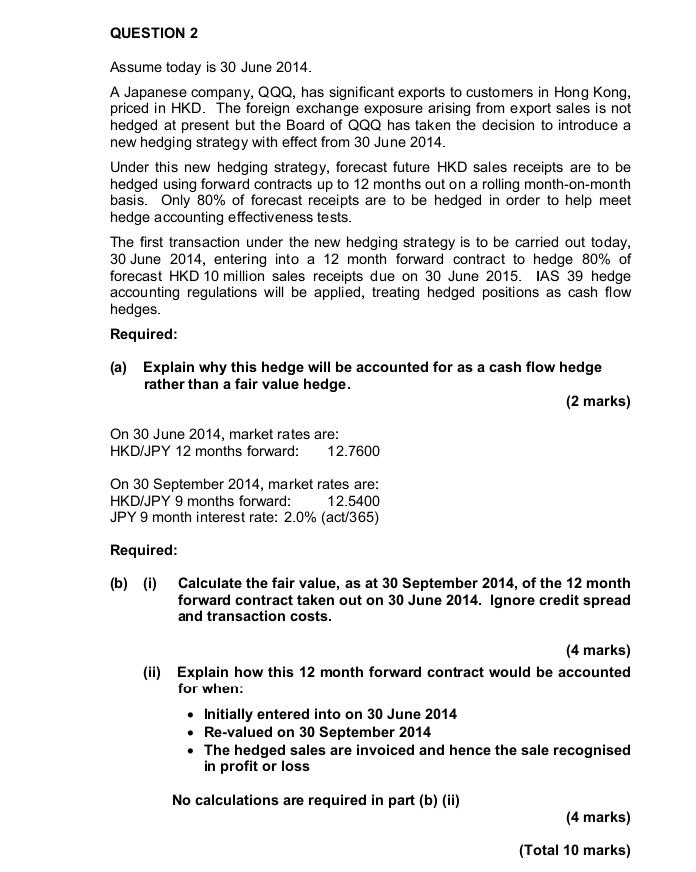
Question: Answer asap.. QUESTION 2 Assume today is 30 June 2014. A Japanese company, QQQ, has significant exports to customers in Hong Kong, priced in HKD.
Answer asap..
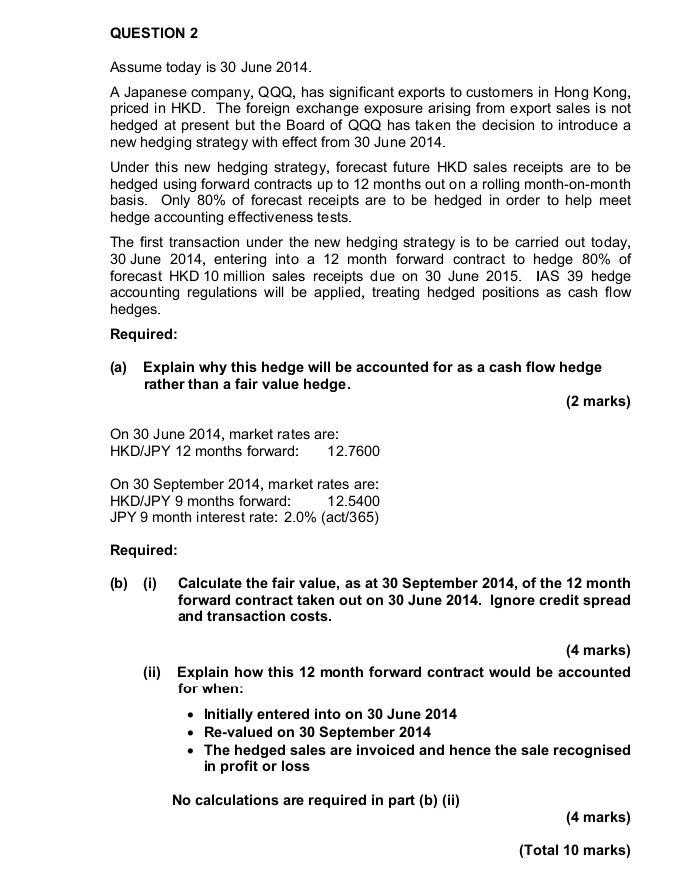
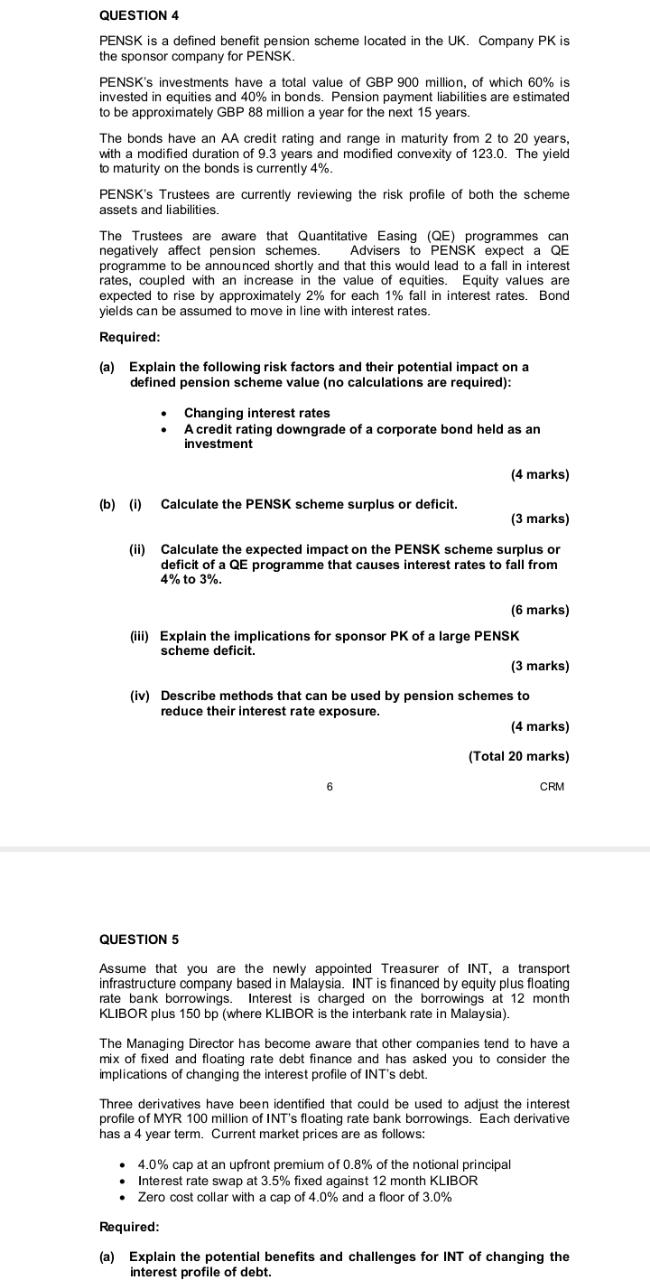
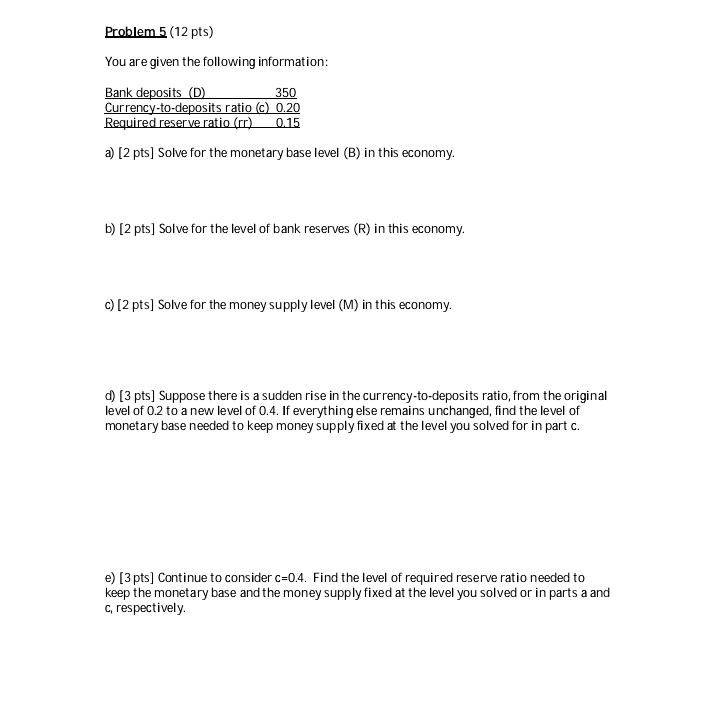
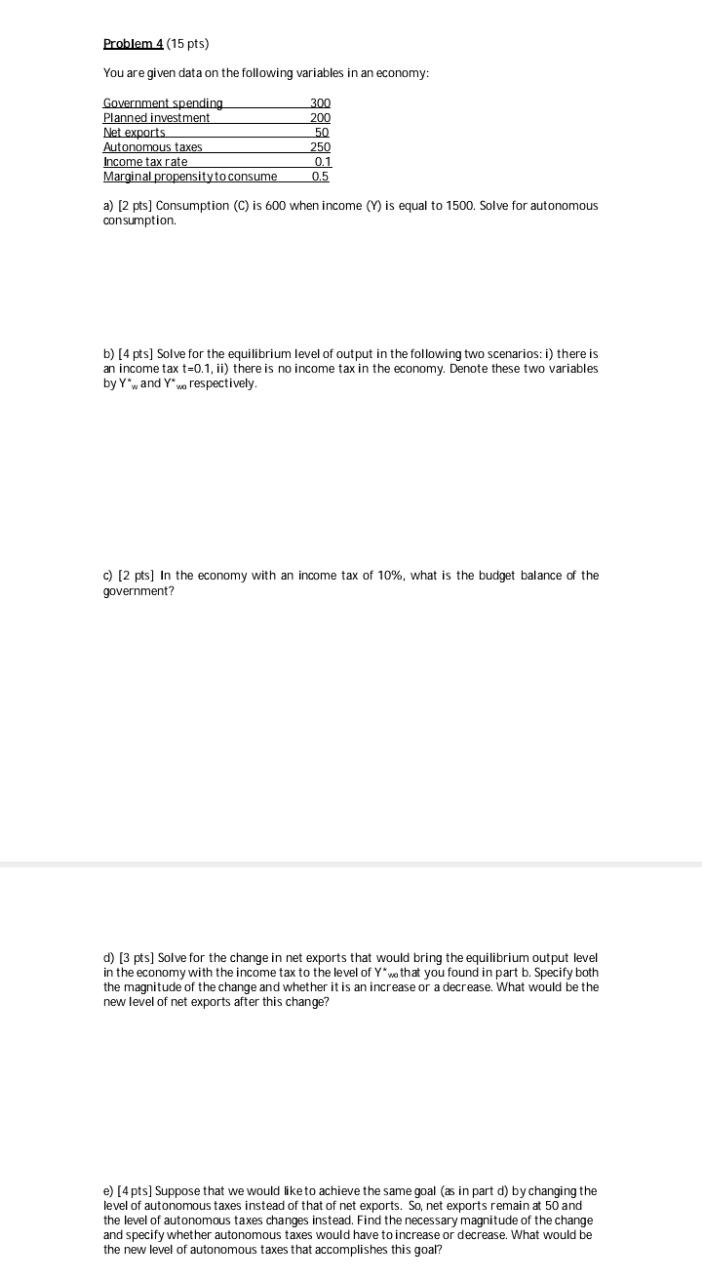
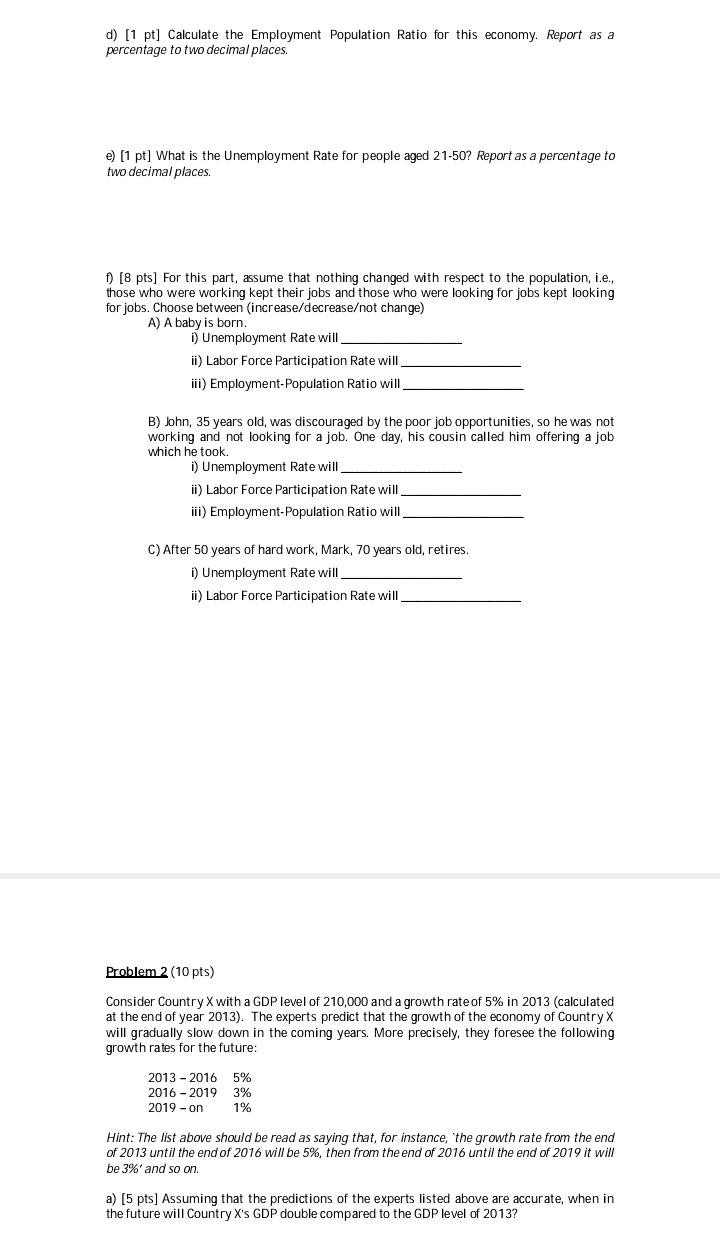
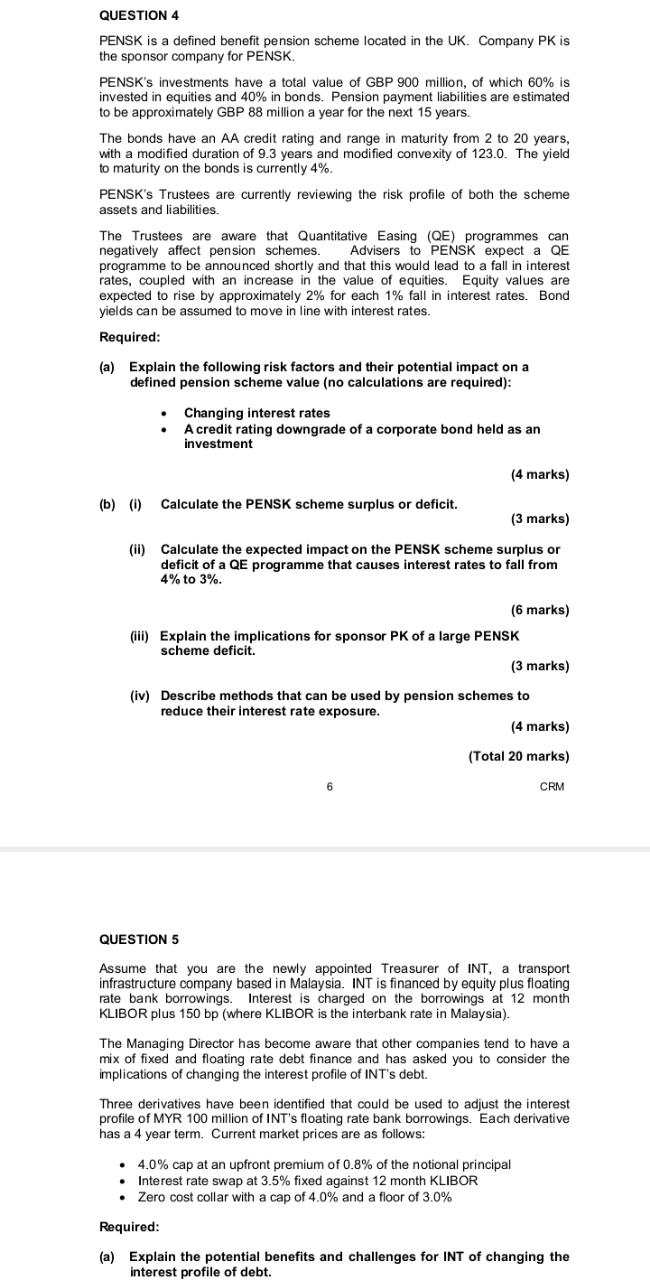
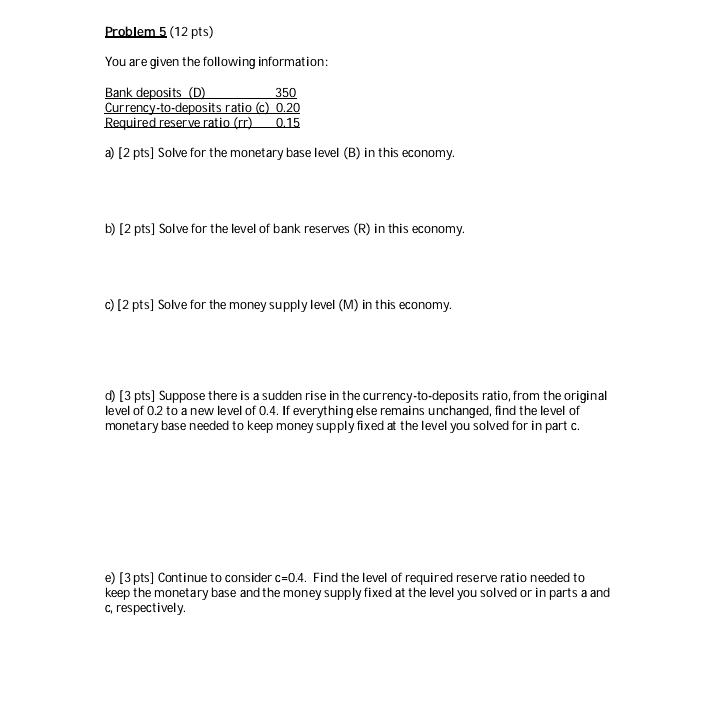
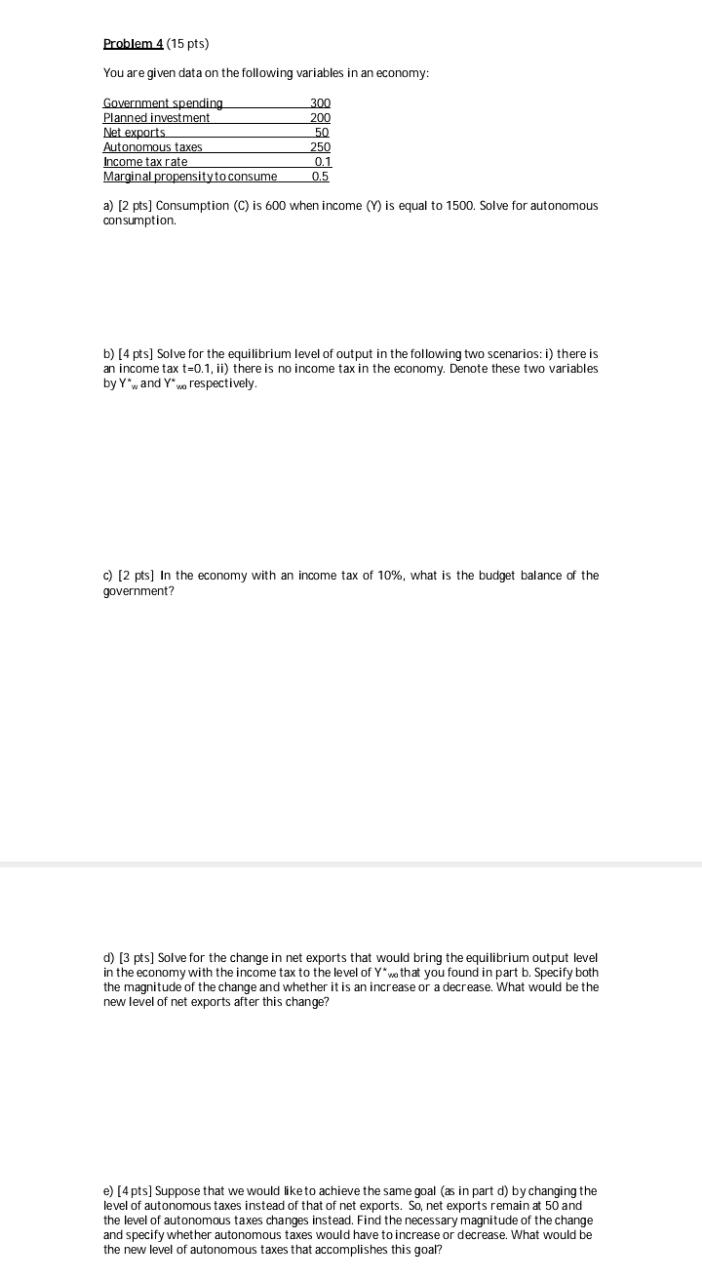
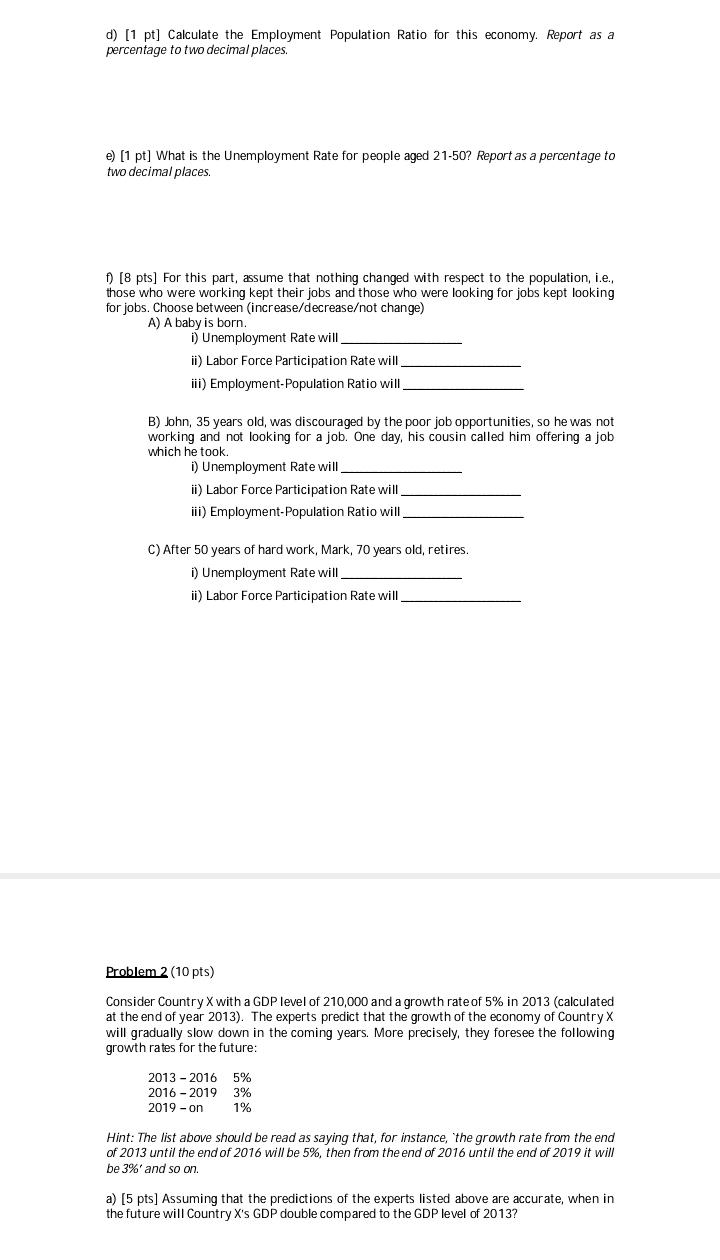
QUESTION 2 Assume today is 30 June 2014. A Japanese company, QQQ, has significant exports to customers in Hong Kong, priced in HKD. The foreign exchange exposure arising from export sales is not hedged at present but the Board of QQQ has taken the decision to introduce a new hedging strategy with effect from 30 June 2014. Under this new hedging strategy, forecast future HKD sales receipts are to be hedged using forward contracts up to 12 months out on a rolling month-on-month basis. Only 80% of forecast receipts are to be hedged in order to help meet hedge accounting effectiveness tests. The first transaction under the new hedging strategy is to be carried out today, 30 June 2014, entering into a 12 month forward contract to hedge 80% of forecast HKD 10 million sales receipts due on 30 June 2015. IAS 39 hedge accounting regulations will be applied, treating hedged positions as cash flow hedges Required: (a) Explain why this hedge will be accounted for as a cash flow hedge rather than a fair value hedge. (2 marks) On 30 June 2014, market rates are: HKD/JPY 12 months forward: 12.7600 On 30 September 2014, market rates are: HKD/JPY 9 months forward: 12.5400 JPY 9 month interest rate: 2.0% (act/365) Required: (b) (1) Calculate the fair value, as at 30 September 2014, of the 12 month forward contract taken out on 30 June 2014. Ignore credit spread and transaction costs. (4 marks) (ii) Explain how this 12 month forward contract would be accounted for when: Initially entered into on 30 June 2014 . Re-valued on 30 September 2014 The hedged sales are invoiced and hence the sale recognised in profit or loss No calculations are required in part (b) (ii) (4 marks) (Total 10 marks)QUESTION 4 PENSK is a defined benefit pension scheme located in the UK. Company PK is the sponsor company for PENSK. PENSK's investments have a total value of GBP 900 million, of which 60% is invested in equities and 40% in bonds. Pension payment liabilities are estimated to be approximately GBP 88 million a year for the next 15 years. The bonds have an AA credit rating and range in maturity from 2 to 20 years, with a modified duration of 9.3 years and modified convexity of 123.0. The yield to maturity on the bonds is currently 4%. PENSK's Trustees are currently reviewing the risk profile of both the scheme assets and liabilities. The Trustees are aware that Quantitative Easing (QE) programmes can negatively affect pension schemes. Advisers to PENSK expect a QE programme to be announced shortly and that this would lead to a fall in interest rates, coupled with an increase in the value of equities. Equity values are expected to rise by approximately 2% for each 1% fall in interest rates. Bond yields can be assumed to move in line with interest rates. Required: (a) Explain the following risk factors and their potential impact on a defined pension scheme value (no calculations are required): Changing interest rates . A credit rating downgrade of a corporate bond held as an investment (4 marks) (b) (1) Calculate the PENSK scheme surplus or deficit. (3 marks) (ii) Calculate the expected impact on the PENSK scheme surplus or deficit of a QE programme that causes interest rates to fall from 4% to 3%. (6 marks) (ili) Explain the implications for sponsor PK of a large PENSK scheme deficit. (3 marks) (iv) Describe methods that can be used by pension schemes to reduce their interest rate exposure. (4 marks) (Total 20 marks) CRM QUESTION 5 Assume that you are the newly appointed Treasurer of INT, a transport infrastructure company based in Malaysia. INT is financed by equity plus floating rate bank borrowings. Interest is charged on the borrowings at 12 month KLIBOR plus 150 bp (where KLIBOR is the interbank rate in Malaysia). The Managing Director has become aware that other companies tend to have a mix of fixed and floating rate debt finance and has asked you to consider the implications of changing the interest profile of INT's debt. Three derivatives have been identified that could be used to adjust the interest profile of MYR 100 million of INT's floating rate bank borrowings. Each derivative has a 4 year term. Current market prices are as follows: 4.0% cap at an upfront premium of 0.8% of the notional principal Interest rate swap at 3.5% fixed against 12 month KLIBOR Zero cost collar with a cap of 4.0% and a floor of 3.0% Required: (a) Explain the potential benefits and challenges for INT of changing the interest profile of debt.Problem 5 (12 pts) You are given the following information: Bank deposits (D) 350 Currency-to-deposits ratio (C) 0.20 Required reserve ratio (m) 0.15 a) [2 pts] Solve for the monetary base level (B) in this economy. b) [2 pts] Solve for the level of bank reserves (R) in this economy. c) [2 pts] Solve for the money supply level (M) in this economy. d) [3 pts] Suppose there is a sudden rise in the currency-to-deposits ratio, from the original level of 0.2 to a new level of 0.4. If everything else remains unchanged, find the level of monetary base needed to keep money supply fixed at the level you solved for in part c. e) [3 pts] Continue to consider c=0.4. Find the level of required reserve ratio needed to keep the monetary base and the money supply fixed at the level you solved or in parts a and c, respectively.Problem 4 (15 pts) You are given data on the following variables in an economy: Government spending 300 Planned investment 200 Net exports 50 Autonomous taxes 250 Income tax rate 0.1 Marginal propensity to consume 0.5 a) [2 pts] Consumption (C) is 600 when income (Y) is equal to 1500. Solve for autonomous consumption. b) [4 pts] Solve for the equilibrium level of output in the following two scenarios: i) there is an income tax t=0.1, ii) there is no income tax in the economy. Denote these two variables by Y", and Y" wo respectively. c) [2 pts] In the economy with an income tax of 10%, what is the budget balance of the government? d) [3 pts] Solve for the change in net exports that would bring the equilibrium output level in the economy with the income tax to the level of Y"we that you found in part b. Specify both the magnitude of the change and whether it is an increase or a decrease. What would be the new level of net exports after this change? e) [4 pts] Suppose that we would like to achieve the same goal (as in part d) by changing the level of autonomous taxes instead of that of net exports. So, net exports remain at 50 and the level of autonomous taxes changes instead. Find the necessary magnitude of the change and specify whether autonomous taxes would have to increase or decrease. What would be the new level of autonomous taxes that accomplishes this goal?d) [1 pt] Calculate the Employment Population Ratio for this economy. Report as a percentage to two decimal places. e) [1 pt] What is the Unemployment Rate for people aged 21-50? Report as a percentage to two decimal places. () [8 pts] For this part, assume that nothing changed with respect to the population, i.e., those who were working kept their jobs and those who were looking for jobs kept looking for jobs. Choose between (increase/decreaseot change) A) A baby is born. () Unemployment Rate will ii) Labor Force Participation Rate will iii) Employment-Population Ratio will B) John, 35 years old, was discouraged by the poor job opportunities, so he was not working and not looking for a job. One day, his cousin called him offering a job which he took. i) Unemployment Rate will ii) Labor Force Participation Rate will iii) Employment-Population Ratio will C) After 50 years of hard work, Mark, 70 years old, retires. ) Unemployment Rate will i) Labor Force Participation Rate will Problem 2 (10 pts) Consider Country X with a GDP level of 210,000 and a growth rate of 5% in 2013 (calculated at the end of year 2013). The experts predict that the growth of the economy of Country X will gradually slow down in the coming years. More precisely, they foresee the following growth rates for the future: 2013 -2016 5% 2016 - 2019 3% 2019 - on 1% Hint: The list above should be read as saying that, for instance, 'the growth rate from the end of 2013 until the end of 2016 will be 5%, then from the end of 2016 until the end of 2019 it will be 3%' and so on. a) [5 pts] Assuming that the predictions of the experts listed above are accurate, when in the future will Country X's GDP double compared to the GDP level of 2013
Step by Step Solution
There are 3 Steps involved in it

Get step-by-step solutions from verified subject matter experts