







Question: Answer both questions in this section. Each whole question carries TWENTY FIVE marks. Clearly show all your workings. 1. a. Following information is about Steady
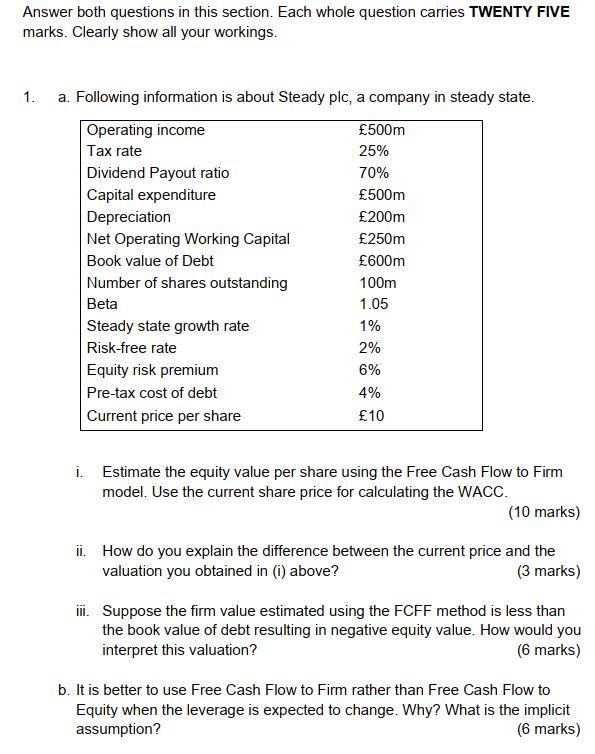
Answer both questions in this section. Each whole question carries TWENTY FIVE marks. Clearly show all your workings. 1. a. Following information is about Steady plc, a company in steady state. Operating income 500m Tax rate 25% Dividend Payout ratio 70% Capital expenditure 500m Depreciation 200m Net Operating Working Capital 250m Book value of Debt 600m Number of shares outstanding 100m Beta 1.05 Steady state growth rate 1% Risk-free rate 2% Equity risk premium 6% Pre-tax cost of debt 4% Current price per share 10 i. Estimate the equity value per share using the Free Cash Flow to Firm model. Use the current share price for calculating the WACC. (10 marks) ii. How do you explain the difference between the current price and the valuation you obtained in (i) above? (3 marks) ii. Suppose the firm value estimated using the FCFF method is less than the book value of debt resulting in negative equity value. How would you interpret this valuation? (6 marks) b. It is better to use Free Cash Flow to Firm rather than Free Cash Flow to Equity when the leverage is expected to change. Why? What is the implicit assumption? (6 marks) Answer both questions in this section. Each whole question carries TWENTY FIVE marks. Clearly show all your workings. 1. a. Following information is about Steady plc, a company in steady state. Operating income 500m Tax rate 25% Dividend Payout ratio 70% Capital expenditure 500m Depreciation 200m Net Operating Working Capital 250m Book value of Debt 600m Number of shares outstanding 100m Beta 1.05 Steady state growth rate 1% Risk-free rate 2% Equity risk premium 6% Pre-tax cost of debt 4% Current price per share 10 i. Estimate the equity value per share using the Free Cash Flow to Firm model. Use the current share price for calculating the WACC. (10 marks) ii. How do you explain the difference between the current price and the valuation you obtained in (i) above? (3 marks) ii. Suppose the firm value estimated using the FCFF method is less than the book value of debt resulting in negative equity value. How would you interpret this valuation? (6 marks) b. It is better to use Free Cash Flow to Firm rather than Free Cash Flow to Equity when the leverage is expected to change. Why? What is the implicit assumption? (6 marks)
Step by Step Solution
There are 3 Steps involved in it

Get step-by-step solutions from verified subject matter experts
 Study Help