







Question: Answer both questions. You are advised to be as analytical as possible. 1A. Define capital budgeting and explain its significance 1B. New York Corporation needs
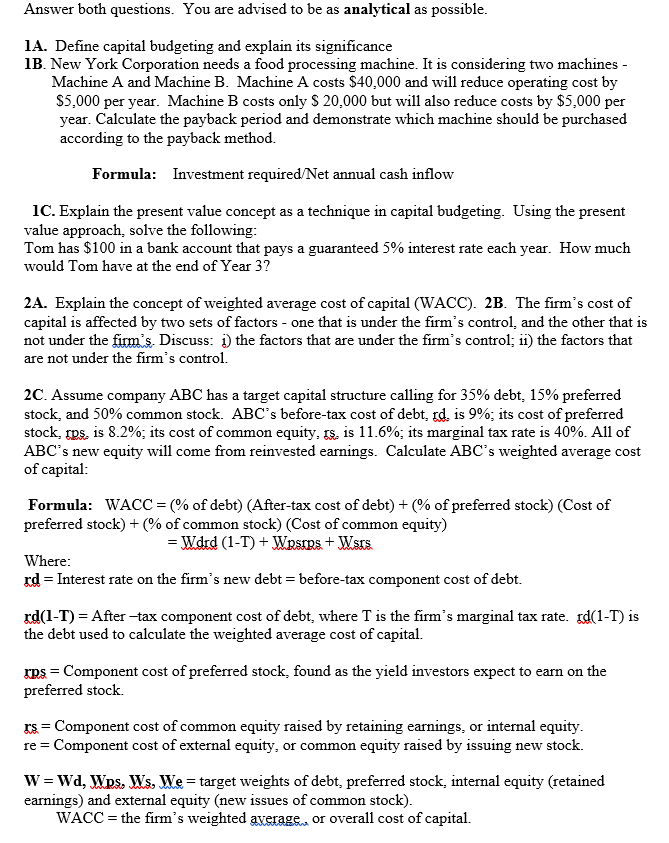
Answer both questions. You are advised to be as analytical as possible. 1A. Define capital budgeting and explain its significance 1B. New York Corporation needs a food processing machine. It is considering two machines - Machine A and Machine B. Machine A costs $40,000 and will reduce operating cost by $5,000 per year. Machine B costs only $ 20,000 but will also reduce costs by $5,000 per year. Calculate the payback period and demonstrate which machine should be purchased according to the payback method. Formula: Investment required/Net annual cash inflow 1C. Explain the present value concept as a technique in capital budgeting. Using the present value approach, solve the following: Tom has $100 in a bank account that pays a guaranteed 5% interest rate each year. How much would Tom have at the end of Year 3? 2A. Explain the concept of weighted average cost of capital (WACC). 2B. The firm's cost of capital is affected by two sets of factors - one that is under the firm's control, and the other that is not under the firm's. Discuss: 1) the factors that are under the firm's control; ii) the factors that are not under the firm's control. 2C. Assume company ABC has a target capital structure calling for 35% debt, 15% preferred stock, and 50% common stock. ABC's before-tax cost of debt, rd. is 9% its cost of preferred stock, tps. is 8.2%, its cost of common equity. is, is 11.6%, its marginal tax rate is 40%. All of ABC's new equity will come from reinvested earnings. Calculate ABC's weighted average cost of capital: Formula: WACC = (% of debt) (After-tax cost of debt) + (% of preferred stock) (Cost of preferred stock) + (% of common stock) (Cost of common equity) = Wdrd (1-1) + WRsIps. + Wars Where: rd = Interest rate on the firm's new debt = before-tax component cost of debt. rd(1-T) = After-tax component cost of debt, where T is the firm's marginal tax rate. Id(1-T) is the debt used to calculate the weighted average cost of capital. rps = Component cost of preferred stock, found as the yield investors expect to earn on the preferred stock rs = Component cost of common equity raised by retaining earnings, or internal equity. re = Component cost of external equity, or common equity raised by issuing new stock. W=wa, Wps, Ws, We = target weights of debt, preferred stock, internal equity (retained earnings) and external equity (new issues of common stock). WACC = the firm's weighted average, or overall cost of capital
Step by Step Solution
There are 3 Steps involved in it

Get step-by-step solutions from verified subject matter experts
 Study Help