







Question: answer c) and d) please 3. Consider a mean-variance investor who cannot borrow and lend at the same rate. Specifically, the investor can borrow at
answer c) and d) please
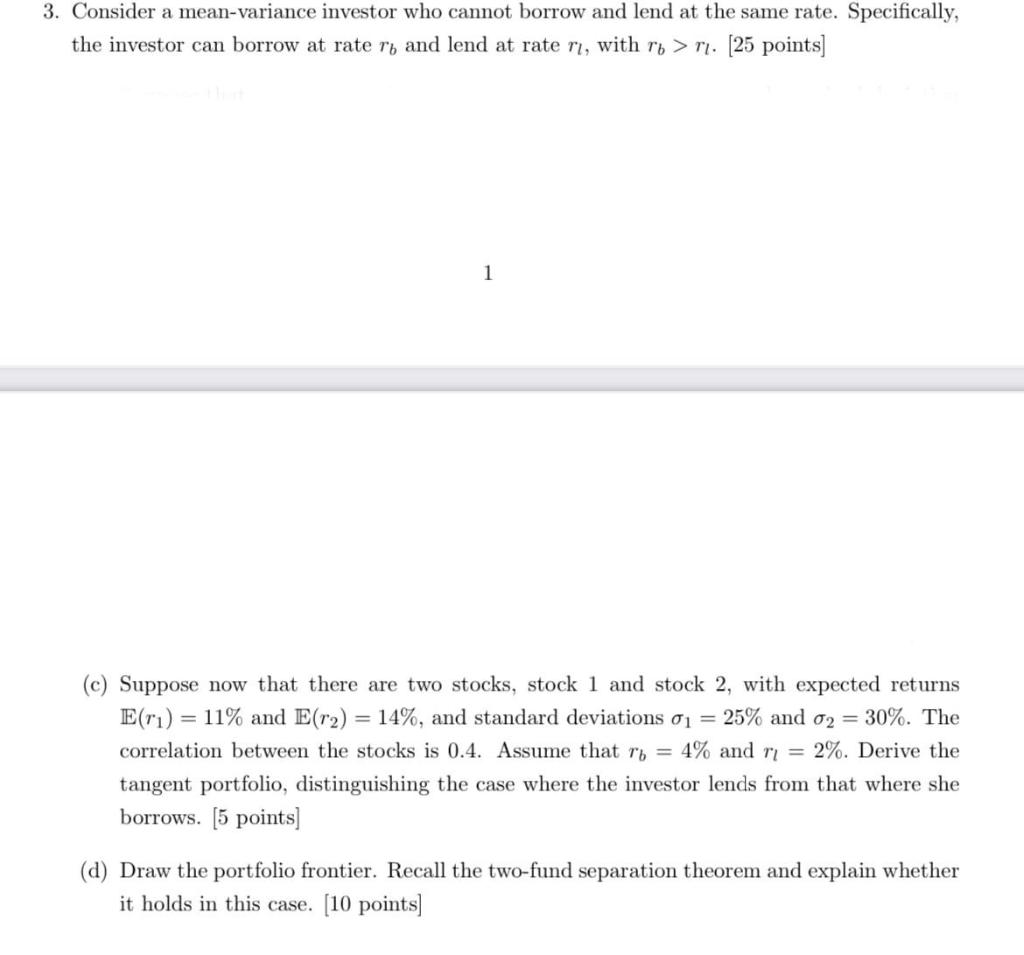
3. Consider a mean-variance investor who cannot borrow and lend at the same rate. Specifically, the investor can borrow at rate ry and lend at rate ri, with ro > r. (25 points] 1 (c) Suppose now that there are two stocks, stock 1 and stock 2, with expected returns E(r) = 11% and E(r2) = 14%, and standard deviations g1 = 25% and 02 = 30%. The correlation between the stocks is 0.4. Assume that ro = 4% and r = 2%. Derive the tangent portfolio, distinguishing the case where the investor lends from that where she borrows. [5 points) (d) Draw the portfolio frontier. Recall the two-fund separation theorem and explain whether it holds in this case. (10 points) 3. Consider a mean-variance investor who cannot borrow and lend at the same rate. Specifically, the investor can borrow at rate ry and lend at rate ri, with ro > r. (25 points] 1 (c) Suppose now that there are two stocks, stock 1 and stock 2, with expected returns E(r) = 11% and E(r2) = 14%, and standard deviations g1 = 25% and 02 = 30%. The correlation between the stocks is 0.4. Assume that ro = 4% and r = 2%. Derive the tangent portfolio, distinguishing the case where the investor lends from that where she borrows. [5 points) (d) Draw the portfolio frontier. Recall the two-fund separation theorem and explain whether it holds in this case. (10 points)
Step by Step Solution
There are 3 Steps involved in it

Get step-by-step solutions from verified subject matter experts
 Study Help