







Question: Answer c d e f only please thank you 11. Consider the linear transformation T: R3 > R3 given by reection across the line L:
Answer c d e f only please thank you
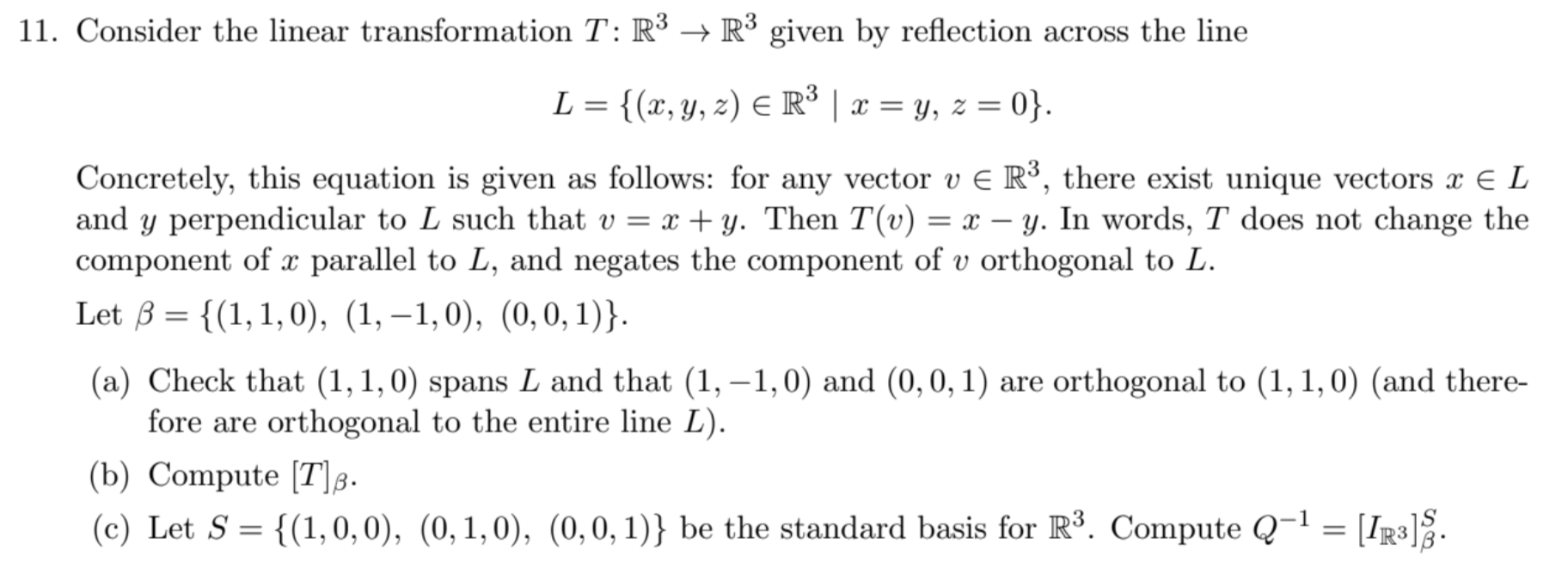
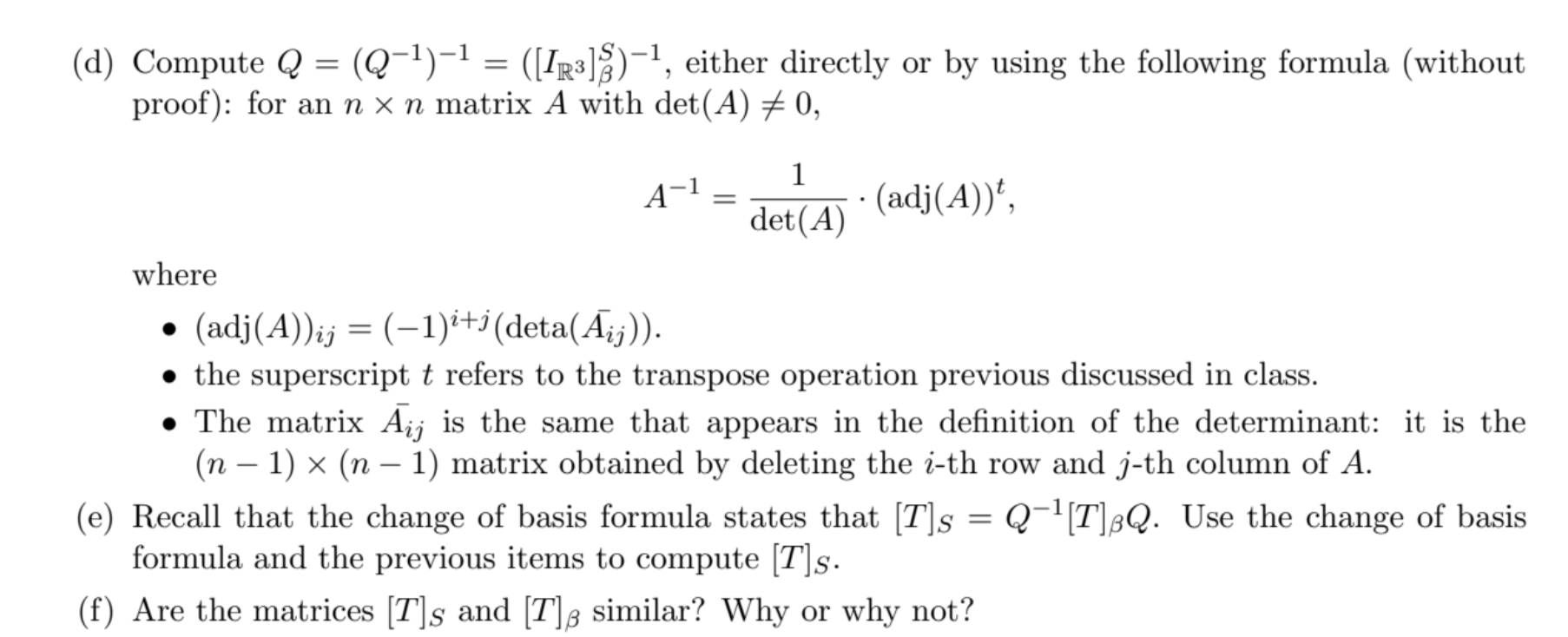
11. Consider the linear transformation T: R3 > R3 given by reection across the line L: {(m,y,z)ER3 | 3:23;, 2:0}. Concretely, this equation is given as follows: for any vector v E R3, there exist unique vectors x 6 L and y perpendicular to L such that v = a: + y. Then T(v) = a: y. In words, T does not change the component of 3: parallel to L, and negates the component of v orthogonal to L. Let g = {(1,1,0), (1,4,0), (0,0,1)}. (a) Check that (1,1,0) spans L and that (1, 1,0) and (0,0,1) are orthogonal to (1, 1,0) (and there- fore are orthogonal to the entire line L). (b) Compute [T] g. (e) Let S = {(1,0,0), (0,1,0), (0,0, 1)} be the standard basis for R3. Compute Q'1 = [IRa]g. (d) Compute Q = (Q-1)-1 = ([/R3]g)-1, either directly or by using the following formula (without proof): for an n x n matrix A with det(A) # 0, A-1 1 det (A) . (adj ( A) ), where . (adj(A))ij = (-1)iti(deta(Ajj)). . the superscript t refers to the transpose operation previous discussed in class. . The matrix Ajj is the same that appears in the definition of the determinant: it is the (n - 1) x (n - 1) matrix obtained by deleting the i-th row and j-th column of A. (e) Recall that the change of basis formula states that [T]s = Q '[T]:Q. Use the change of basis formula and the previous items to compute [Tis. (f) Are the matrices [T]s and [T]s similar? Why or why not
Step by Step Solution
There are 3 Steps involved in it

Get step-by-step solutions from verified subject matter experts
 Study Help