







Question: Answer case Questions 1 and 2. Also, discuss supply chain problems we are having, from cars to homes, who is to blame. 1. Discuss the
Answer case Questions 1 and 2. Also, discuss supply chain problems we are having, from cars to homes, who is to blame.
1. Discuss the role of SCM in retail industry. Give examples from the two cases.
2. Is Zaras competitive strategy aligned with supply chain strategy?
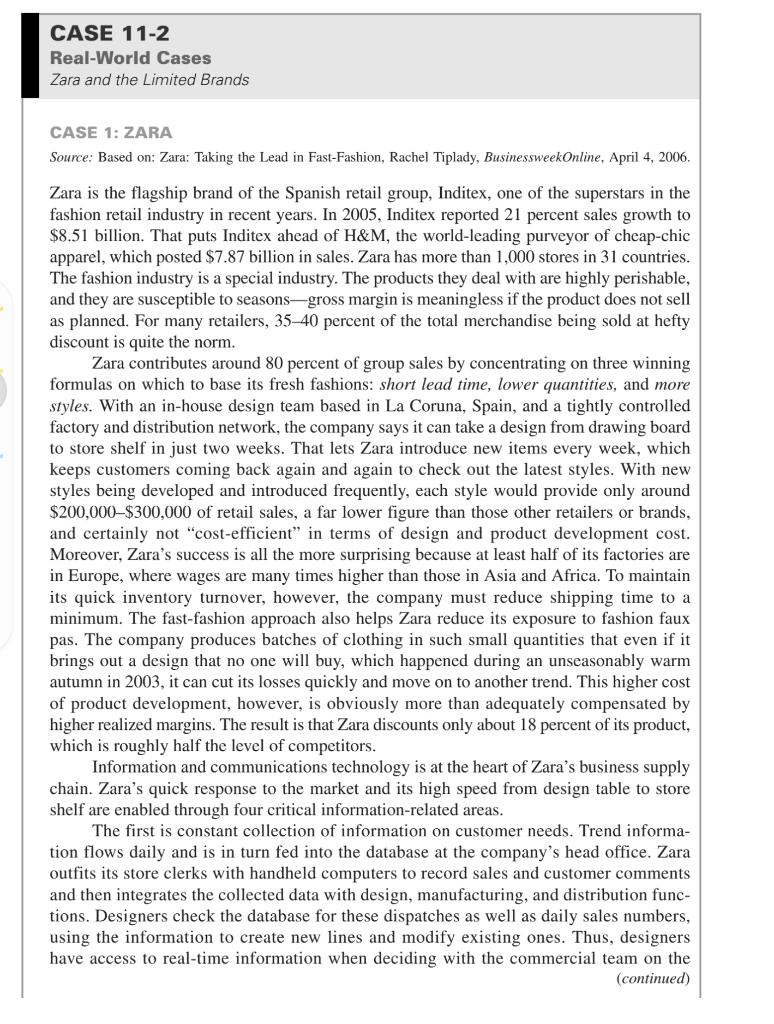
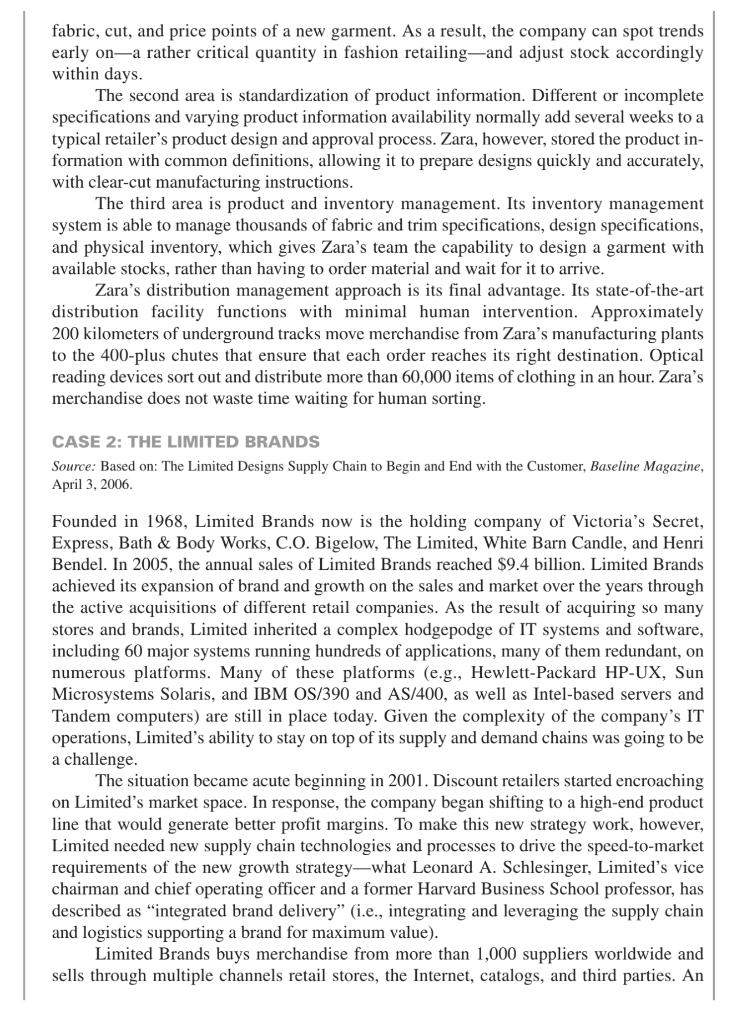
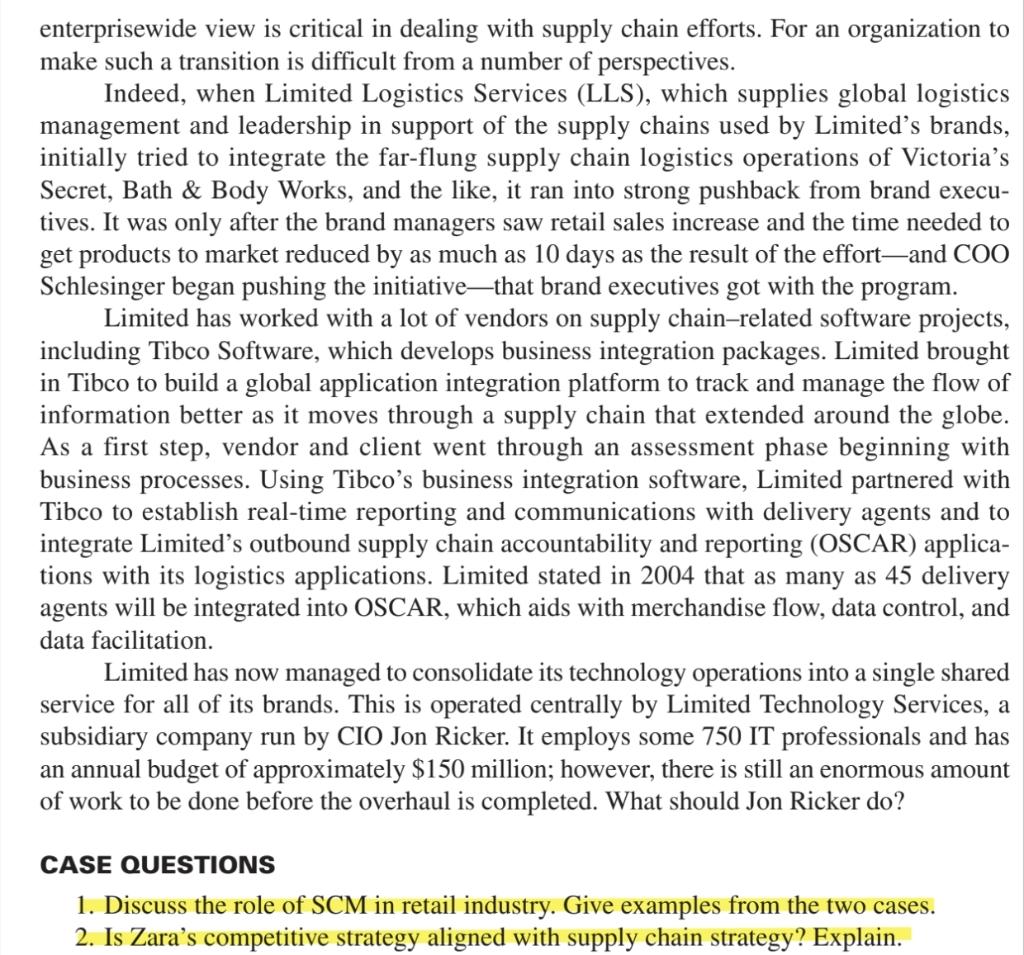
CASE 1: ZARA Source: Based on: Zara: Taking the Lead in Fast-Fashion, Rachel Tiplady, BusinessweekOnline, April 4, 2006. Zara is the flagship brand of the Spanish retail group, Inditex, one of the superstars in the fashion retail industry in recent years. In 2005, Inditex reported 21 percent sales growth to $8.51 billion. That puts Inditex ahead of H\&M, the world-leading purveyor of cheap-chic apparel, which posted $7.87 billion in sales. Zara has more than 1,000 stores in 31 countries. The fashion industry is a special industry. The products they deal with are highly perishable, and they are susceptible to seasons-gross margin is meaningless if the product does not sell as planned. For many retailers, 3540 percent of the total merchandise being sold at hefty discount is quite the norm. Zara contributes around 80 percent of group sales by concentrating on three winning formulas on which to base its fresh fashions: short lead time, lower quantities, and more styles. With an in-house design team based in La Coruna, Spain, and a tightly controlled factory and distribution network, the company says it can take a design from drawing board to store shelf in just two weeks. That lets Zara introduce new items every week, which keeps customers coming back again and again to check out the latest styles. With new styles being developed and introduced frequently, each style would provide only around $200,000$300,000 of retail sales, a far lower figure than those other retailers or brands, and certainly not "cost-efficient" in terms of design and product development cost. Moreover, Zara's success is all the more surprising because at least half of its factories are in Europe, where wages are many times higher than those in Asia and Africa. To maintain its quick inventory turnover, however, the company must reduce shipping time to a minimum. The fast-fashion approach also helps Zara reduce its exposure to fashion faux pas. The company produces batches of clothing in such small quantities that even if it brings out a design that no one will buy, which happened during an unseasonably warm autumn in 2003 , it can cut its losses quickly and move on to another trend. This higher cost of product development, however, is obviously more than adequately compensated by higher realized margins. The result is that Zara discounts only about 18 percent of its product, which is roughly half the level of competitors. Information and communications technology is at the heart of Zara's business supply chain. Zara's quick response to the market and its high speed from design table to store shelf are enabled through four critical information-related areas. The first is constant collection of information on customer needs. Trend information flows daily and is in turn fed into the database at the company's head office. Zara outfits its store clerks with handheld computers to record sales and customer comments and then integrates the collected data with design, manufacturing, and distribution functions. Designers check the database for these dispatches as well as daily sales numbers, using the information to create new lines and modify existing ones. Thus, designers have access to real-time information when deciding with the commercial team on the (continued) fabric, cut, and price points of a new garment. As a result, the company can spot trends early on-a rather critical quantity in fashion retailing-and adjust stock accordingly within days. The second area is standardization of product information. Different or incomplete specifications and varying product information availability normally add several weeks to a typical retailer's product design and approval process. Zara, however, stored the product information with common definitions, allowing it to prepare designs quickly and accurately, with clear-cut manufacturing instructions. The third area is product and inventory management. Its inventory management system is able to manage thousands of fabric and trim specifications, design specifications, and physical inventory, which gives Zara's team the capability to design a garment with available stocks, rather than having to order material and wait for it to arrive. Zara's distribution management approach is its final advantage. Its state-of-the-art distribution facility functions with minimal human intervention. Approximately 200 kilometers of underground tracks move merchandise from Zara's manufacturing plants to the 400-plus chutes that ensure that each order reaches its right destination. Optical reading devices sort out and distribute more than 60,000 items of clothing in an hour. Zara's merchandise does not waste time waiting for human sorting. CASE 2: THE LIMITED BRANDS Source: Based on: The Limited Designs Supply Chain to Begin and End with the Customer, Baseline Magazine, April 3, 2006. Founded in 1968, Limited Brands now is the holding company of Victoria's Secret, Express, Bath \& Body Works, C.O. Bigelow, The Limited, White Barn Candle, and Henri Bendel. In 2005, the annual sales of Limited Brands reached $9.4 billion. Limited Brands achieved its expansion of brand and growth on the sales and market over the years through the active acquisitions of different retail companies. As the result of acquiring so many stores and brands, Limited inherited a complex hodgepodge of IT systems and software, including 60 major systems running hundreds of applications, many of them redundant, on numerous platforms. Many of these platforms (e.g., Hewlett-Packard HP-UX, Sun Microsystems Solaris, and IBM OS/390 and AS/400, as well as Intel-based servers and Tandem computers) are still in place today. Given the complexity of the company's IT operations, Limited's ability to stay on top of its supply and demand chains was going to be a challenge. The situation became acute beginning in 2001. Discount retailers started encroaching on Limited's market space. In response, the company began shifting to a high-end product line that would generate better profit margins. To make this new strategy work, however, Limited needed new supply chain technologies and processes to drive the speed-to-market requirements of the new growth strategy-what Leonard A. Schlesinger, Limited's vice chairman and chief operating officer and a former Harvard Business School professor, has described as "integrated brand delivery" (i.e., integrating and leveraging the supply chain and logistics supporting a brand for maximum value). Limited Brands buys merchandise from more than 1,000 suppliers worldwide and sells through multiple channels retail stores, the Internet, catalogs, and third parties. An enterprisewide view is critical in dealing with supply chain efforts. For an organization to make such a transition is difficult from a number of perspectives. Indeed, when Limited Logistics Services (LLS), which supplies global logistics management and leadership in support of the supply chains used by Limited's brands, initially tried to integrate the far-flung supply chain logistics operations of Victoria's Secret, Bath \& Body Works, and the like, it ran into strong pushback from brand executives. It was only after the brand managers saw retail sales increase and the time needed to get products to market reduced by as much as 10 days as the result of the effort-and COO Schlesinger began pushing the initiative - that brand executives got with the program. Limited has worked with a lot of vendors on supply chain-related software projects, including Tibco Software, which develops business integration packages. Limited brought in Tibco to build a global application integration platform to track and manage the flow of information better as it moves through a supply chain that extended around the globe. As a first step, vendor and client went through an assessment phase beginning with business processes. Using Tibco's business integration software, Limited partnered with Tibco to establish real-time reporting and communications with delivery agents and to integrate Limited's outbound supply chain accountability and reporting (OSCAR) applications with its logistics applications. Limited stated in 2004 that as many as 45 delivery agents will be integrated into OSCAR, which aids with merchandise flow, data control, and data facilitation. Limited has now managed to consolidate its technology operations into a single shared service for all of its brands. This is operated centrally by Limited Technology Services, a subsidiary company run by CIO Jon Ricker. It employs some 750 IT professionals and has an annual budget of approximately $150 million; however, there is still an enormous amount of work to be done before the overhaul is completed. What should Jon Ricker do? CASE QUESTIONS 1. Discuss the role of SCM in retail industry. Give examples from the two cases. 2. Is Zara's competitive strategy aligned with supply chain strategy? Explain
Step by Step Solution
There are 3 Steps involved in it

Get step-by-step solutions from verified subject matter experts
 Study Help