Question: answer clearly step by step 12. Consider two stations in series. Each is composed of a single machine that requires a rather lengthy setup. Large

answer clearly step by step
answer clearly step by step 12. Consider twoanswer clearly step by step 12. Consider two
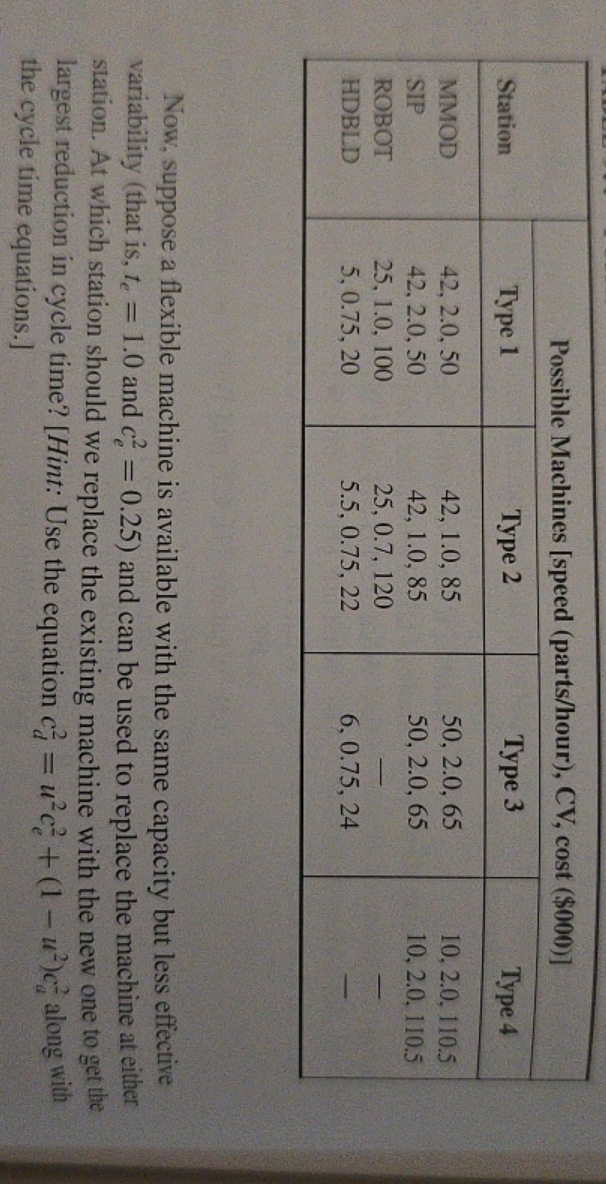
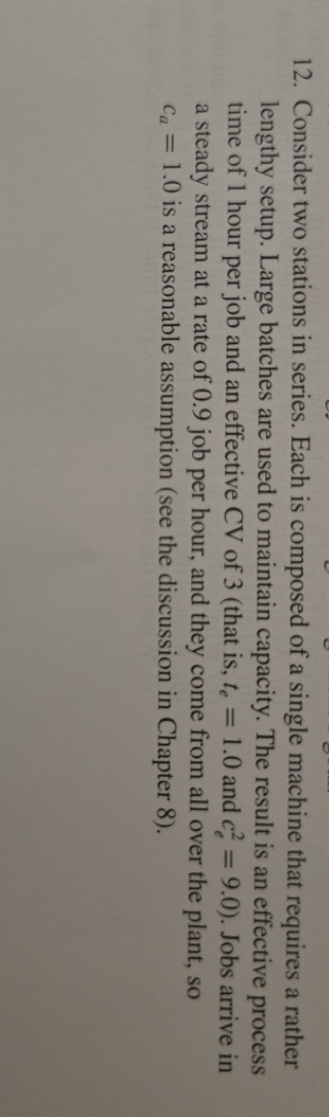
12. Consider two stations in series. Each is composed of a single machine that requires a rather lengthy setup. Large batches are used to maintain capacity. The result is an effective process time of 1 hour per job and an effective CV of 3 (that is, to = 1.0 and c? = 9.0). Jobs arrive in a steady stream at a rate of 0.9 job per hour, and they come from all over the plant, so Ca = 1.0 is a reasonable assumption (see the discussion in Chapter 8).Possible Machines [speed (parts/hour), CV, cost ($000) ] Station Type 1 Type 2 Type 3 Type 4 MMOD 42, 2.0, 50 42, 1.0, 85 50, 2.0, 65 10, 2.0. 110.5 SIP 42. 2.0. 50 42, 1.0, 85 50, 2.0, 65 10, 2.0. 110.5 ROBOT 25, 1.0, 100 25, 0.7, 120 HDBLD 5, 0.75, 20 5.5, 0.75, 22 6, 0.75, 24 Now, suppose a flexible machine is available with the same capacity but less effective variability (that is, te = 1.0 and c. = 0.25) and can be used to replace the machine at either station. At which station should we replace the existing machine with the new one to get the largest reduction in cycle time? [Hint: Use the equation c2 = u c? + (1 - u?)c- along with the cycle time equations. ]

Step by Step Solution

There are 3 Steps involved in it

1 Expert Approved Answer
Step: 1 Unlock blur-text-image

Question Has Been Solved by an Expert!

Get step-by-step solutions from verified subject matter experts

Step: 2 Unlock
Step: 3 Unlock

Students Have Also Explored These Related Law Questions!