







Question: Answer correctly... 1. Consider an individual with preferences? N, dened over two commodities, money,m , and TVs, a. While no can he consumed in any
Answer correctly...
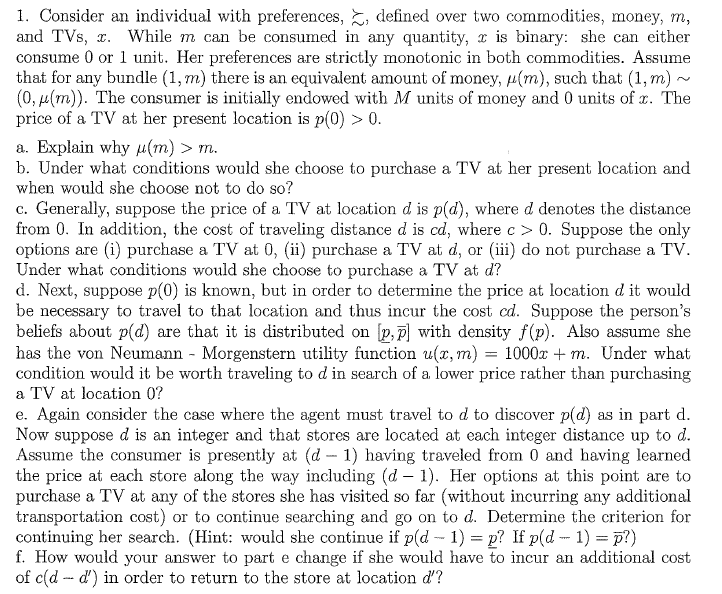
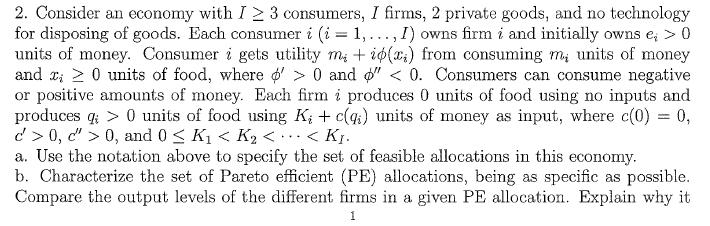
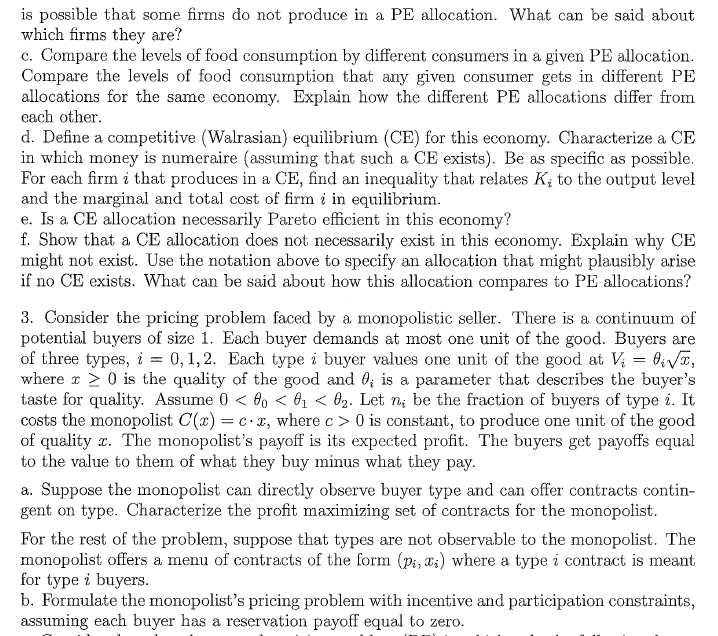
1. Consider an individual with preferences? N, dened over two commodities, money,m , and TVs, a. While no can he consumed in any quantity, :1: is binary: she can either consume D or 1 unit. Her preferences are strictly monotonic in both commodities. Assume that for any bundle [1, at} there is an equivalent amount of money, afar), such that (1, m] w (ill, Marl}. The consumer is initially endowed with M units of money and [I units of 1:. The price of a TV at her present location is pl] a D. a. Explain why slim} } an h. Under what conditions would she choose to purchase a TV at her present location and when would she choose not to do so? c. Generally, suppose the price of a. TV at location d is pEd}, where oi denotes the distance from 0. In addition, the cost of traveling distance d is ed, where c I": ll. Suppose the only options are [i } purchase a TV at D,{i.1} purchase a TV at hi, or {iii} do not purchase a. TV. Under what conditions would she choose to purchase a TV at d? (1. Next, suppose p() is known, but in order to determine the price at location d it would be necessary to travel to that location and thus incur the cost cri. Suppose the person's beliefs about p(d} are that it is distributed on [3p] with density p}. Also assume she has the yon Neumann ~ Morgenstern utility function n(n, in.) = l'ilar + m. Under what condition would it be worth traveling to d in search of a lower price rather than purchasing a TV at location 0? e. Again consider the case where the agent must travel to d to discover grid} as in part d. Now suppose d is an integer and that stores are located at each integer distance up to d. Amara the consumer is presently at (d 1) having traveled from i] and having learned the price at each store along the way including (at 1). Her options at this point are to purchase a TV at any of the stores she has visited so far (without incurring any additional transportation cost} or to continue searching and go on to d. Determine the criterion for continuing her search. (Hint: would she continue if pfd - 1) = p? If p[d w 1):;111?) f. How would your answer to part a change if she would have to incur an additional cost of c[d ~ d'} in order to return to the store at location If? 2. Consider an economy with I l}; 3 consumers, I rms, 2 private goods, and no technology for disposing of goods. Each consumer i (2'. = 1, . . . , I) owns rm i and initially owns a, :9 units of money. Consumer t' gets utilitj,r 111,; + ies} from consuming on units of money and It 3-: {I units of food, where qt' :2: U and e5\" 6.: [1. Consumers can consume negative or positive amounts of money. Each rm i producm IJ units of food using no inputs and produces q,- .'.> 0 units of food using Kg + c(q,;) units of mono-:1F as input, where cm) = , Cr},0}i],.di:K1{.Kg'CH'iKI. a. Use the notation above to specify the set of feasible allocations in this economy. I). Characterize the set of Pareto eicient {PE} allocations, being as specic as possible. Compare the output levels of the different rms in a given PE allocation. Explain why it 1 is possible that some rms do not produce in a PE allocation. 1'uiil'hal; can be said about which rms they are? c. Compare the levels of food consumption by di'ercnt consumers in a given PE allocation. Compare the levels of food consumption that any given consumer gets in different PE allocations for the same economy. Explain how the di'erent PE allocations dier hem each other. d. Dene a. competitive {Walrasian} equilibrium {CE} for this economy. Characterize a CE in which money is numeraire {assuming that such a GE exists). Be as specic as possible. For each rm a. that produces in a GE, nd an inequality that relates If; to the output level and the marginal and total cost of rm i in equilibrium. e. IS a GE allocation necessarily Pareto eicient in this economy? f. Show that a GE allocation does not necessarily eadst in this economy. Ehrplain why CE might not exist. Use the notation above to specify an allocation that might plausibly arise if no CE exists. 'What can be said about how this allocation compares to PE allocations? 3. Consider the pricing problem faced by a monopolistic seller. There is a continuum of potential buyers of. size 1. Each buyer demands at most one unit of the good. Buyers are of three types, at = 0,1,2. Each type i buyer values one unit of the good at 1"; = r, where a: 2 U is the quality of the good and 3,; is a parameter that describe: the buyer's taste for quality. Assume [l a EU a: 31 a: 33. Let n; be the traction of buyers of type i. It costs the monopolist C(ar} = c - a, where c :5 {l is constant, to produce one unit of the good of quality I. The monopolist's payo is its expected prot. The buyers get payo's equal to the value to them of what they buy minus what they pay. a. Suppose the monopolist can directly observe buyer type and can offer contracts contin- gent on type. Characterize the prot maximizing set of contracts for the monopolist. For the rest of the problem, suppose that types are not observable to the monopolist. The monopolist offers a menu of contracts of the form (pr, as] where a type 13 contract is meant for type t buyers. b. Formulate the monopolist's pricing problem with incentive and participation constraints, assuming each buyer has a reservation payo canal to zero. and
Step by Step Solution
There are 3 Steps involved in it

Get step-by-step solutions from verified subject matter experts
 Study Help