







Question: PROBLEM 4.3.* Suppose that a continuous-time sinusoid (t) is sampled at a sampling rate of 6000 samples/sec, resulting in the following discrete-time signal: x[n]
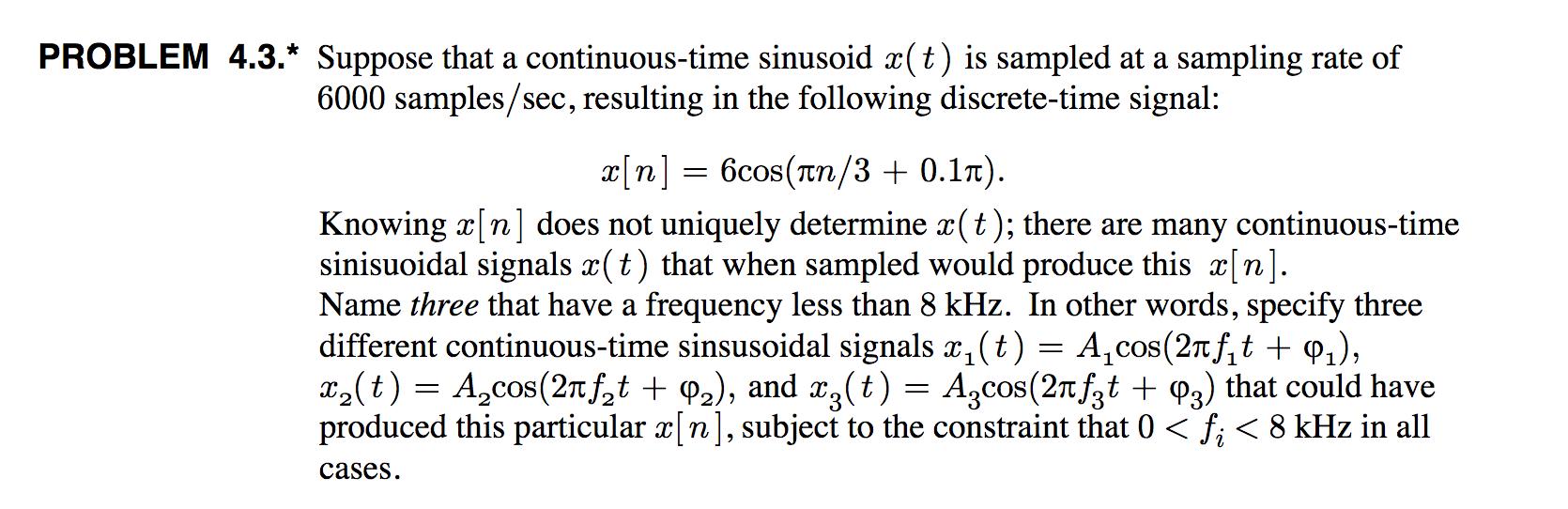
PROBLEM 4.3.* Suppose that a continuous-time sinusoid (t) is sampled at a sampling rate of 6000 samples/sec, resulting in the following discrete-time signal: x[n] = 6cos(n/3 + 0.1). Knowing x[n] does not uniquely determine x(t); there are many continuous-time sinisuoidal signals x( t) that when sampled would produce this x[n]. Name three that have a frequency less than 8 kHz. In other words, specify three different continuous-time sinsusoidal signals x(t) Acos (2ft+ 9), x(t) = Acos (2ft +9), and x3(t) = Acos(2nft +93) that could have produced this particular x[n], subject to the constraint that 0 < f; < 8 kHz in all cases. =
Step by Step Solution
There are 3 Steps involved in it
660 x n 6 cos 01x fo 6000 samplessec 1 x t Acos 2xfit 1 t mfs 11 Here x n A cos axf... View full answer

Get step-by-step solutions from verified subject matter experts
 Study Help