Question: Answer Document 2 CRQ Set 2 Directions (32-34b): Analyze the documents and answer the short-answer questions tha Deng Xiaoping was the most powerful leader in
Answer
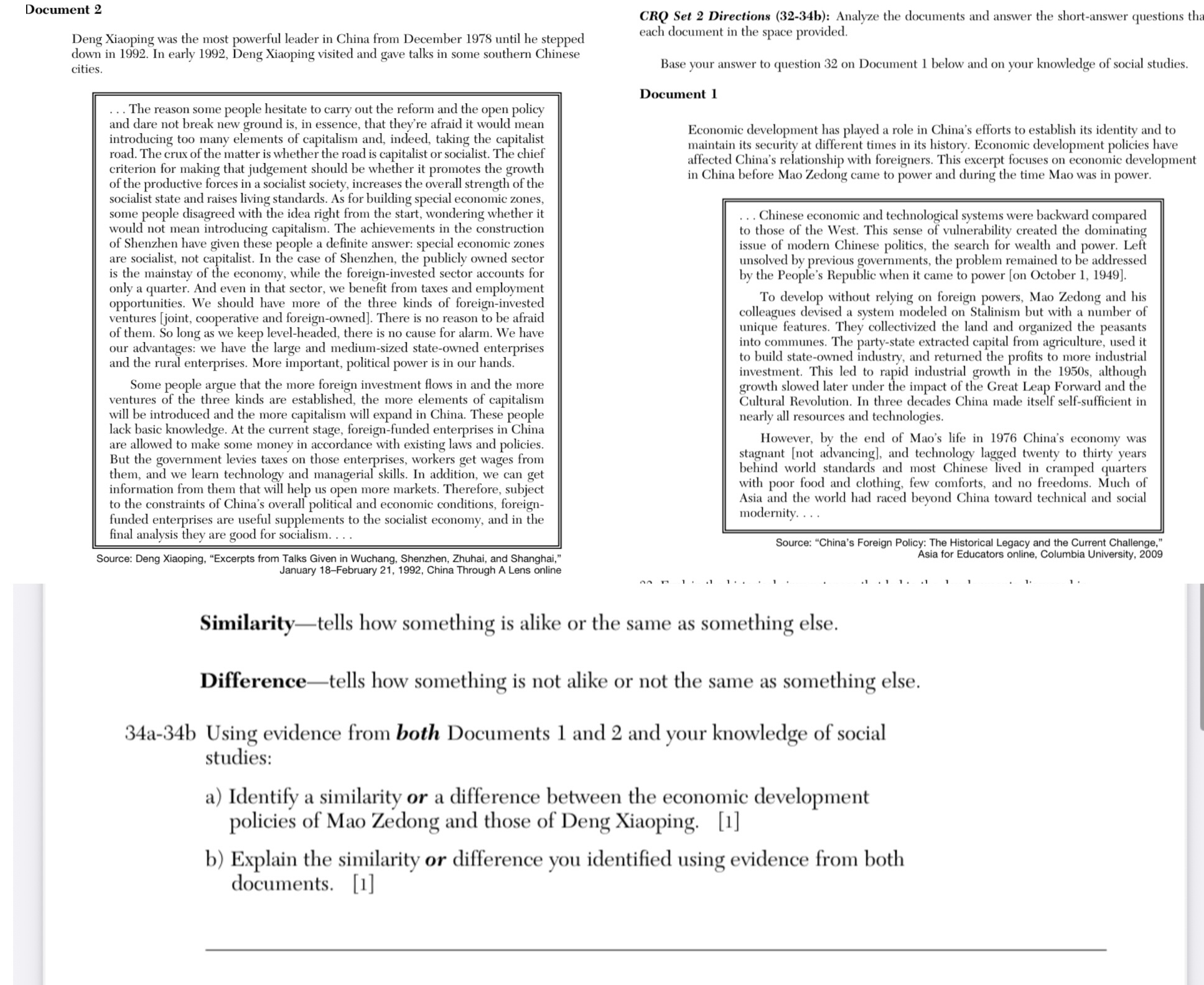
Document 2 CRQ Set 2 Directions (32-34b): Analyze the documents and answer the short-answer questions tha Deng Xiaoping was the most powerful leader in China from December 1978 until he stepped each document in the space provided. down in 1992. In early 1992, Deng Xiaoping visited and gave talks in some southern Chinese cities Base your answer to question 32 on Document 1 below and on your knowledge of social studies, Document 1 ... The reason some people hesitate to carry out the reform and the open policy = a new ground ea oo ae a un 'ealiet Economic development has played a role in China's efforts to establish its identity and to um a The aie ithe 4 o ha the ie am aie ? seuli Thy } io maintain its security at different times in its history. Economic development policies have Roache nuk OF ie matter i waether fie road by capitalist or socialist: he ci affected China's relationship with foreigners. This excerpt focuses on economic development criterion for making that judgement should be whether it promotes the growth of the productive forces in a socialist society, increases the overall strength of the socialist state and raises living standards. As for building special economic zones, some people disagreed with the idea right from the start, wondering whether it would not mean introducing capitalism. The achievements in the construction of Shenzhen have given these people a definite answer: special economic zones are socialist, not capitalist. In the case of Shenzhen, the publicly owned sector is the mainstay of the economy, while the foreign-invested sector accounts for only a quarter. And even in that sector, we benefit from taxes and employment opportunities. We should have more of the three kinds of foreign-invested ventures [joint, cooperative and foreign-owned]. There is no reason to be afraid of them. So long as we keep level-headed, there is no cause for alarm. We have our advantages: we have the large and medium-sized state-owned enterprises and the rural enterprises. More important, political power is in our hands. Some people argue that the more foreign investment flows in and the more ventures of the three kinds are established, the more elements of capitalism will be introduced and the more capitalism will expand in China. These people lack basic knowledge. At the current stage, foreign-funded enterprises in China are allowed to make some money in accordance with existing laws and policies. But the government levies taxes on those enterprises, workers get wages from them, and we learn technology and managerial skills. In addition, we can get information from them that will help us open more markets. Therefore, subject to the constraints of China's overall political and economic conditions, foreign- funded enterprises are useful supplements to the socialist economy, and in the final analysis they are good for socialism. . . . Source: Deng Xiaoping, \"Excerpts from Talks Given in Wuchang, Shenzhen, Zhuhai, and Shanghai,\" January 18-February 21, 1992, China Through A Lens online in China before Mao Zedong came to power and during the time Mao was in power. anomoeoa . .. Chinese economic and technological s s were backward compared to those of the West. This sense of vulnerability created the dominating issue of modern Chinese pol the search for wealth and power. Left unsolved by previous governments, the problem remained to be addressed by the People's Republic when it came to power [on October 1, 1949]. To develop without relying on foreign powers, Mao Zedong and his colleagues devised a system modeled on Stalinism but with a number of unique features. They collectivized the land and organized the peasants into communes. The party-state extracted capital from agriculture, used it to build state-owned industry, and returned the profits to more industrial investment. This led to rapid industrial growth in the 1950s, although growth slowed later under the impact of the Great Leap Forward and the Cultural Revolution. In three decades China made itself self-sufficient in nearly all resources and technologies. However, by the end of Mao's life in 1976 China's economy was stagnant [not advancing], and technology lagged twenty to thirty years behind world standards and most Chinese lived in cramped quarters with poor food and clothing, few comforts, and no freedoms. Much of Asia and the world had raced beyond China toward technical and social modernity. . . . Source: \"China's Foreign Policy: The Historical Legacy and the Current Challenge, Asia for Educators online, Columbia University, 2009 as 2 aaa ee a al so. Ve Similaritytells how something is alike or the same as something else, Differencetells how something is not alike or not the same as something else. 34a-34b Using evidence from both Documents | and 2 and your knowledge of social studies: a) Identify a similarity or a difference between the economic development policies of Mao Zedong and those of Deng Xiaoping. [1] b) Explain the similarity or difference you identified using evidence from both documents. [1]









 Study Help