







Question: Answer each please Multidivisional companies may have certain weaknesses compared to other organizational forms. All factors listed below can be such disadvantages EXCEPT: a. Duplication
Answer each please
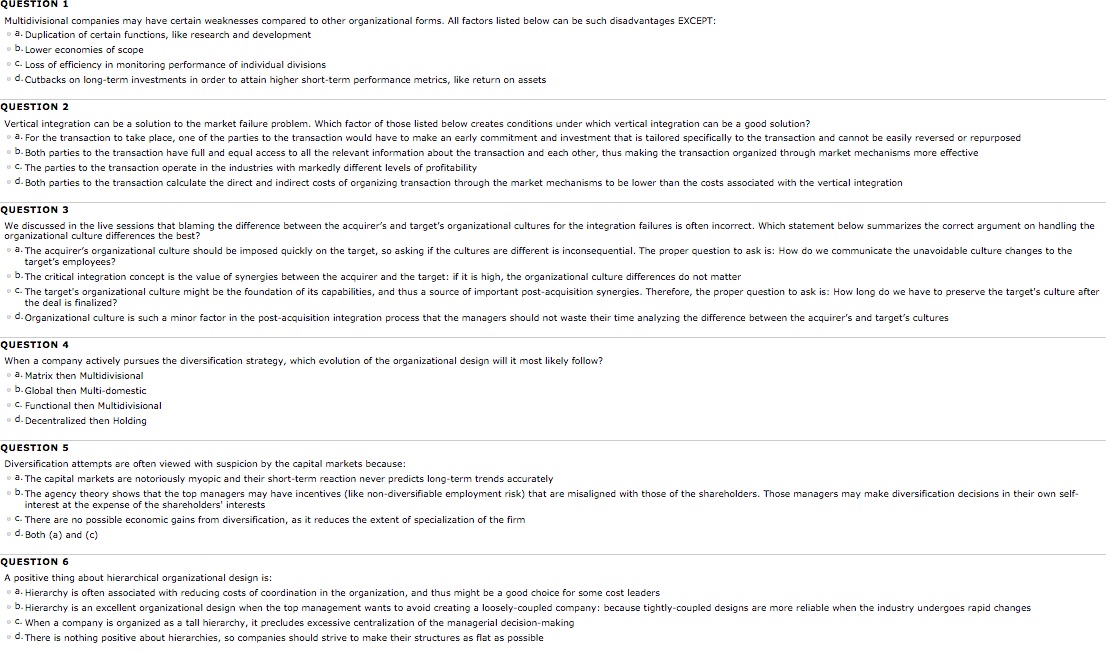
Multidivisional companies may have certain weaknesses compared to other organizational forms. All factors listed below can be such disadvantages EXCEPT: a. Duplication of certain functions, like research and development . b. Lower economies of scope . C. Loss of efficiency in monitoring performance of individual divisions d. Cutbacks on long-term investments in order to attain higher short-term performance metrics, like return on assets QUESTION 2 Vertical integration can be a solution to the market failure problem. Which factor of those listed below creates conditions under which vertical integration can be a good solution? " 3. For the transaction to take place, one of the parties to the transaction would have to make an early commitment and investment that is tailored specifically to the transaction and cannot be easily reversed or repurposed b. Both parties to the transaction have full and equal access to all the relevant information about the transaction and each other, thus making the transaction organized through market mechanisms more effective C. The parties to the transaction operate in the industries with markedly different levels of profitability O. Both parties to the transaction calculate the direct and indirect costs of organizing transaction through the market mechanisms to be lower than the costs associated with the vertical integration QUESTION 3 We discussed in the live sessions that blaming the difference between the acquirer's and target's organizational cultures for the integration failures is often incorrect. Which statement below summarizes the correct argument on handling the organizational culture differences the best? a. The acquirer's organizational culture should be imposed quickly on the target, so asking if the cultures are different is inconsequential. The proper question to ask is: How do we communicate the unavoidable culture changes to the target's employees . b. The critical integration concept is the value of synergies between the acquirer and the target: if it is high, the organizational culture differences do not matter C. The target's organizational culture might be the foundation of its capabilities, and thus a source of important post-acquisition synergies. Therefore, the proper question to ask is: How long do we have to preserve the target's culture after the deal is finalized: . d. Organizational culture is such a minor factor in the post-acquisition integration process that the managers should not waste their time analyzing the difference between the acquirer's and target's cultures QUESTION 4 When a company actively pursues the diversification strategy, which evolution of the organizational design will it most likely follow? . a. Matrix then Multidivisional . b. Global then Multi-domestic . C. Functional then Multidivisional . d. Decentralized then Holding QUESTION 5 Diversification attempts are often viewed with suspicion by the capital markets because: . 3. The capital markets are notoriously myopic and their short-term reaction never predicts long-term trends accurately D. The agency theory shows that the top managers may have incentives (like non-diversifiable employment risk) that are misaligned with those of the shareholders. Those managers may make diversification decisions in their own self- interest at the expense of the shareholders' interests . C. There are no possible economic gains from diversification, as it reduces the extent of specialization of the firm . d. Both (a) and (C) QUESTION 6 A positive thing about hierarchical organizational design is: a. Hierarchy is often associated with reducing costs of coordination in the organization, and thus might be a good choice for some cost leaders b. Hierarchy is an excellent organizational design when the top management wants to avoid creating a loosely-coupled company: because tightly-coupled designs are more reliable when the industry undergoes rapid changes C. When a company is organized as a tall hierarchy, it precludes excessive centralization of the managerial decision-making O. There is nothing positive about hierarchies, so companies should strive to make their structures as flat as possible
Step by Step Solution
There are 3 Steps involved in it

Get step-by-step solutions from verified subject matter experts
 Study Help