







Question: Answer each question individually, answer all parts for each question. there are a total of 8 questions. Homework: Chapter 9 Homework Save Score: 0 of
Answer each question individually, answer all parts for each question. there are a total of 8 questions.
![Industries has a project with the following projected cash flows: [ ]](https://s3.amazonaws.com/si.experts.images/answers/2024/06/66624196ea39d_35066624196d95c6.jpg)
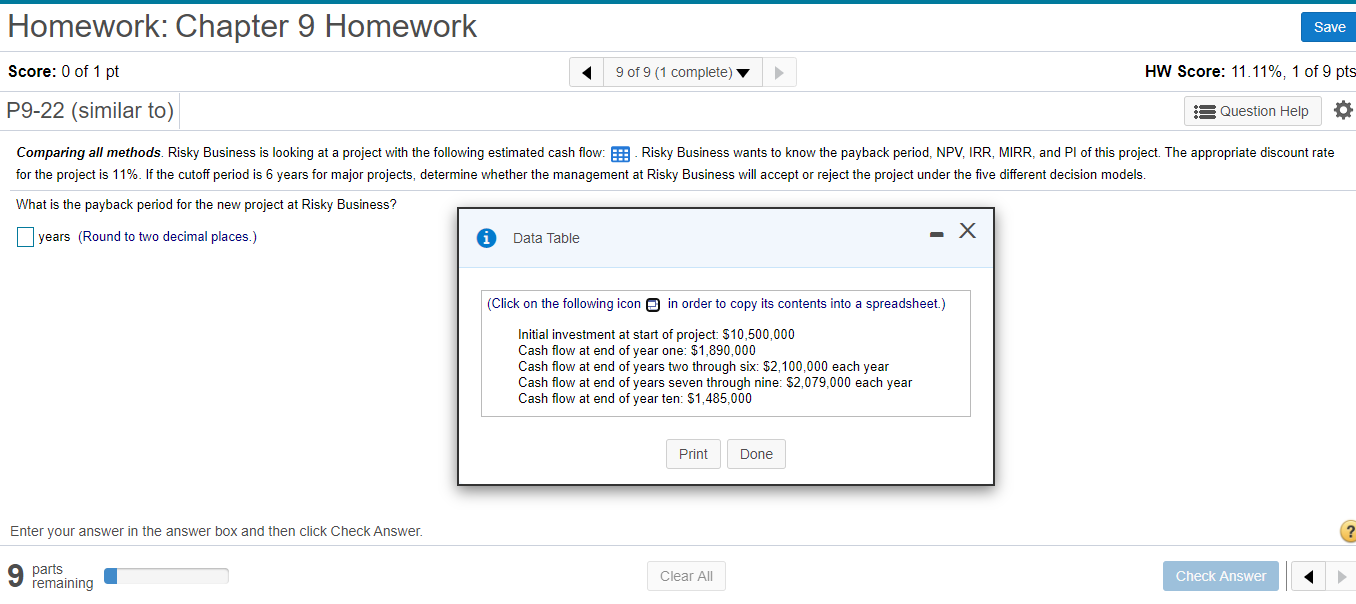
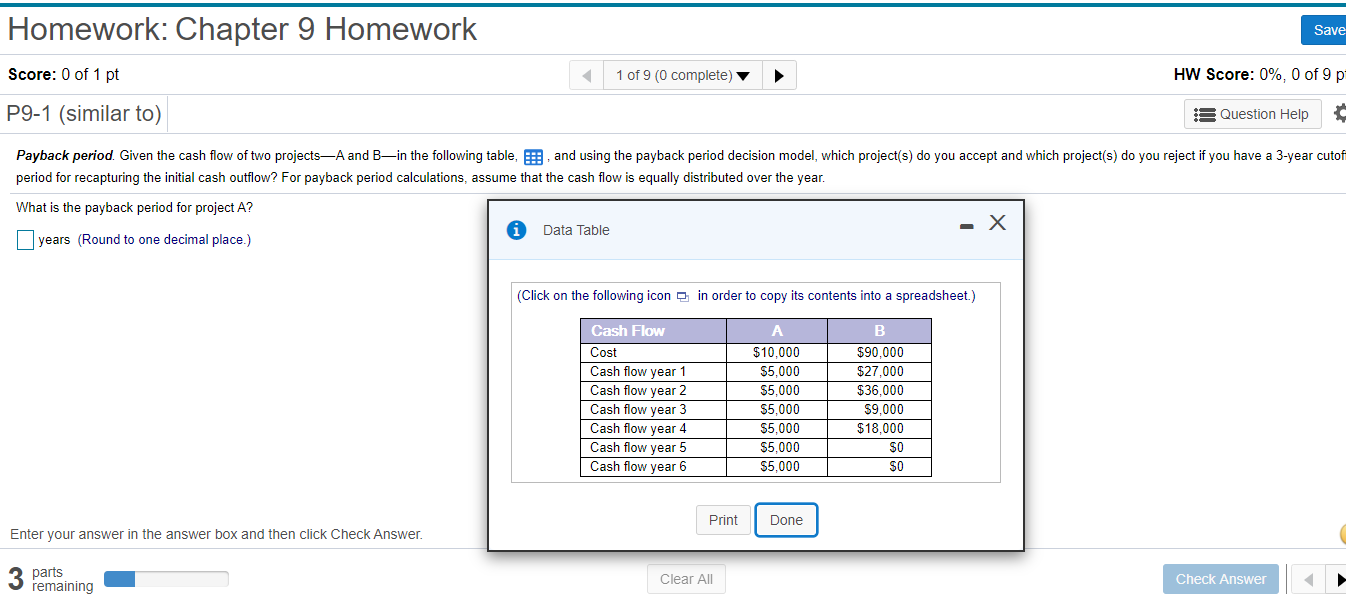
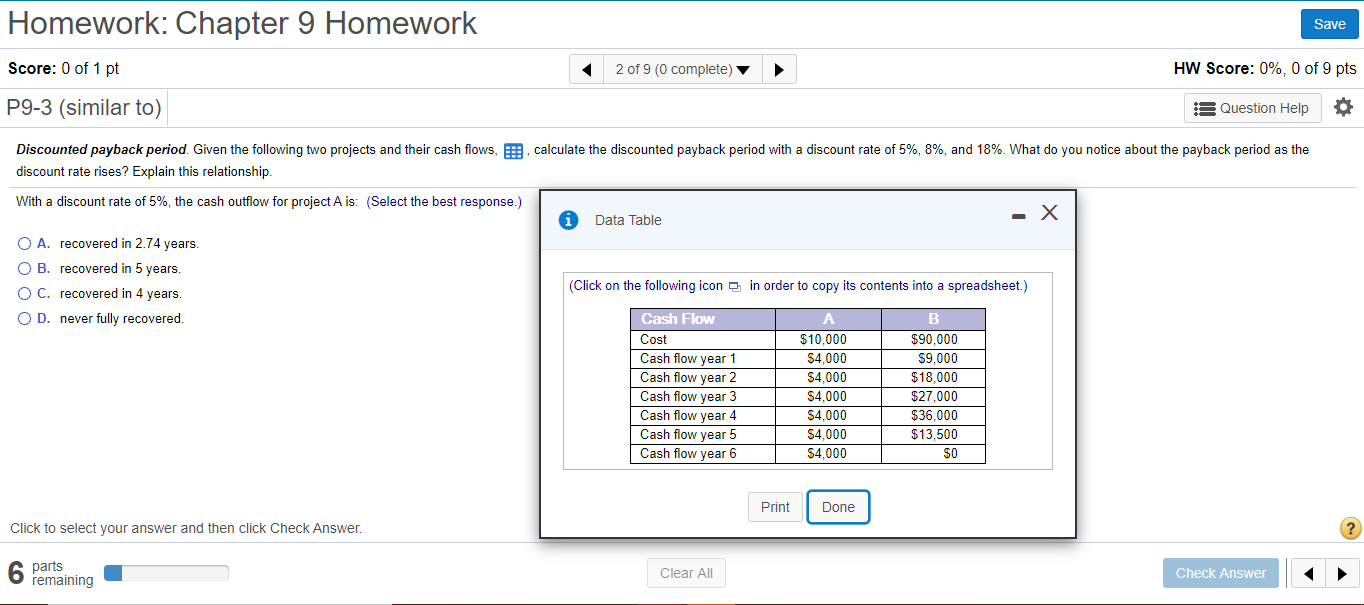
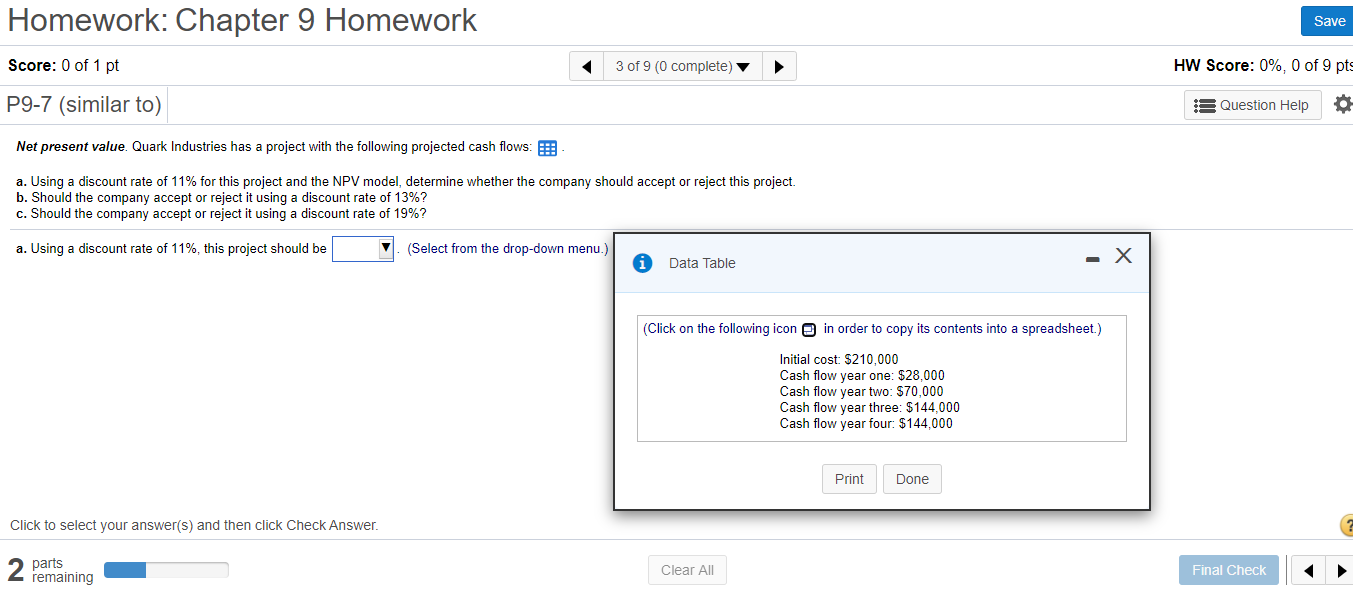
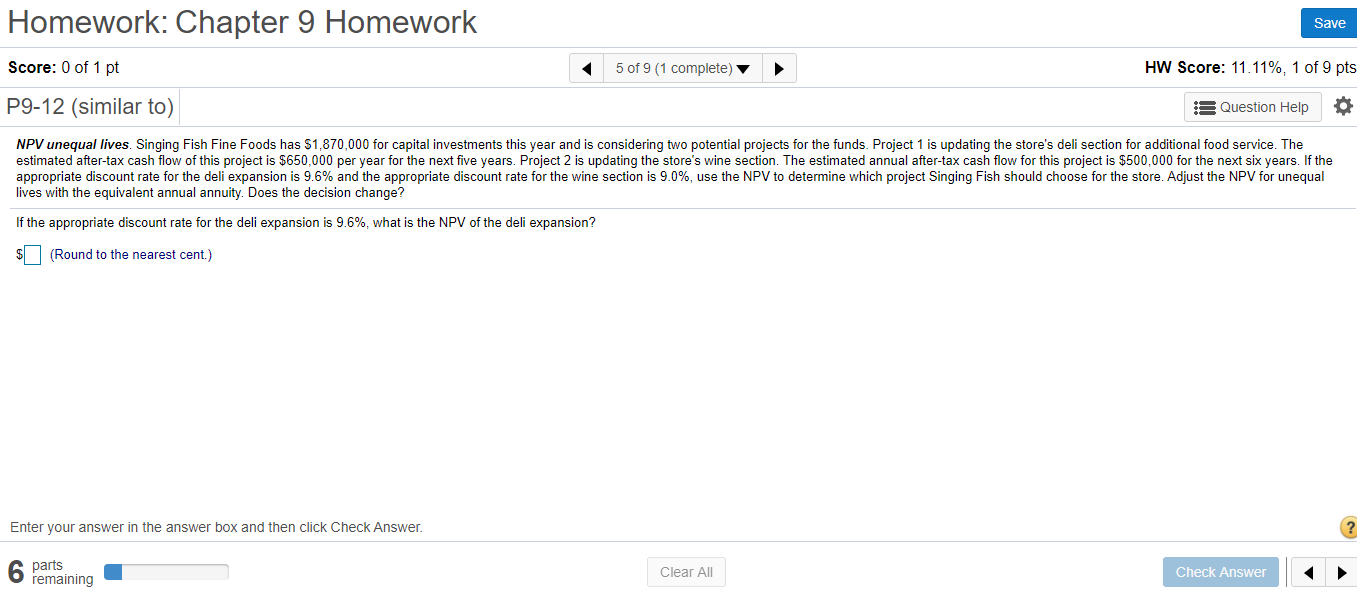
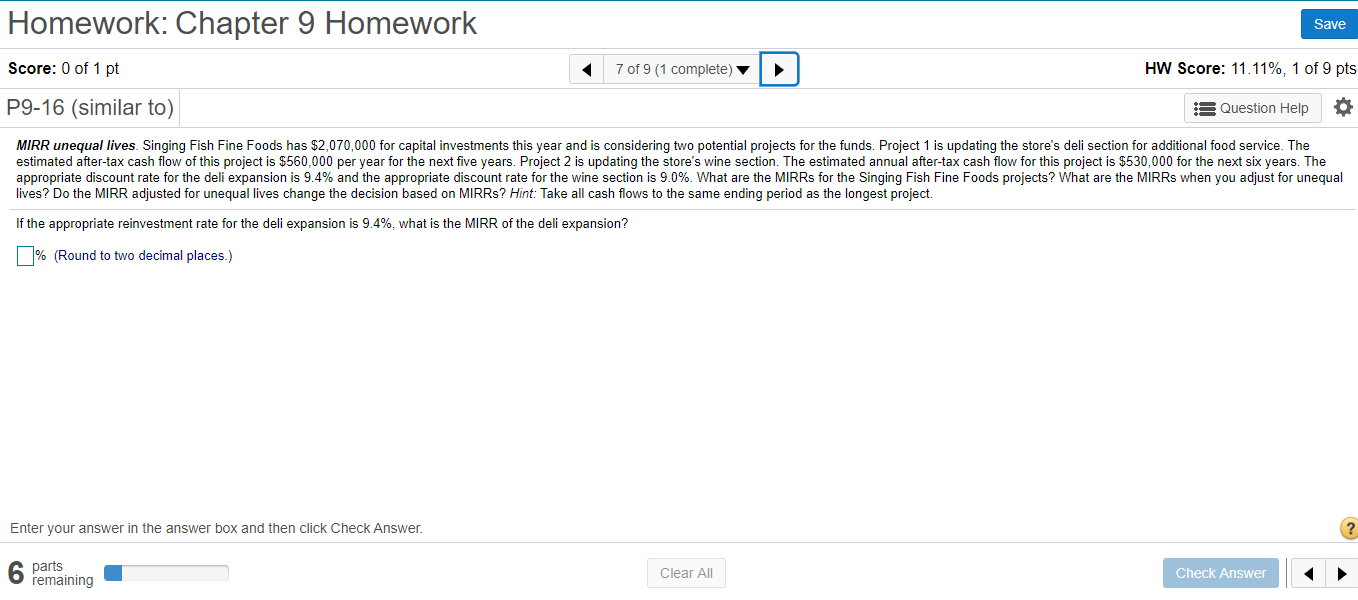
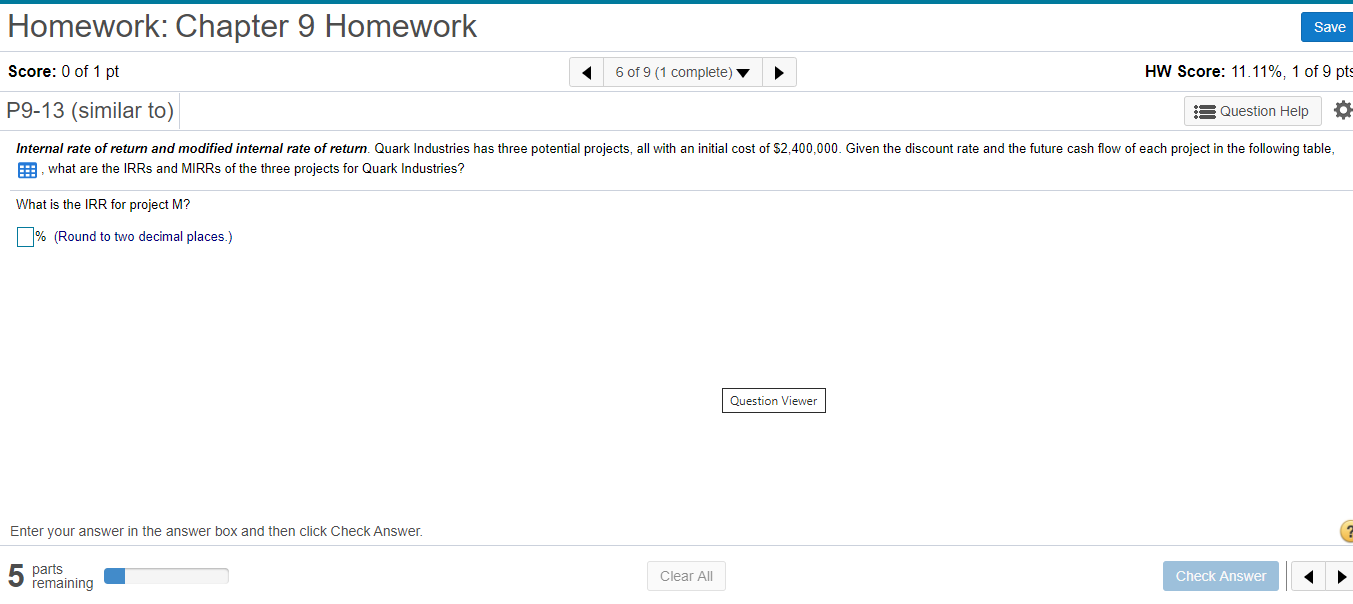
Homework: Chapter 9 Homework Save Score: 0 of 1 pt 3 of 9 (0 complete) HW Score: 0%, 0 of 9 pt P9-7 (similar to) Question Help Net present value. Quark Industries has a project with the following projected cash flows: [ ] a. Using a discount rate of 11% for this project and the NPV model, determine whether the company should accept or reject this project. b. Should the company accept or reject it using a discount rate of 13%? c. Should the company accept or reject it using a discount rate of 19%? a. Using a discount rate of 11%, this project should be (Select from the drop-down menu.) i Data Table - X (Click on the following icon @ in order to copy its contents into a spreadsheet.) Initial cost: $210,000 Cash flow year one: $28,000 Cash flow year two: $70,000 Cash flow year three: $144,000 Cash flow year four: $144,000 Print Done Click to select your answer(s) and then click Check Answer. 2 parts remaining Clear All Final CheckHomework: Chapter 9 Homework Save Score: 0 of 1 pt 5 of 9 (1 complete) HW Score: 11.11%, 1 of 9 pts P9-12 (similar to) Question Help NPV unequal lives. Singing Fish Fine Foods has $1,870,000 for capital investments this year and is considering two potential projects for the funds. Project 1 is updating the store's deli section for additional food service. The estimated after-tax cash flow of this project is $650,000 per year for the next five years. Project 2 is updating the store's wine section. The estimated annual after-tax cash flow for this project is $500,000 for the next six years. If the appropriate discount rate for the deli expansion is 9.6% and the appropriate discount rate for the wine section is 9.0%, use the NPV to determine which project Singing Fish should choose for the store. Adjust the NPV for unequal lives with the equivalent annual annuity. Does the decision change? If the appropriate discount rate for the deli expansion is 9.6%, what is the NPV of the deli expansion? 5(Round to the nearest cent.) Enter your answer in the answer box and then click Check Answer. (? 6 parts remaining Clear All Check AnswerHomework: Chapter 9 Homework Save Score: 0 of 1 pt 7 of 9 (1 complete) HW Score: 11.11%, 1 of 9 pts P9-16 (similar to) Question Help MIRR unequal lives. Singing Fish Fine Foods has $2,070,000 for capital investments this year and is considering two potential projects for the funds. Project 1 is updating the store's deli section for additional food service. The estimated after-tax cash flow of this project is $560,000 per year for the next five years. Project 2 is updating the store's wine section. The estimated annual after-tax cash flow for this project is $530,000 for the next six years. The appropriate discount rate for the deli expansion is 9.4% and the appropriate discount rate for the wine section is 9.0%. What are the MIRRs for the Singing Fish Fine Foods projects? What are the MIRRs when you adjust for unequal lives? Do the MIRR adjusted for unequal lives change the decision based on MIRRs? Hint: Take all cash flows to the same ending period as the longest project. If the appropriate reinvestment rate for the deli expansion is 9.4%, what is the MIRR of the deli expansion? % (Round to two decimal places.) Enter your answer in the answer box and then click Check Answer. (? 6 parts remaining Clear All Check AnswerHomework: Chapter 9 Homework Save Score: 0 of 1 pt 6 of 9 (1 complete) HW Score: 11.11%, 1 of 9 pts P9-13 (similar to) Question Help Internal rate of return and modified internal rate of return. Quark Industries has three potential projects, all with an initial cost of $2,400,000. Given the discount rate and the future cash flow of each project in the following table, Eff, what are the IRRs and MIRRs of the three projects for Quark Industries? What is the IRR for project M? % (Round to two decimal places.) Question Viewer Enter your answer in the answer box and then click Check Answer. 5 parts remaining Clear All Check AnswerHomework: Chapter 9 Homework Save Score: 0 of 1 pt 8 of 9 (1 complete) HW Score: 11.11%, 1 of 9 pt P9-20 (similar to) Question Help Profitability index. Given the discount rate and the future cash flow of each project listed in the following table, [ ] , use the PI to determine which projects the company should accept. What is the PI of project A? - X (Round to two decimal places.) Data Table (Click on the following icon in order to copy its contents into a spreadsheet.) Cash Flow Project A Project B Year 0 - $1,900,000 - $2,400,000 Year 1 $550,000 $1,200,000 Year 2 $650,000 $1, 100,000 Year 3 $750,000 $1,000,000 Year 4 $850,000 $900,000 Year 5 $950,000 $800,000 Discount rate 7% 15% Print Done Enter your answer in the answer box and then click Check Answer. 3 parts remaining Clear All Check AnswerHomework: Chapter 9 Homework Save Score: 0 of 1 pt 9 of 9 (1 complete) HW Score: 11.11%, 1 of 9 pt P9-22 (similar to) Question Help Comparing all methods. Risky Business is looking at a project with the following estimated cash flow: . Risky Business wants to know the payback period, NPV, IRR, MIRR, and PI of this project. The appropriate discount rate for the project is 11%. If the cutoff period is 6 years for major projects, determine whether the management at Risky Business will accept or reject the project under the five different decision models. What is the payback period for the new project at Risky Business? years (Round to two decimal places.) i Data Table - X (Click on the following icon @ in order to copy its contents into a spreadsheet.) Initial investment at start of project: $10,500,000 Cash flow at end of year one: $1,890,000 Cash flow at end of years two through six: $2, 100,000 each year Cash flow at end of years seven through nine: $2,079,000 each year Cash flow at end of year ten: $1,485,000 Print Done Enter your answer in the answer box and then click Check Answer. 9 parts remaining Clear All Check AnswerHomework: Chapter 9 Homework Save Score: 0 of 1 pt 1 of 9 (0 complete) HW Score: 0%, 0 of 9 p P9-1 (similar to) Question Help Payback period. Given the cash flow of two projects-A and B-in the following table, , and using the payback period decision model, which project(s) do you accept and which project(s) do you reject if you have a 3-year cuto period for recapturing the initial cash outflow? For payback period calculations, assume that the cash flow is equally distributed over the year. What is the payback period for project A? years (Round to one decimal place.) Data Table - X (Click on the following icon in order to copy its contents into a spreadsheet.) Cash Flow A B Cost $10,000 $90,000 Cash flow year 1 $5,000 $27,000 Cash flow year 2 $5,000 $36,00 Cash flow year 3 $5,000 $9,000 Cash flow year 4 $5,000 $18,000 Cash flow year 5 $5,000 Cash flow year 6 35,000 50 Print Done Enter your answer in the answer box and then click Check Answer. 3 parts remaining Clear All Check AnswerHomework: Chapter 9 Homework Save Score: 0 of 1 pt 2 of 9 (0 complete) HW Score: 0%, 0 of 9 pts P9-3 (similar to) i Question Help Discounted payback period. Given the following two projects and their cash flows, [ , calculate the discounted payback period with a discount rate of 5%, 8%, and 18%. What do you notice about the payback period as the discount rate rises? Explain this relationship. With a discount rate of 5%, the cash outflow for project A is: (Select the best response.) i Data Table - X O A. recovered in 2.74 years. O B. recovered in 5 years. O C. recovered in 4 years. (Click on the following icon in order to copy its contents into a spreadsheet.) O D. never fully recovered. Cash Flow A B Cost $10,000 $90,000 Cash flow year 1 54,000 59,000 Cash flow year 2 54.000 $18,000 Cash flow year 3 54.000 $27,000 Cash flow year 4 54,000 $36,000 Cash flow year 5 54,000 $13,500 Cash flow year 6 $4,000 $0 Print Done Click to select your answer and then click Check Answer. ? 6 parts remaining Clear All Check
Step by Step Solution
There are 3 Steps involved in it

Get step-by-step solutions from verified subject matter experts
 Study Help