Question: Answer each questions. Case: DuPont Case: Logitech (B)24 back to the Logitech case (A) at the end of Chapter 10. The clock has rolled Card
Case: DuPont
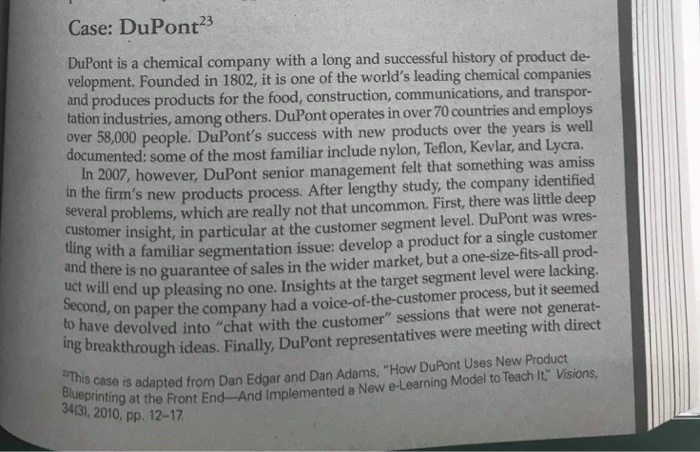
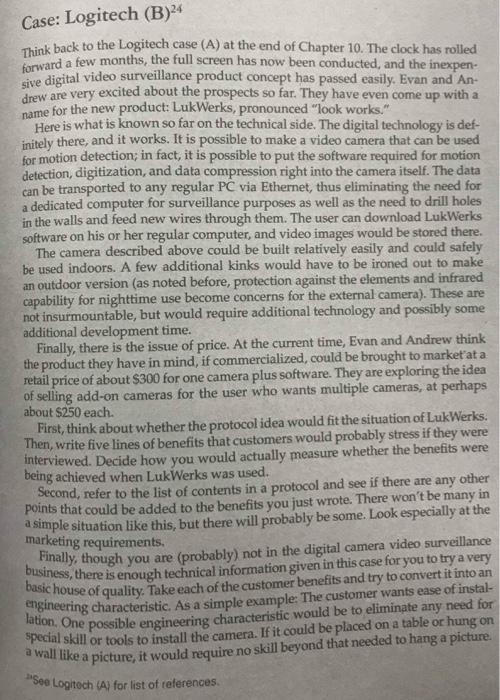
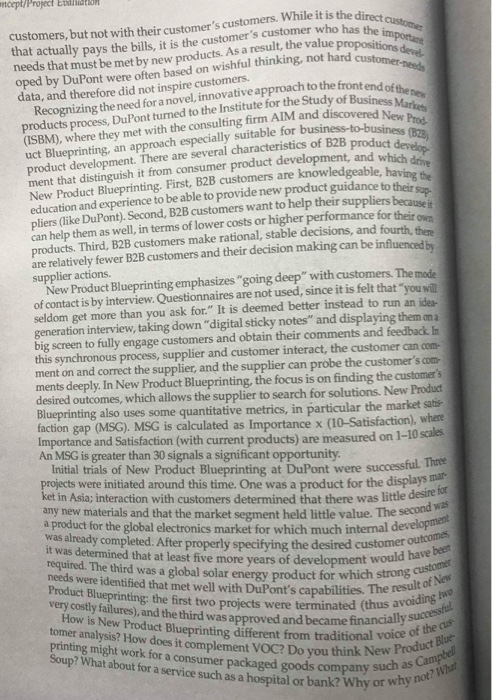
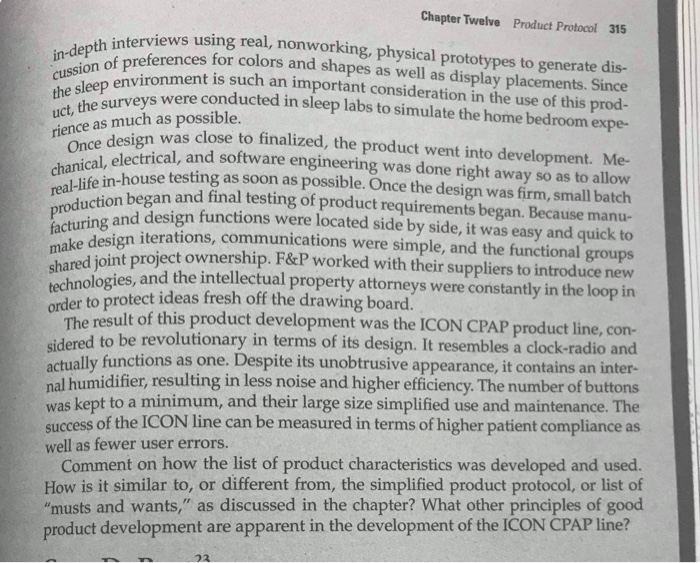
Case: Logitech (B)24 back to the Logitech case (A) at the end of Chapter 10. The clock has rolled Card a few months, the full screen has now been conducted, and the inexpen- e digital video surveillance product concept has passed easily. Evan and An- ow are very excited about the prospects so far. They have even come up with a name for the new product: LukWerks, pronounced "look works." Here is what is known so far on the technical side. The digital technology is def- initely there, and it works. It is possible to make a video camera that can be used for motion detection; in fact, it is possible to put the software required for motion detection, digitization, and data compression right into the camera itself. The data can be transported to any regular PC via Ethernet, thus eliminating the need for a dedicated computer for surveillance purposes as well as the need to drill holes in the walls and feed new wires through them. The user can download LukWerks software on his or her regular computer, and video images would be stored there. The camera described above could be built relatively easily and could safely be used indoors. A few additional kinks would have to be ironed out to make an outdoor version (as noted before, protection against the elements and infrared capability for nighttime use become concerns for the external camera). These are not insurmountable, but would require additional technology and possibly some additional development time. Finally, there is the issue of price. At the current time, Evan and Andrew think the product they have in mind, if commercialized, could be brought to market'at a retail price of about $300 for one camera plus software. They are exploring the idea of selling add-on cameras for the user who wants multiple cameras, at perhaps about $250 each. First, think about whether the protocol idea would fit the situation of LukWerks. Then, write five lines of benefits that customers would probably stress if they were Interviewed. Decide how you would actually measure whether the benefits were being achieved when LukWerks was used. Second, refer to the list of contents in a protocol and see if there are any other points that could be added to the benefits you just wrote. There won't be many in a simple situation like this, but there will probably be some. Look especially at the marketing requirements. Finally Finally, though you are (probably) not in the digital camera video surveillance usiness, there is enough technical information given in this case for you to try a very house of quality. Take each of the customer benefits and try to convert it into an neering characteristic. As a simple example: The customer wants ease of instal- n. One possible engineering characteristic would be to eliminate any need for di skill or tools to install the camera. If it could be placed on a table or hung on like a picture, it would require no skill beyond that needed to hang a picture "See Logitech (A) for list of references oncept/Project End the direct customer as the importa ropositions devel customer needs front end of the dy of Business Markets discovered New Prod ness-to-business (B2B B product develop and which drive reable, having the dance to their sup customers, but not with their customer's customers. While it is the dire that actually pays the bills, it is the customer's customer who has the needs that must be met by new products. As a result, the value proposis swishful thinking, not hard customer oped by DuPont were often based on wish data, and therefore did not inspire customers. Recognizing the need for a novel, innovative approach to the frontend products process, DuPont turned to the Institute for the Study of Busi (ISBM), where they met with the consulting firm AIM and discovered uct Blueprinting, an approach especially suitable for business-to-br product development. There are several characteristics of B2B produ ment that distinguish it from consumer product development, and whe New Product Blueprinting. First, B2B customers are knowledgeable, haw education and experience to be able to provide new product guidance to the pliers (like DuPont). Second, B2B customers want to help their suppliers beca can help them as well, in terms of lower costs or higher performance for their products. Third, B2B customers make rational, stable decisions, and fourth, th are relatively fewer B2B customers and their decision making can be influenced by supplier actions. New Product Blueprinting emphasizes "going deep" with customers. The mode of contact is by interview. Questionnaires are not used, since it is felt that you will seldom get more than you ask for." It is deemed better instead to run an idea- generation interview, taking down "digital sticky notes" and displaying them on a big screen to fully engage customers and obtain their comments and feedback. In this synchronous process, supplier and customer interact, the customer can com- ment on and correct the supplier, and the supplier can probe the customer's.com ments deeply. In New Product Blueprinting, the focus is on finding the customer's desired outcomes, which allows the supplier to search for solutions. New Product Blueprinting also uses some quantitative metrics, in particular the market satis faction gap (MSG). MSG is calculated as Importance x (10-Satisfaction), wher Importance and Satisfaction (with current products) are measured on 1-10 scale An MSG is greater than 30 signals a significant opportunity. Initial trials of New Product Blueprinting at DuPont were successful projects were initiated around this time. One was a product for the display ket in Asia; interaction with customers determined that there was little des any new materials and that the market segment held little value. The second a product for the global electronics market for which much internal deve was already completed. After properly specifying the desired customer it was determined that at least five more years of development would required. The third was a global solar energy product for which stron needs were identified that met well with DuPont's capabilities. There blueprinting: the first two projects were terminated (thusa very costly failures), and the third was approved and became financially How is New Product Blueprinting different from traditiona w does it complement VOC? Do you think New Proo Slittle desire for The second was al development ed customer outcomes hent would have been ch strong customer Very costly an DuPont's capabilities. The result of New ting: the first (thus avoiding two ncially successful al voice of the cus printing might work for a consumer packaged goods companys Soup? What about for a service such as a hospital or bank? Why of Product Blue mpany such as Campbe y or why not? What Chapter Twelve Product Protocol 315 interviews using real, nonworking, physical prototypes to generate dis- preferences for colors and shapes as well as display placements. Since ironment is such an important consideration in the use of this prod- were conducted in sleep labs to simulate the home bedroom expe- cussion of preferenc the sleep environment i uct, the surveys were cond rience as much as possible. Once design was clos chanical, electrical, and real-life in-house test production began facturing and design fi make design iteration shared joint project owne technologies, and the inte sign was close to finalized, the product went into development. Me- Ectrical, and software engineering was done right away so as to allow whouse testing as soon as possible. Once the design was firm, small batch on began and final testing of product requirements began. Because manu- and design functions were located side by side, it was easy and quick to sign iterations, communications were simple, and the functional groups joint project ownership. F&P worked with their suppliers to introduce new ogies, and the intellectual property attorneys were constantly in the loop in der to protect ideas fresh off the drawing board. e result of this product development was the ICON CPAP product line, con- dered to be revolutionary in terms of its design. It resembles a clock-radio and sually functions as one. Despite its unobtrusive appearance, it contains an inter- mal humidifier, resulting in less noise and higher efficiency. The number of buttons was kept to a minimum, and their large size simplified use and maintenance. The success of the ICON line can be measured in terms of higher patient compliance as well as fewer user errors. Comment on how the list of product characteristics was developed and used. How is it similar to, or different from, the simplified product protocol, or list of "musts and wants," as discussed in the chapter? What other principles of good product development are apparent in the development of the ICON CPAP line? 23 Comment on how the list of product characteristics was developed and used. How is it similar to, or different from, the simplified product protocol, or list of "musts and wants," as discussed in the chapter? What other principles of good product development are apparent in the development of the ICON CPAP line? Case: DuPont23 DuPont is a chemical company with a long and successful history of product de- velopment. Founded in 1802, it is one of the world's leading chemical companies and produces products for the food, construction, communications, and transpor- tation industries, among others. DuPont operates in over 70 countries and employs over 58,000 people. DuPont's success with new products over the years is well documented: some of the most familiar include nylon, Teflon, Kevlar, and Lycra. In 2007, however, DuPont senior management felt that something was amiss in the firm's new products process. After lengthy study, the company identified several problems, which are really not that uncommon. First, there was little deep stomer insight, in particular at the customer segment level. DuPont was wres- ng with a familiar segmentation issue: develop a product for a single customer there is no guarantee of sales in the wider market, but a one-size-fits-all prod- end up pleasing no one. Insights at the target segment level were lacking. nd, on paper the company had a voice-of-the-customer process, but it seemed ve devolved into "chat with the customer" sessions that were not generat- reakthrough ideas. Finally, DuPont representatives were meeting with direct *This case is adapted Blueprinting at the Front 34(3), 2010, pp. 12-17 is adapted from Dan Edgar and Dan Adams, "How DuPont Uses New Product ng at the Front End And Implemented a New e-Learning Model to Teach It," Visions, Chapter Twelve Product Protocol 317 rawbacks of New Product Blueprinting for a high-tech manufacturer might be drawbacks e DuPont or for other kinds of firms? Case: Logitech (B)24 back to the Logitech case (A) at the end of Chapter 10. The clock has rolled Card a few months, the full screen has now been conducted, and the inexpen- e digital video surveillance product concept has passed easily. Evan and An- ow are very excited about the prospects so far. They have even come up with a name for the new product: LukWerks, pronounced "look works." Here is what is known so far on the technical side. The digital technology is def- initely there, and it works. It is possible to make a video camera that can be used for motion detection; in fact, it is possible to put the software required for motion detection, digitization, and data compression right into the camera itself. The data can be transported to any regular PC via Ethernet, thus eliminating the need for a dedicated computer for surveillance purposes as well as the need to drill holes in the walls and feed new wires through them. The user can download LukWerks software on his or her regular computer, and video images would be stored there. The camera described above could be built relatively easily and could safely be used indoors. A few additional kinks would have to be ironed out to make an outdoor version (as noted before, protection against the elements and infrared capability for nighttime use become concerns for the external camera). These are not insurmountable, but would require additional technology and possibly some additional development time. Finally, there is the issue of price. At the current time, Evan and Andrew think the product they have in mind, if commercialized, could be brought to market'at a retail price of about $300 for one camera plus software. They are exploring the idea of selling add-on cameras for the user who wants multiple cameras, at perhaps about $250 each. First, think about whether the protocol idea would fit the situation of LukWerks. Then, write five lines of benefits that customers would probably stress if they were Interviewed. Decide how you would actually measure whether the benefits were being achieved when LukWerks was used. Second, refer to the list of contents in a protocol and see if there are any other points that could be added to the benefits you just wrote. There won't be many in a simple situation like this, but there will probably be some. Look especially at the marketing requirements. Finally Finally, though you are (probably) not in the digital camera video surveillance usiness, there is enough technical information given in this case for you to try a very house of quality. Take each of the customer benefits and try to convert it into an neering characteristic. As a simple example: The customer wants ease of instal- n. One possible engineering characteristic would be to eliminate any need for di skill or tools to install the camera. If it could be placed on a table or hung on like a picture, it would require no skill beyond that needed to hang a picture "See Logitech (A) for list of references oncept/Project End the direct customer as the importa ropositions devel customer needs front end of the dy of Business Markets discovered New Prod ness-to-business (B2B B product develop and which drive reable, having the dance to their sup customers, but not with their customer's customers. While it is the dire that actually pays the bills, it is the customer's customer who has the needs that must be met by new products. As a result, the value proposis swishful thinking, not hard customer oped by DuPont were often based on wish data, and therefore did not inspire customers. Recognizing the need for a novel, innovative approach to the frontend products process, DuPont turned to the Institute for the Study of Busi (ISBM), where they met with the consulting firm AIM and discovered uct Blueprinting, an approach especially suitable for business-to-br product development. There are several characteristics of B2B produ ment that distinguish it from consumer product development, and whe New Product Blueprinting. First, B2B customers are knowledgeable, haw education and experience to be able to provide new product guidance to the pliers (like DuPont). Second, B2B customers want to help their suppliers beca can help them as well, in terms of lower costs or higher performance for their products. Third, B2B customers make rational, stable decisions, and fourth, th are relatively fewer B2B customers and their decision making can be influenced by supplier actions. New Product Blueprinting emphasizes "going deep" with customers. The mode of contact is by interview. Questionnaires are not used, since it is felt that you will seldom get more than you ask for." It is deemed better instead to run an idea- generation interview, taking down "digital sticky notes" and displaying them on a big screen to fully engage customers and obtain their comments and feedback. In this synchronous process, supplier and customer interact, the customer can com- ment on and correct the supplier, and the supplier can probe the customer's.com ments deeply. In New Product Blueprinting, the focus is on finding the customer's desired outcomes, which allows the supplier to search for solutions. New Product Blueprinting also uses some quantitative metrics, in particular the market satis faction gap (MSG). MSG is calculated as Importance x (10-Satisfaction), wher Importance and Satisfaction (with current products) are measured on 1-10 scale An MSG is greater than 30 signals a significant opportunity. Initial trials of New Product Blueprinting at DuPont were successful projects were initiated around this time. One was a product for the display ket in Asia; interaction with customers determined that there was little des any new materials and that the market segment held little value. The second a product for the global electronics market for which much internal deve was already completed. After properly specifying the desired customer it was determined that at least five more years of development would required. The third was a global solar energy product for which stron needs were identified that met well with DuPont's capabilities. There blueprinting: the first two projects were terminated (thusa very costly failures), and the third was approved and became financially How is New Product Blueprinting different from traditiona w does it complement VOC? Do you think New Proo Slittle desire for The second was al development ed customer outcomes hent would have been ch strong customer Very costly an DuPont's capabilities. The result of New ting: the first (thus avoiding two ncially successful al voice of the cus printing might work for a consumer packaged goods companys Soup? What about for a service such as a hospital or bank? Why of Product Blue mpany such as Campbe y or why not? What Chapter Twelve Product Protocol 315 interviews using real, nonworking, physical prototypes to generate dis- preferences for colors and shapes as well as display placements. Since ironment is such an important consideration in the use of this prod- were conducted in sleep labs to simulate the home bedroom expe- cussion of preferenc the sleep environment i uct, the surveys were cond rience as much as possible. Once design was clos chanical, electrical, and real-life in-house test production began facturing and design fi make design iteration shared joint project owne technologies, and the inte sign was close to finalized, the product went into development. Me- Ectrical, and software engineering was done right away so as to allow whouse testing as soon as possible. Once the design was firm, small batch on began and final testing of product requirements began. Because manu- and design functions were located side by side, it was easy and quick to sign iterations, communications were simple, and the functional groups joint project ownership. F&P worked with their suppliers to introduce new ogies, and the intellectual property attorneys were constantly in the loop in der to protect ideas fresh off the drawing board. e result of this product development was the ICON CPAP product line, con- dered to be revolutionary in terms of its design. It resembles a clock-radio and sually functions as one. Despite its unobtrusive appearance, it contains an inter- mal humidifier, resulting in less noise and higher efficiency. The number of buttons was kept to a minimum, and their large size simplified use and maintenance. The success of the ICON line can be measured in terms of higher patient compliance as well as fewer user errors. Comment on how the list of product characteristics was developed and used. How is it similar to, or different from, the simplified product protocol, or list of "musts and wants," as discussed in the chapter? What other principles of good product development are apparent in the development of the ICON CPAP line? 23 Comment on how the list of product characteristics was developed and used. How is it similar to, or different from, the simplified product protocol, or list of "musts and wants," as discussed in the chapter? What other principles of good product development are apparent in the development of the ICON CPAP line? Case: DuPont23 DuPont is a chemical company with a long and successful history of product de- velopment. Founded in 1802, it is one of the world's leading chemical companies and produces products for the food, construction, communications, and transpor- tation industries, among others. DuPont operates in over 70 countries and employs over 58,000 people. DuPont's success with new products over the years is well documented: some of the most familiar include nylon, Teflon, Kevlar, and Lycra. In 2007, however, DuPont senior management felt that something was amiss in the firm's new products process. After lengthy study, the company identified several problems, which are really not that uncommon. First, there was little deep stomer insight, in particular at the customer segment level. DuPont was wres- ng with a familiar segmentation issue: develop a product for a single customer there is no guarantee of sales in the wider market, but a one-size-fits-all prod- end up pleasing no one. Insights at the target segment level were lacking. nd, on paper the company had a voice-of-the-customer process, but it seemed ve devolved into "chat with the customer" sessions that were not generat- reakthrough ideas. Finally, DuPont representatives were meeting with direct *This case is adapted Blueprinting at the Front 34(3), 2010, pp. 12-17 is adapted from Dan Edgar and Dan Adams, "How DuPont Uses New Product ng at the Front End And Implemented a New e-Learning Model to Teach It," Visions, Chapter Twelve Product Protocol 317 rawbacks of New Product Blueprinting for a high-tech manufacturer might be drawbacks e DuPont or for other kinds of firms










 Study Help