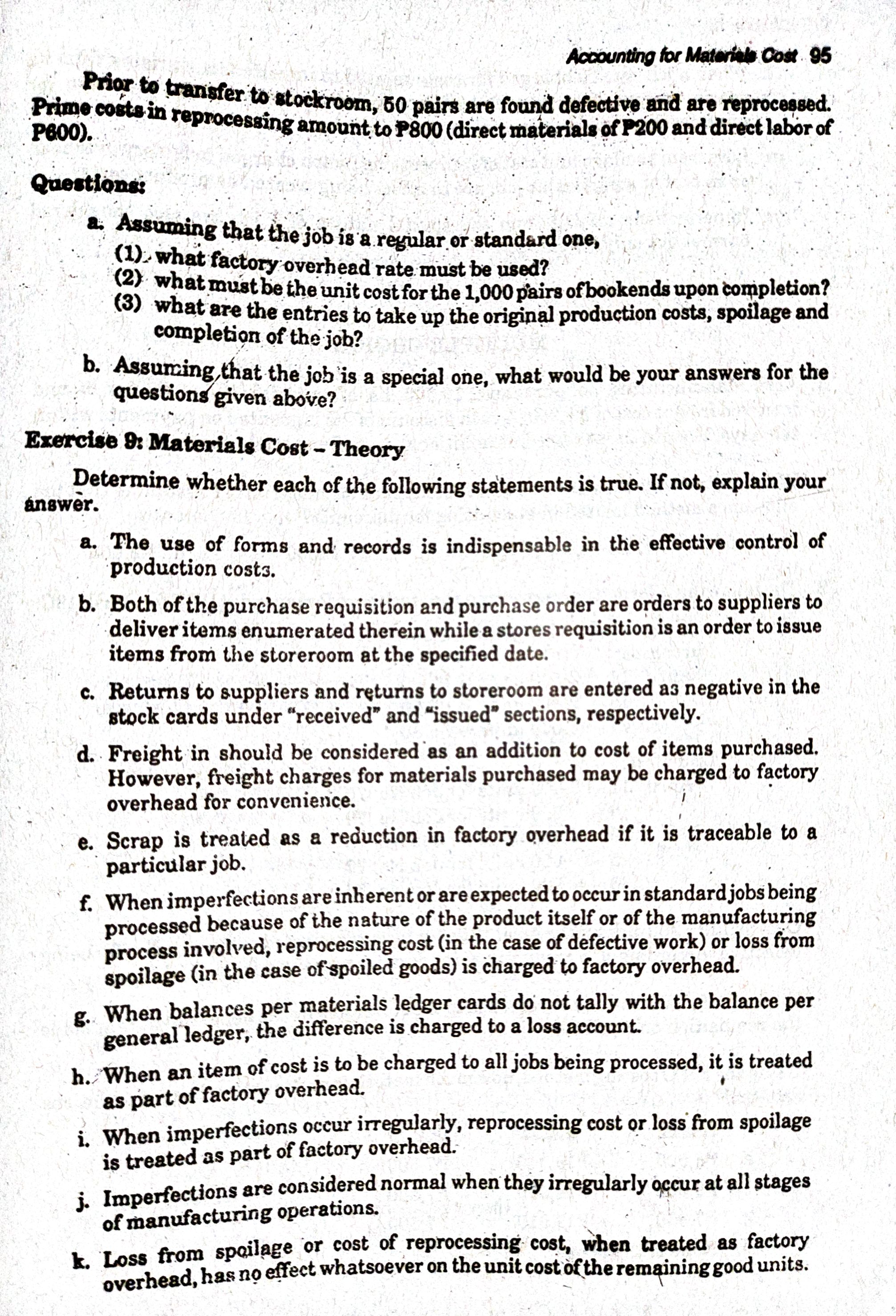
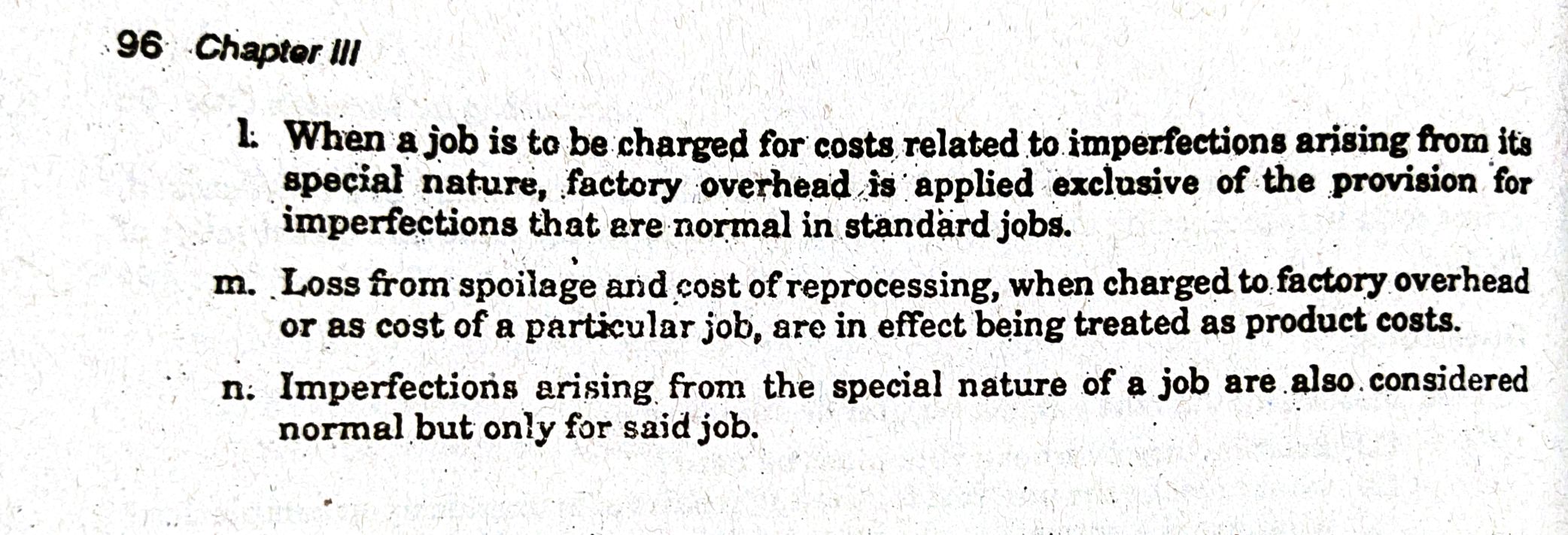
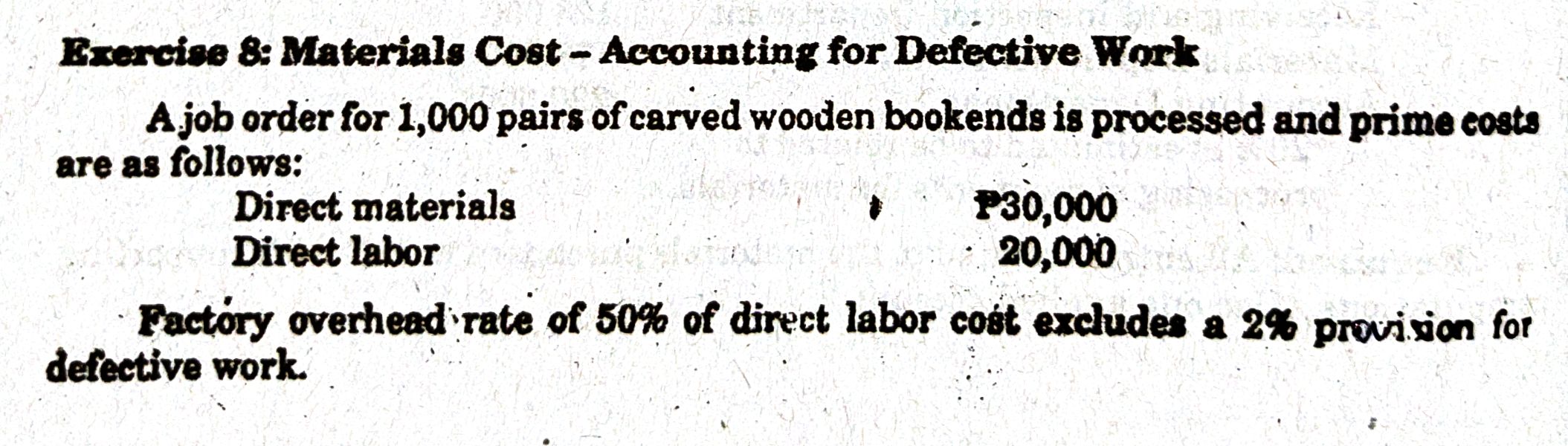
Accounting for Materials Cost . 95 Prior to transfer to stockroom, 50 pairs are found defective and are reprocessed. P600). Prime costs in reprocessing amount to P800 (direct materials of P200 and direct labor of Questions: Assuming that the job is a regular or standard one, (1). what factory overhead rate must be used? (2) what must be the unit cost for the 1,000 pairs of bookends upon completion? (3) what are the entries to take up the original production costs, spoilage and completion of the job? b. Assuming that the job is a special one, what would be your answers for the questions given above? Exercise 9: Materials Cost - Theory Determine whether each of the following statements is true. If not, explain your answer. a. The use of forms and records is indispensable in the effective control of production costs. b. Both of the purchase requisition and purchase order are orders to suppliers to deliver items enumerated therein while a stores requisition is an order to issue items from the storeroom at the specified date. c. Returns to suppliers and returns to storeroom are entered as negative in the stock cards under "received" and "issued" sections, respectively. d. Freight in should be considered as an addition to cost of items purchased. However, freight charges for materials purchased may be charged to factory overhead for convenience. e. Scrap is treated as a reduction in factory overhead if it is traceable to a particular job. f. When imperfections are inherent or are expected to occur in standard jobs being processed because of the nature of the product itself or of the manufacturing process involved, reprocessing cost (in the case of defective work) or loss from spoilage (in the case of spoiled goods) is charged to factory overhead. g. When balances per materials ledger cards do not tally with the balance per general ledger, the difference is charged to a loss account. h. When an item of cost is to be charged to all jobs being processed, it is treated as part of factory overhead. i. When imperfections occur irregularly, reprocessing cost or loss from spoilage is treated as part of factory overhead. j. Imperfections are considered normal when they irregularly occur at all stages of manufacturing operations. k. Loss from spoilage or cost of reprocessing cost, when treated as factory overhead, has no effect whatsoever on the unit cost of the remaining good units.96 Chapter Ill 1: When a job is to be charged for costs related to imperfections arising from it's special nature, factory overhead is applied exclusive of the provision for imperfections that are normal in standard jobs. m. Loss from spoilage and cost of reprocessing, when charged to factory overhead or as cost of a particular job, are in effect being treated as product costs. n. Imperfections arising from the special nature of a job are also. considered normal but only for said job.Exercise 8: Materials Cost - Accounting for Defective Work A job order for 1,000 pairs of carved wooden bookends is processed and prime costs are as follows: Direct materials P30,000 Direct labor 20,000 Factory overhead rate of 50% of direct labor cost excludes a 2% provision for defective work
Step by Step Solution
There are 3 Steps involved in it
1 Expert Approved Answer
Step: 1 Unlock
Question Has Been Solved by an Expert!
Get step-by-step solutions from verified subject matter experts
Step: 2 Unlock
Step: 3 Unlock
Students Have Also Explored These Related Accounting Questions!









 Study Help