







Question: ANSWER FAST PLEASE 8. This exercise is meant to understand better the p-value. This is a similar exercise to one that is in the exercise
ANSWER FAST PLEASE
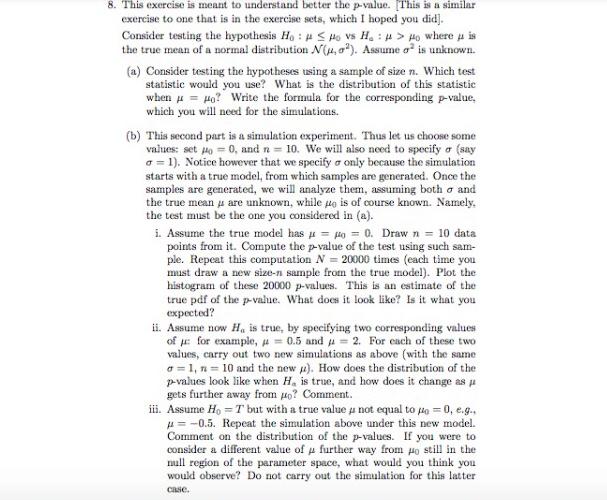
8. This exercise is meant to understand better the p-value. This is a similar exercise to one that is in the exercise sets, which I hoped you did]. Consider testing the hypothesis H. : #SH VS H.: # > Ho where his the true mean of a normal distribution (4,3). Assume o is unknown. (a) Consider testing the hypotheses using a sample of size n. Which test statistic would you use? What is the distribution of this statistic when u = Ho? Write the formula for the corresponding p-value. which you will need for the simulations. (b) This second part is a simulation experiment. Thus let us choose some values: set Ho = 0, and n = 10. We will also need to specify o (say a = 1). Notice however that we specify o only because the simulation starts with a true model, from which samples are generated. Once the samples are generated, we will analyze them, assuming both o and the true mean y are unknown, while He is of course known. Namely, the test must be the one you considered in (a). i. Assume the true model has x = po = 0. Draw n = 10 data points from it. Compute the p-value of the test using such sam- ple. Repeat this computation N = 20000 times (each time you must draw a new size-11 sample from the true model). Plot the histogram of these 20000 p-values. This is an estimate of the true pdf of the p-value. What does it look like? Is it what you expected? ii. Assume now He is true, by specifying two corresponding values of e for example, h = 0.5 and 4 = 2. For each of these two values, carry out two new simulations as above (with the same o=1, n = 10 and the new M). How does the distribution of the p-values look like when H, is true, and how does it change as u gets further away from wo? Comment iii. Assume H, = T but with a true value not equal to po = 0, e.g. = -0.5. Repeat the simulation above under this new model. Comment on the distribution of the p-values. If you were to consider a different value of further way from Ho still in the mull region of the parameter space, what would you think you would observe? Do not carry out the simulation for this latter CRS. 8. This exercise is meant to understand better the p-value. This is a similar exercise to one that is in the exercise sets, which I hoped you did]. Consider testing the hypothesis H. : #SH VS H.: # > Ho where his the true mean of a normal distribution (4,3). Assume o is unknown. (a) Consider testing the hypotheses using a sample of size n. Which test statistic would you use? What is the distribution of this statistic when u = Ho? Write the formula for the corresponding p-value. which you will need for the simulations. (b) This second part is a simulation experiment. Thus let us choose some values: set Ho = 0, and n = 10. We will also need to specify o (say a = 1). Notice however that we specify o only because the simulation starts with a true model, from which samples are generated. Once the samples are generated, we will analyze them, assuming both o and the true mean y are unknown, while He is of course known. Namely, the test must be the one you considered in (a). i. Assume the true model has x = po = 0. Draw n = 10 data points from it. Compute the p-value of the test using such sam- ple. Repeat this computation N = 20000 times (each time you must draw a new size-11 sample from the true model). Plot the histogram of these 20000 p-values. This is an estimate of the true pdf of the p-value. What does it look like? Is it what you expected? ii. Assume now He is true, by specifying two corresponding values of e for example, h = 0.5 and 4 = 2. For each of these two values, carry out two new simulations as above (with the same o=1, n = 10 and the new M). How does the distribution of the p-values look like when H, is true, and how does it change as u gets further away from wo? Comment iii. Assume H, = T but with a true value not equal to po = 0, e.g. = -0.5. Repeat the simulation above under this new model. Comment on the distribution of the p-values. If you were to consider a different value of further way from Ho still in the mull region of the parameter space, what would you think you would observe? Do not carry out the simulation for this latter CRS
Step by Step Solution
There are 3 Steps involved in it

Get step-by-step solutions from verified subject matter experts
 Study Help