







Question: Answer following question please Problem 1. Suppose you have seven diceeach a different color of the rainbow; otherwise the dice are standard, with faces numbered
Answer following question please
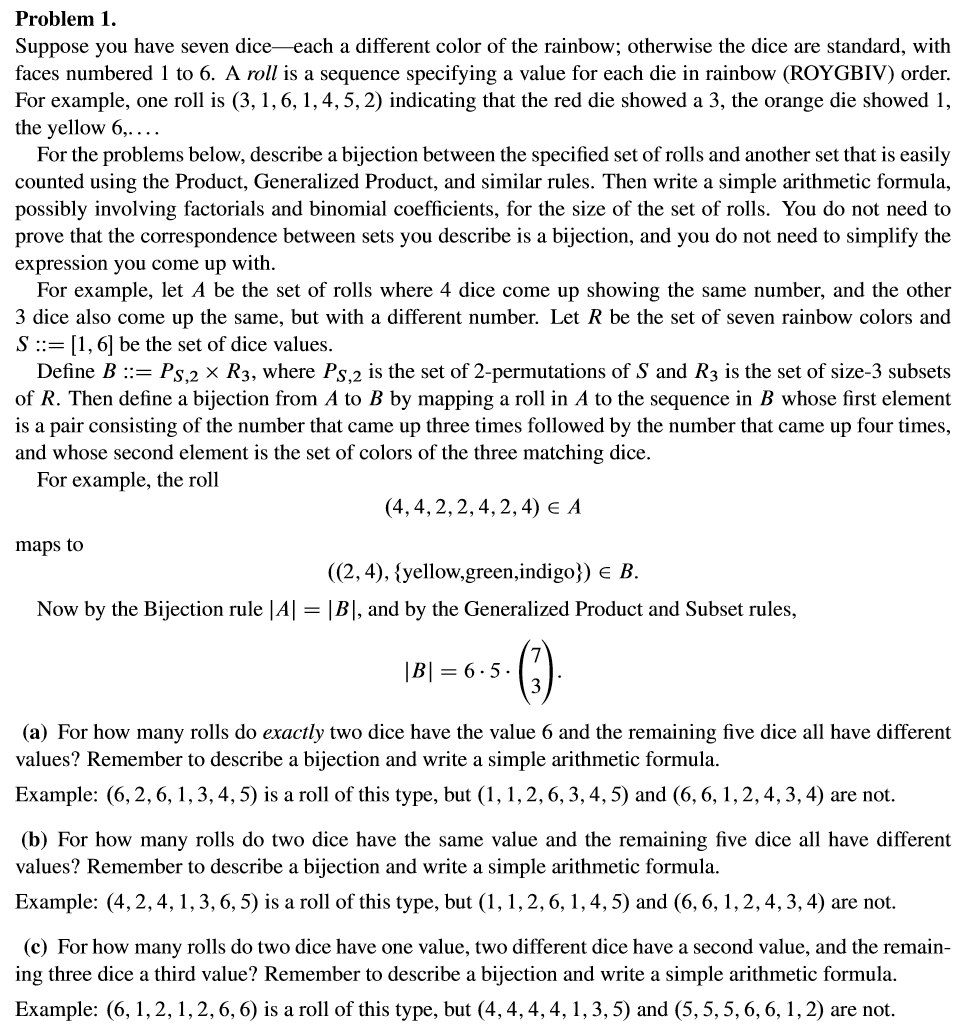
Problem 1. Suppose you have seven diceeach a different color of the rainbow; otherwise the dice are standard, with faces numbered 1 to 6. A not! is a sequence specifying a value for each die in rainbow (ROYGBIV) order. For example, one roll is (3, 1, 6, 1,4, 5,2) indicating that the red die showed a 3, the orange die showed 1, the yellow 6,. . .. For the problems below, describe a bijection between the specied set of rolls and another set that is easily counted using the Product, Generalized Product, and similar rules. Then write a simple arithmetic formula, possibly involving factorials and binomial coefcients, for the size of the set of rolls. You do not need to prove that the correspondence between sets you describe is a bijection, and you do not need to simplify the expression you come up with. For example, let A be the set of rolls where 4 dice come up showing the same number, and the other 3 dice also come up the same, but with a different number. Let R be the set of seven rainbow colors and S ::= [1, 6] be the set of dice values. Dene B ::= PS; X R3, where P532 is the set of 2permutations of S and R3 is the set of size-3 subsets of R. Then dene a bijection from A to B by mapping a roll in A to the sequence in B whose rst element is a pair consisting of the number that came up three times followed by the number that came up four times, and whose second element is the set of colors of the three matching dice. For example, the roll (4,4,2,2, 4,2,4) 6 A maps to ((2, 4), {yellow,gteen,indigo}) E B. Now by the Bijection rule |A| = |B|, and by the Generalized Product and Subset rules, "I B =6o5- . I I (3) (a) For how many rolls do exactly two dice have the value 6 and the remaining ve dice all have different values? Remember to describe a bijection and write a simple arithmetic formula. Example: (6, 2, 6, 1, 3, 4, 5) is a roll of this type, but (1,1,2, 6, 3,4, 5) and (6,6, 1, 2, 4, 3,4) are not. (b) For how many rolls do two dice have the same value and the remaining ve dice all have different values? Remember to describe a bijection and write a simple arithmetic formula. Example: (4, 2,4, l, 3,6, 5) is aroll ofthis type, but (1, 1, 2, 6, 1,4, 5) and (6,6, 1, 2, 4, 3,4) are not. (c) For how many rolls do two dice have one value, two different dice have a second value, and the remain- ing three dioe a third value? Remember to describe a bijection and write a simple arithmetic formula. Example: (6, 1, 2, 1, 2,6, 6) is a roll of this type, but (4, 4,4, 4, 1,3, 5) and (5, 5,5,6, 6,1,2) are not
Step by Step Solution
There are 3 Steps involved in it

Get step-by-step solutions from verified subject matter experts
 Study Help