







Question: Answer for a permanent increase not a decrease. Question 1 ( 5 points): Illustrate a permanent increase in government spending (let's say infrastructure spendings) implemented
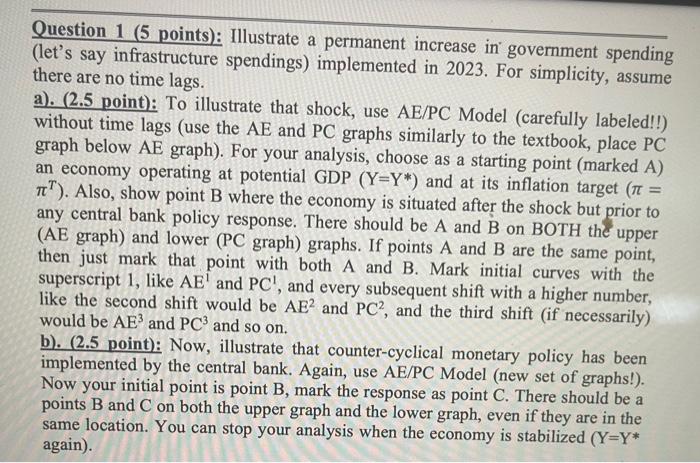
Question 1 ( 5 points): Illustrate a permanent increase in government spending (let's say infrastructure spendings) implemented in 2023 . For simplicity, assume there are no time lags. a). (2.5 point): To illustrate that shock, use AE/PC Model (carefully labeled!!) without time lags (use the AE and PC graphs similarly to the textbook, place PC graph below AE graph). For your analysis, choose as a starting point (marked A) an economy operating at potential GDP (Y=Y) and at its inflation target (= T ). Also, show point B where the economy is situated after the shock but prior to any central bank policy response. There should be A and B on BOTH the upper (AE graph) and lower (PC graph) graphs. If points A and B are the same point, then just mark that point with both A and B. Mark initial curves with the superscript 1 , like AE1 and PC1, and every subsequent shift with a higher number, like the second shift would be AE2 and PC2, and the third shift (if necessarily) would be AE3 and PC3 and so on. b). (2.5 point): Now, illustrate that counter-cyclical monetary policy has been implemented by the central bank. Again, use AE/PC Model (new set of graphs!). Now your initial point is point B, mark the response as point C. There should be a points B and C on both the upper graph and the lower graph, even if they are in the same location. You can stop your analysis when the economy is stabilized (Y=Y again)
Step by Step Solution
There are 3 Steps involved in it

Get step-by-step solutions from verified subject matter experts
 Study Help