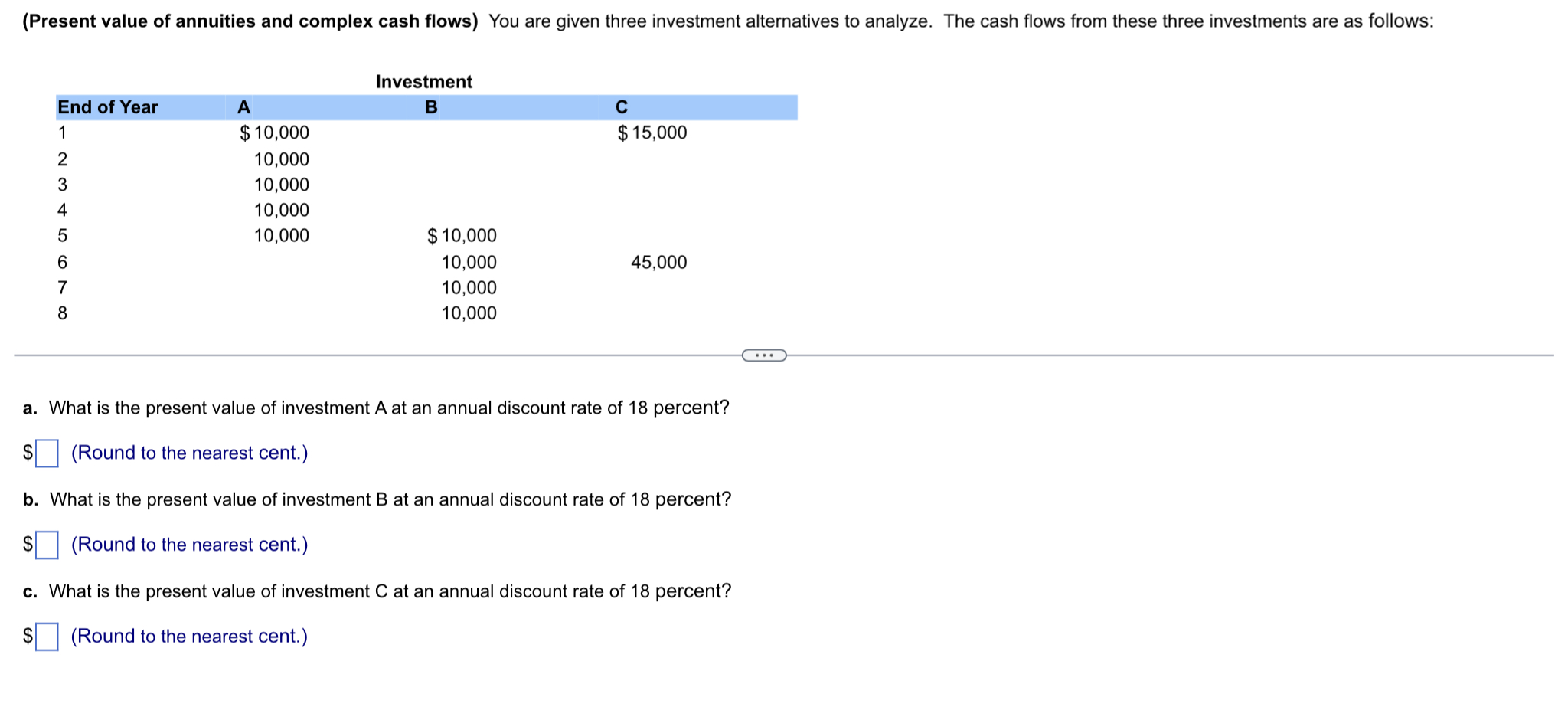
Question: answer for automatic like. (Present value of annuities and complex cash flows) You are given three investment alternatives to analyze. The cash ows from these
answer for automatic like.
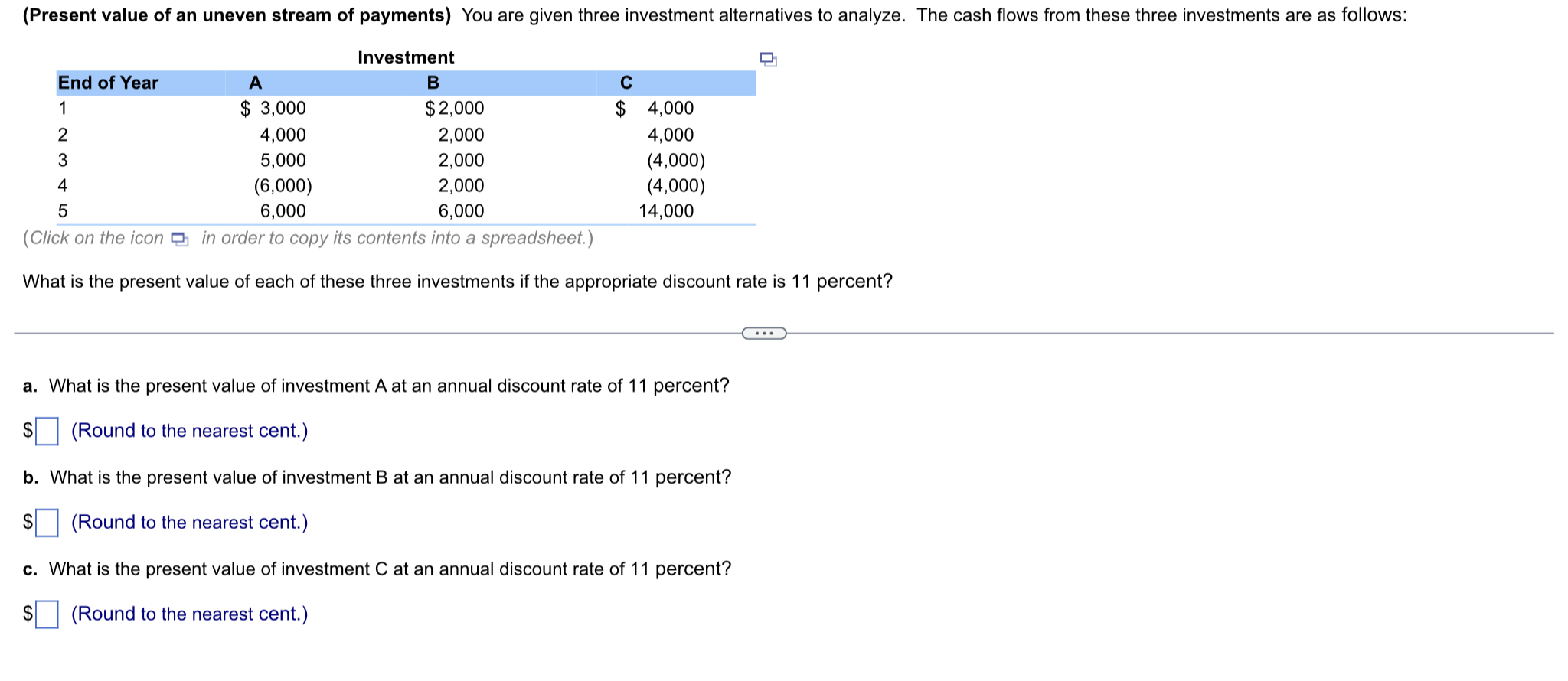
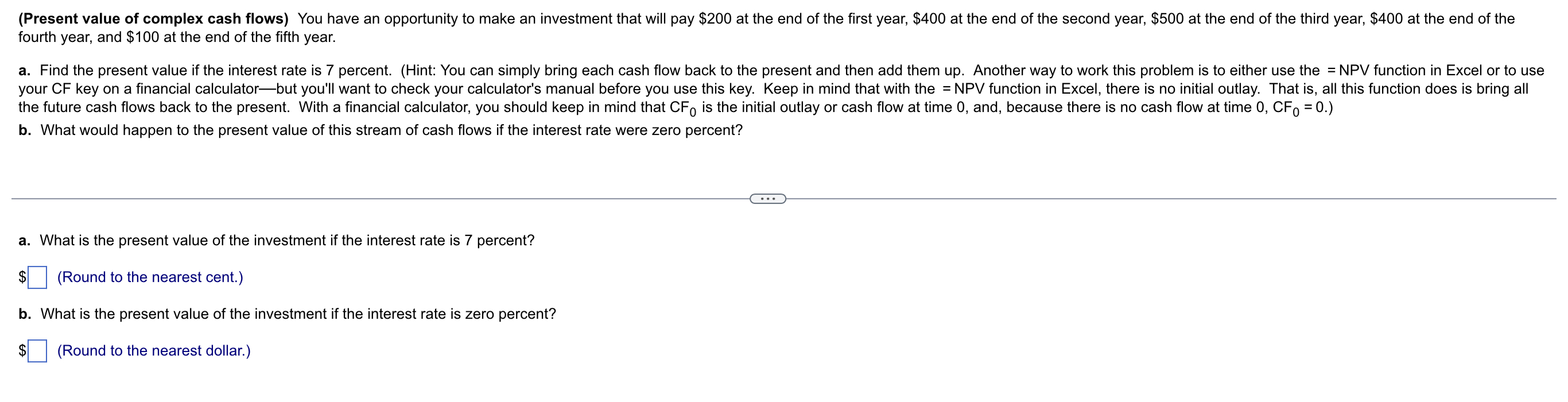
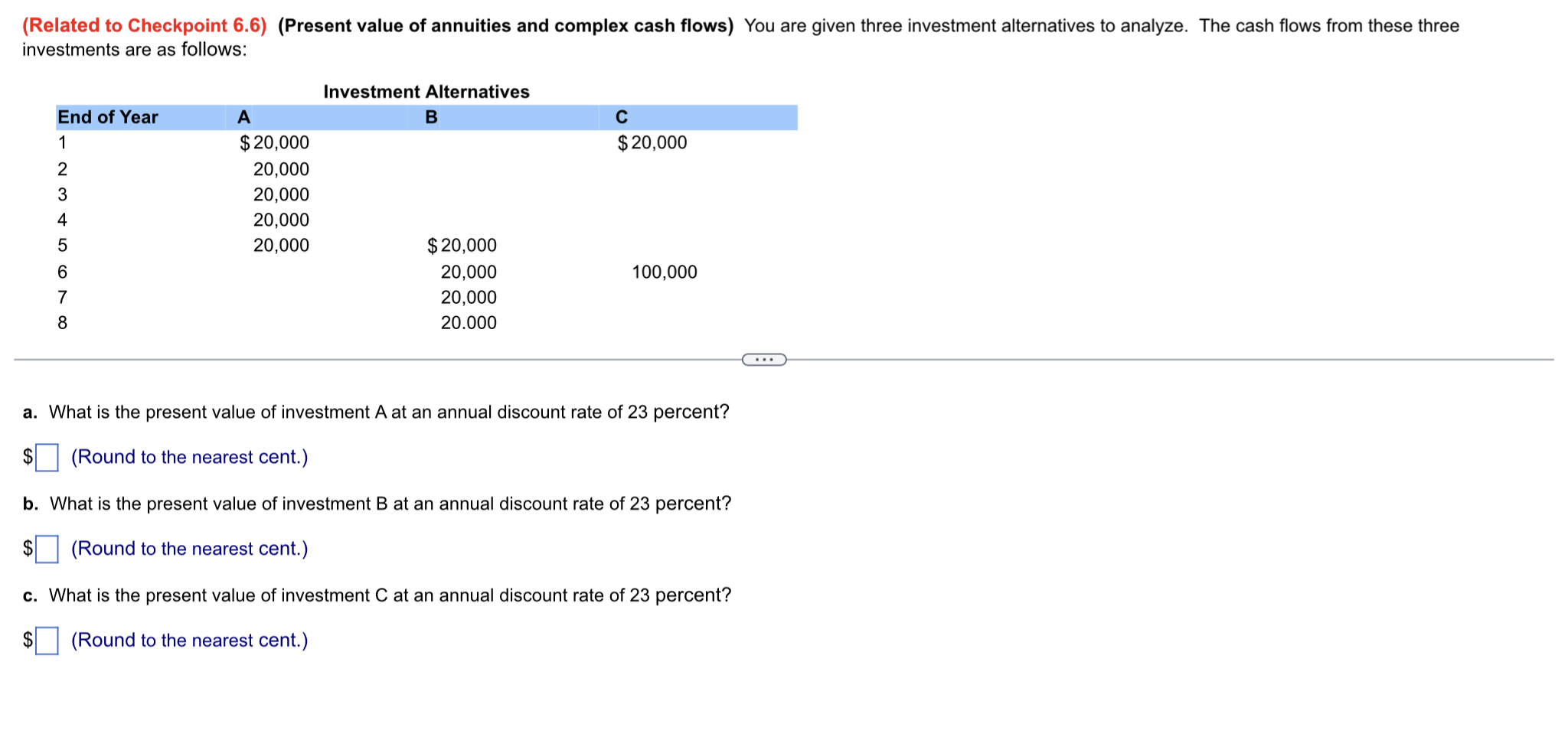
(Present value of annuities and complex cash flows) You are given three investment alternatives to analyze. The cash ows from these three investments are as follows: Investment 1 $10,000 $15,000 2 10,000 3 10,000 4 10,000 5 10,000 $10,000 6 10,000 45,000 7 10.000 8 10.000 a. What is the present value of investment Aat an annual discount rate of 18 percent? $:| (Round to the nearest cent.) b. What is the present value of investment B at an annual discount rate of 18 percent? $:| (Round to the nearest cent.) c. What is the present value of investment 0 at an annual discount rate of 18 percent? $:| (Round to the nearest cent.) (Present value of an uneven stream of payments) You are given three investment alternatives to analyze. The cash flows from these three investments are as follows: Investment lT-h 1 $ 3,000 $2,000 $ 4,000 2 4,000 2,000 4,000 3 5,000 2,000 (4,000) 4 (6,000) 2,000 (4,000) 5 6,000 6.000 14,000 (Click on the icon Q: in order to copy its contents into a spreadsheet.) What is the present value of each of these three investments if the appropriate discount rate is 11 percent? E a. What is the present value of investment Aat an annual discount rate of 11 percent? $E| (Round to the nearest cent.) b. What is the present value of investment B at an annual discount rate of 11 percent? $E| (Round to the nearest cent.) c. What is the present value of investment 0 at an annual discount rate of 11 percent? $E| (Round to the nearest cent.) (Present value of complex cash flows) You have an opportunity to make an investment that wili pay $200 at the end of the rst year, $400 at the end of the second year, $500 at the end of the third year, $400 at the end of the fourth year, and $100 at the end of the fifth year. a. Find the present value if the interest rate is 7 percent. (Hint: You can simply bring each cash ow back to the present and then add them up. Another way to work this problem is to either use the = NPV function in Excel or to use your CF key on a financial calculatorbut you'll want to check your calculator's manual before you use this key. Keep in mind that with the = NPV function in Excel, there is no initial outlay. That is, ail this function does is bring all the future cash flows back to the present. With a nancial calculator, you should keep in mind that CF0 is the initial outlay or cash flow at time 0, and, because there is no cash ow at time 0, CFO = 0.) b. What would happen to the present value of this stream of cash flows if the interest rate were zero percent? a. What is the present value of the investment if the interest rate is 7 percent? 35 (Round to the nearest cent.) b. What is the present value of the investment if the interest rate is zero percent? $ (Round to the nearest dollar.) (Related to Checkpoint 6.6) (Present value of annuities and complex cash ows) You are given three investment alternatives to analyze. The cash ows from these three investments are as follows: Investment Alternatives 1 $ 20,000 $ 20,000 2 20,000 3 20,000 4 20,000 5 20,000 $ 20,000 6 20,000 100,000 7 20,000 8 20.000 a. What is the present value of investment Aat an annual discount rate of 23 percent? $:| (Round to the nearest cent.) b. What is the present value of investment B at an annual discount rate of 23 percent? $:| (Round to the nearest cent.) c. What is the present value of investment 0 at an annual discount rate of 23 percent? $:| (Round to the nearest cent.)
Step by Step Solution
There are 3 Steps involved in it
1 Expert Approved Answer
Step: 1 Unlock
Question Has Been Solved by an Expert!
Get step-by-step solutions from verified subject matter experts
Step: 2 Unlock
Step: 3 Unlock
Students Have Also Explored These Related Finance Questions!









 Study Help