







Question: answer for number 1 is provided, need help with number 2. compare: addi $sp, $sp, 4 sw $ra, 0($sp) add $s0, $a0, $0 add $s1,
answer for number 1 is provided, need help with number 2. 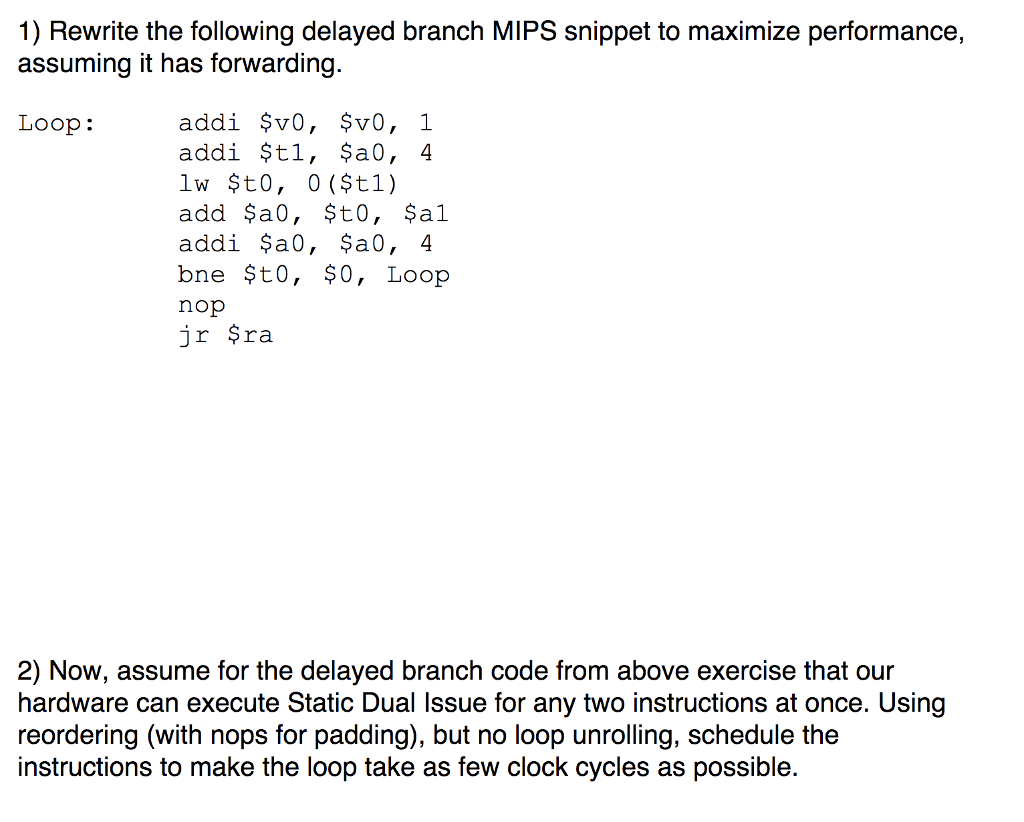
compare:
addi $sp, $sp, 4
sw $ra, 0($sp)
add $s0, $a0, $0
add $s1, $a1, $0
jal sub
addi $t1, $0, 1
beq $v0, $0, exit
slt $t2, $0, $v0
bne $t2, $0, exit
addi $t1, $0, $0
exit:
add $v0, $t1, $0
lw $ra, 0($sp)
addi $sp, $sp, 4
jr $ra
sub:
sub $v0, $a0, $a1
jr $ra
1) Rewrite the following delayed branch MIPS snippet to maximize performance, assuming it has forwarding. addi $v0, $v0, 1 addi $tl, ?a0, 4 lw $t0, 0 ($tl) add $a0, $t0, ?al addi $a0, $a0, 4 bne $to, $0, Loop nop jr $ra Loop: 2) Now, assume for the delayed branch code from above exercise that our hardware can execute Static Dual Issue for any two instructions at once. Using reordering (with nops for padding), but no loop unrolling, schedule the instructions to make the loop take as few clock cycles as possible. 1) Rewrite the following delayed branch MIPS snippet to maximize performance, assuming it has forwarding. addi $v0, $v0, 1 addi $tl, ?a0, 4 lw $t0, 0 ($tl) add $a0, $t0, ?al addi $a0, $a0, 4 bne $to, $0, Loop nop jr $ra Loop: 2) Now, assume for the delayed branch code from above exercise that our hardware can execute Static Dual Issue for any two instructions at once. Using reordering (with nops for padding), but no loop unrolling, schedule the instructions to make the loop take as few clock cycles as possible
Step by Step Solution
There are 3 Steps involved in it

Get step-by-step solutions from verified subject matter experts
 Study Help