





Question: Answer Full question or allow someone else to get credit. Please provide answers with comments and document intermediate steps in sufficient detail. It needs to

Answer Full question or allow someone else to get credit. Please provide answers with comments and document intermediate steps in sufficient detail. It needs to be clear what procedure you have followed in solving the problem.
Answer Full question or allow someone else to get

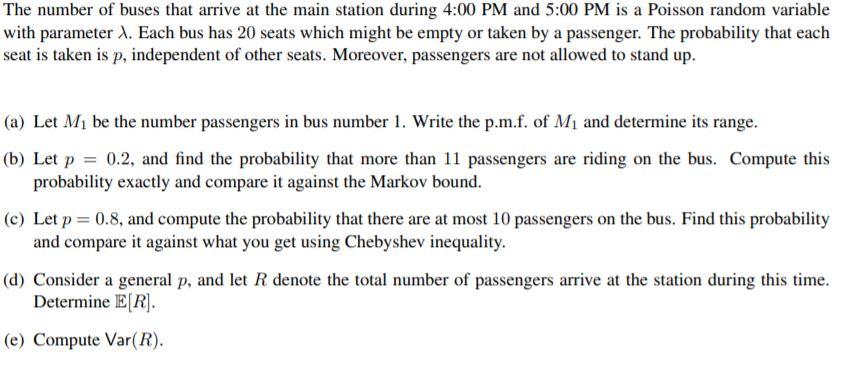
The number of buses that arrive at the main station during 4:00 PM and 5:00 PM is a Poisson random variable with parameter 1. Each bus has 20 seats which might be empty or taken by a passenger. The probability that each seat is taken is p, independent of other seats. Moreover, passengers are not allowed to stand up. (a) Let M be the number passengers in bus number 1. Write the p.m.f. of My and determine its range. (b) Let p = 0.2, and find the probability that more than 11 passengers are riding on the bus. Compute this probability exactly and compare it against the Markov bound. (c) Let p = 0.8, and compute the probability that there are at most 10 passengers on the bus. Find this probability and compare it against what you get using Chebyshev inequality. (d) Consider a general p, and let R denote the total number of passengers arrive at the station during this time. Determine E[R] (e) Compute Var(R). The number of buses that arrive at the main station during 4:00 PM and 5:00 PM is a Poisson random variable with parameter 1. Each bus has 20 seats which might be empty or taken by a passenger. The probability that each seat is taken is p, independent of other seats. Moreover, passengers are not allowed to stand up. (a) Let M be the number passengers in bus number 1. Write the p.m.f. of My and determine its range. (b) Let p = 0.2, and find the probability that more than 11 passengers are riding on the bus. Compute this probability exactly and compare it against the Markov bound. (c) Let p = 0.8, and compute the probability that there are at most 10 passengers on the bus. Find this probability and compare it against what you get using Chebyshev inequality. (d) Consider a general p, and let R denote the total number of passengers arrive at the station during this time. Determine E[R] (e) Compute Var(R)

Step by Step Solution

There are 3 Steps involved in it

1 Expert Approved Answer
Step: 1 Unlock blur-text-image

Question Has Been Solved by an Expert!

Get step-by-step solutions from verified subject matter experts

Step: 2 Unlock
Step: 3 Unlock

Students Have Also Explored These Related General Management Questions!