





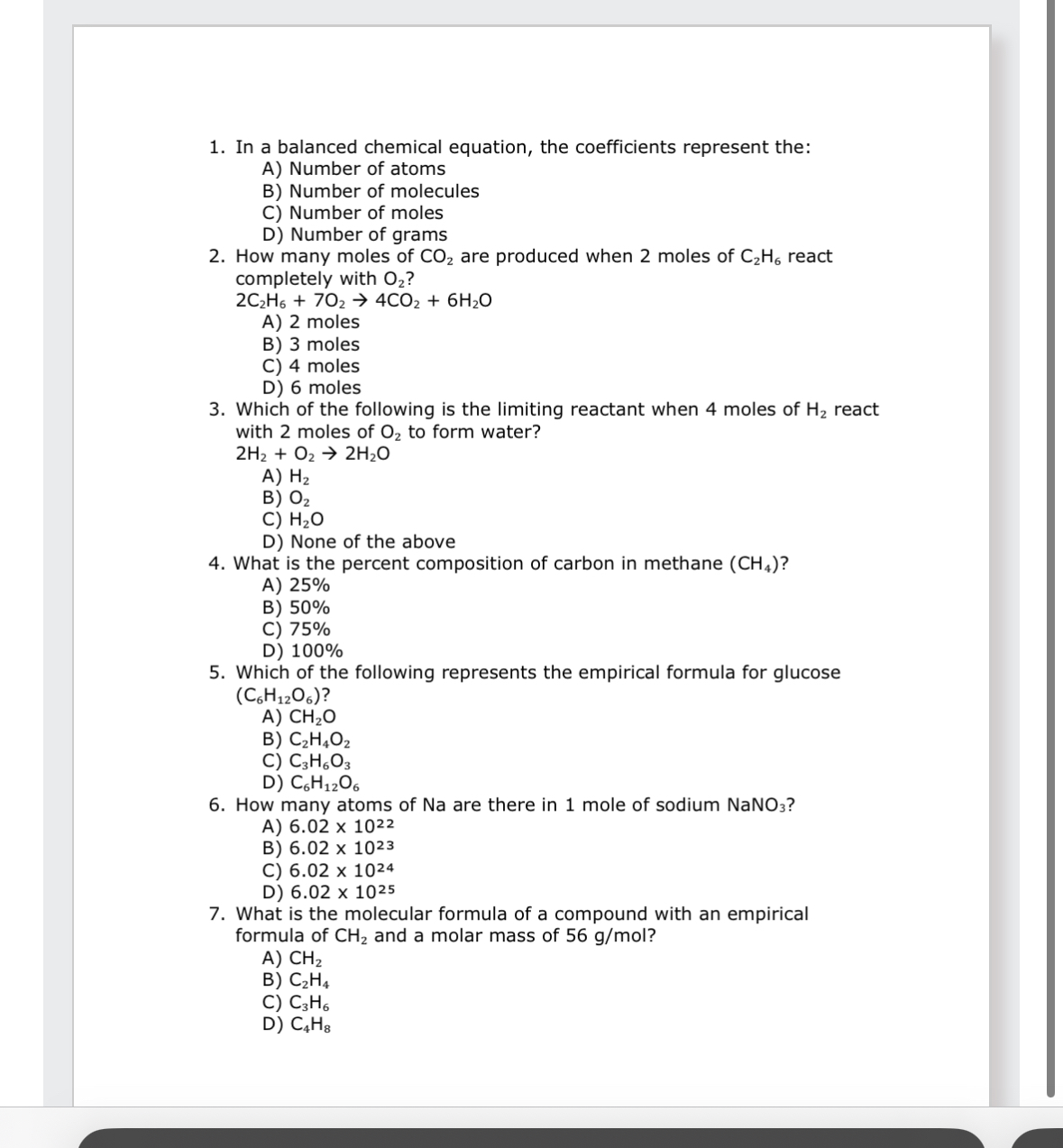
Question: Answer . In a balanced chemical equation, the coefficients represent the: A) Number of atoms B) Number of molecules C) Number of moles D) Number

Answer
Answer . In a balanced chemical equation, the
. In a balanced chemical equation, the coefficients represent the: A) Number of atoms B) Number of molecules C) Number of moles D) Number of grams . How many moles of CO, are produced when 2 moles of C,H, react completely with O,? 2C;Hes + 70, = 4CO; + 6H.0 A) 2 moles B) 3 moles C) 4 moles D) 6 moles . Which of the following is the limiting reactant when 4 moles of H, react with 2 moles of O, to form water? 2H; + 02 2 2H,0 D) None of the above . What is the percent composition of carbon in methane (CH,)? A) 25% B) 50% C) 75% D) 100% . Which of the following represents the empirical formula for glucose (CeH1206)? A) CH,0 B) C;H,0. C) C3Hq0; D) CH,206 . How many atoms of Na are there in 1 mole of sodium NaNQOs? A) 6.02 x 10²² B) 6.02 x 10²³ C) 6.02 x 1024 D) 6.02 x 1025 . What is the molecular formula of a compound with an empirical formula of CH, and a molar mass of 56 g/mol? A) CH, B) CH, C) CsH, D) C4H

Step by Step Solution

There are 3 Steps involved in it

1 Expert Approved Answer
Step: 1 Unlock blur-text-image

Question Has Been Solved by an Expert!

Get step-by-step solutions from verified subject matter experts

Step: 2 Unlock
Step: 3 Unlock

Students Have Also Explored These Related Business Writing Questions!