Question: Answer in paragraph form. I WILL GIVE FAST UP VOTE FOR ALL ANSWERED QUESTIONS On March 15, 2019, a shooter opened fire during Friday prayers
Answer in paragraph form.
I WILL GIVE FAST UP VOTE FOR ALL ANSWERED QUESTIONS
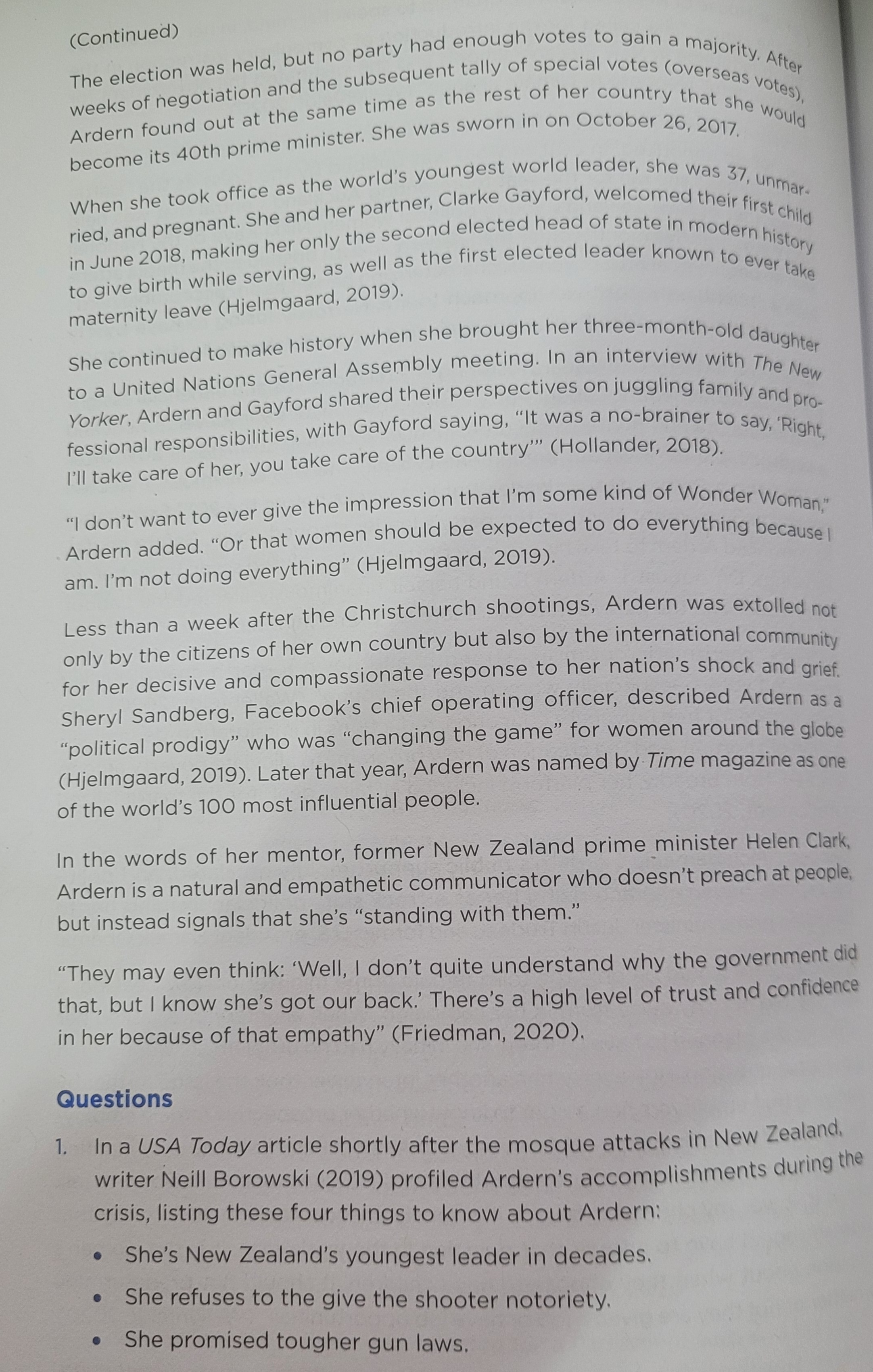
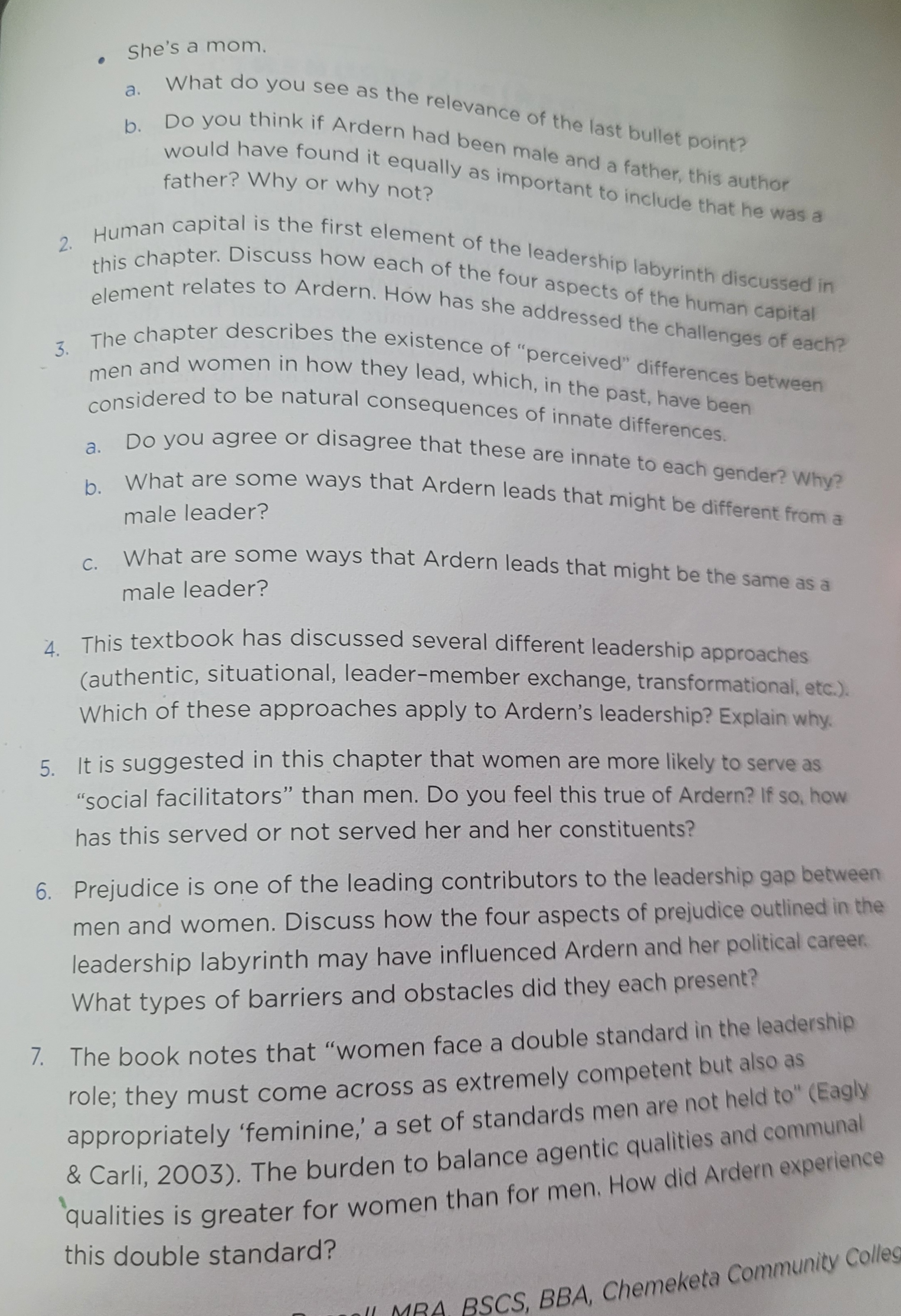
On March 15, 2019, a shooter opened fire during Friday prayers at two Muslim mosques in Christchurch, New Zealand. More than 50 people were killed (including several children), a number that rivaled the island country's total murders for a year, and dozens more were wounded. Prior to the attack, the shooter penned a chilling 74-page manifesto, which was sent to the prime minister's office. He then livestreamed himself on Facebook as he stormed the Al Noor Mosque. The hate-based attacks left New Zealand, a country known for its low crime rates and reputation for welcoming immigrants, in a state of shock and grief. The response by Prime Minister Jacinda Ardern, New Zealand's 39-year-old leader, was swift and unflinching. Avoiding divisive language, she instead united and galvanized a country in crisis. Speaking at a press conference, she reminded people of the importance of the diversity of their culture: For many, New Zealand was their choice... The place they actively came to, and committed themselves to ... where they were part of communities who they loved and who loved them. A place where they were free to practice their culture and their religion. For those of you who are watching at home tonight, and questioning how this could have happened here, we-New Zealand-we were not a chosen for this act of violence because wor those who hate. We were not chosen for the very fact that we are we condone racism. We were represent diversity, kindness, compassion, a these things. Because we our values, refuge for those who need it. a home for those who share We are a proud nation of more than 200 ethnicities, 160 languages. And amongst that diversity we share common values. And the one that we place the currency on right now-and tonight-is our compassion and support for the community of those directly affected by this In an address to Parliament a few days later, she stood firm, refusing to give the shooter the one thing she felt he desired: notoriety. After opening her address with the Arabic greeting As-salamu alaykum ("Peace be upon you"), she expounded, "He is a terrorist, he is a criminal, he is an extremist, but he will, when I speak, be nameless, and to others I implore you: Speak the names of those who were lost rather than the name of the man who took them. He may have sought notoriety but we in New Zealand will give him nothing-not even his name" (Hjelmgaard, 2019). Focusing her efforts on honoring those who lost their lives and standing up to right-wing terrorism, Ardern vowed to cover funeral costs and provide financial assistance to grief-stricken families. Recognizing that gun control was a weak link in New Zealand, a land where gun ownership is widespread, she also pledged to take swift action on gun control, A month later, under her leadership, New Zealand's Parliament approved a ban on semiautomatic and military-style weapons, a feat that much larger countries struggling with long histories of mass shootings had yet to accomplish. While Prime Minister Ardern was well supported in her efforts, her detractors were not quiet. The speed of the process was criticized, to which she countered, "You either believe that in New Zealand these weapons have a place or you do not. And if you believe, like us, that they do not, you should be able to agree that we can move swiftly. My view is that an argument about process is an argument to do nothing" (M. Schwartz, 2019). Her resolute and expedient actions were only one element of Ardern's approach to leading her country through uncertainty, tragedy, and grief. She reached out directy to the communities most affected, visiting Christchurch the day after the shooting to the communities most affected, visiting Christchurch the day after the Wisiteo the and taking with her the leaders of all New Zealand's political parties. She (Continued) (Continued) in the shooting. In a show of respect and empathy, she donned a black hijab, a traditional headscarf of the Muslim faith. "The Prime Minister, when she came wearing her scarf, that was big for us," shared Dalia Mohamed, one of the many mourners who attended (Hjelmgaard, 2019). Who Is Jacinda Ardern? At 37. Jacinda Kate Laurell Ardern became the youngest prime minister (PM) of New Zealand since 1856 and only the third woman to hold the position. Her rise in New Zealand politics was termed the "most meteoric rise to power of any New Zealand PM" (Atkinson, 2018). Ardern was born in 1980 in Hamilton, located in New Zealand's politically conservative Waikato Region. She was the second of two daughters and raised in the Mormon religion, a conservative faith that advocates for the traditional role of women within the family. She ultimately broke from the church over its prohibitive view on homosexuality and same-sex marriage (Wallenfeldt, 2020). Ardern spent her early years in Murupara, a small, isolated town known as the center of Maori gang activity. Maori are the indigenous Polynesian people of New Zealand and comprise almost 15% of the country's population (New Zealand History, n.d.). Seeing "children without shoes on their feet or anything to eat for lunch" inspired her to enter politics (Jones, 2017). At the age of 17 , she deviated from her conservative roots and joined New Zealand's more liberal Labour Party. With the help of an aunt, she joined the reelection campaign of Harry Duynhoven, a Labour member of Parliament (MP). After receiving a bachelor's degree in communication studies from the University of Waikato in 2001, Ardern became a researcher for Labour MP Phil Goff, which led to a position on the staff of then prime minister Helen Clark. The second woman to hold New Zealand's highest office, Clark was Ardern's political hero and mentor (Wallenfeldt, 2020). In 2005, Ardern left this position for an "overseas experience," a traditional rite of passage for New Zealand's middle- and upper-class youth involving an extended-usually working-trip to Britain. While many young New Zealanders often use this as a time to work menial jobs and tour the continent, Ardern instead secured a position in the cabinet office of British prime minister Tony Blair. As the associate director for Better Regulation Executive, she spent two and a half years working to improve the interactions between local authorities and small businesses. Her subsequent election as president of the International Union of Socialist Youth in 2007 further expanded her horizons, taking her to Algeria, China, India, Israel, Jordan, and Lebanon (Wallenfeldt, 2020). Back in New Zealand, Ardern was selected for a Parliament seat as a list candidate and, at the age of 28, took her place as New Zealand's youngest member of the House of Representatives. Unafraid to speak her mind, in her first address to the House "she called for the introduction of compulsory instruction in the its 'shameful' response to climate change" (Wallenfeldated the government for Because she was a rising political star, Ardern's did not go unnoticed. In 2011, in what was dubbed and physical attractiveness of the Babes," she ran for the seat representing by the press as the "Battle by another of New Zealand's young political women, Nund Central that was held party, who was five months older than Ardern. Ardern briki Kaye of the National tion on her physical attractiveness, characterizing herself as an "accepted attenwith a "relentlessly positive" approach to life. Narrowly losing to Kaye by 717 votes, Ardern returned to Parliament again as a list candidate (Wallenfeldt, 2020 ). 717 Ardern spent the next few years fostering key relationships and beneficial assionments, being named the Labour Party's spokesperson for social beneficial assignments, being named the Labour Party's spokesperson for social development and for arts, culture and heritage, children, justice, and small business. In 2017, after a landslide win for a vacant parliamentary seat, she was unanimously elected as the Labour Party's deputy leader. But just weeks before the 2017 September general parliamentary election, the party's leader stepped down. Before he did, he convinced Ardern to take his place (reportedly, she refused seven times before agreeing). On August 1, Ardern found herself unanimously elected the Labour party leader and the party's new candidate for prime minister. Ardern's "charismatic optimism, strength, and down-to-earth charm quickly energized voters-especially women and the young" (Wallenfeldt, 2020). She campaigned for free university education, reductions in immigration, decriminalization of abortion, and the creation of new programs to alleviate poverty among children. More broadly, her platform included a "fairer deal" for the marginalized (Wallenfeldt, 2020). Dubbed "Jacindamania," Ardern's public support rapidly escalated, and political experts began characterizing her as a "rock star" politician likening her to Canadian prime minister Justin Trudeau and former U.S. president Barack Obama. If elected, she would be only the third female prime minister of New Zealand, a fact she did not shy away from in her campaign. When an interviewer asked her whether she planned to have children, she initially had no problem answering such a personal puestion. However, when another interviewer took the issue further by impersonal question. However, when another interviewer took the issue further by eeslying that employers had a right to know whether prospective female employees planned on taking time off from work to have children, she atickly clarifed her previous response and the acceptability of such questions. "I decided to taks about it, it was my choice... but ... it is totally unacceptable in 2017 to say that women should have to answer that question in the workplace. It is the woman's decision about when they choose to have children. It should not predetermine Whether or not they are given a job or have job opportunities" (Wallenfelalizaringed) (Continued) The election was held, but no party had enough votes to gain a majority. After weeks of negotiation and the subsequent tally of special votes (overseas votes), Ardern found out at the same time as the rest of her country that she would become its 40 th prime minister. She was sworn in When she took office as the world's youngest world leader, she was 37 , unmar. ried, and pregnant. She and her partner, Clarke Gayford, welcomed their first child of state in modern history to give birth while serving, as well as tord, 2019). maternity leave (Hjelmgaard, 2019 ). brought her three-month-old daughter She continued to make history when she brought her three-month-old in an interview with The Thew to a United Nations General Assembly meeting. In an intervive on jugging family and professional responsibilities, with Gayford saying, "It was a no-brainer to say, 'Right, I'll take care of her, you take care of the country'" (Hollander, 2018 ). "I don't want to ever give the impression that I'm some kind of Wonder Woman," Ardern added. "Or that women should be expected to do everything because I am. I'm not doing everything" (Hjelmgaard, 2019). Less than a week after the Christchurch shootings, Ardern was extolled not only by the citizens of her own country but also by the international community for her decisive and compassionate response to her nation's shock and grief. Sheryl Sandberg. Facebook's chief operating officer, described Ardern as a "political prodigy" who was "changing the game" for women around the globe (Hjelmgaard, 2019). Later that year, Ardern was named by Time magazine as one of the world's 100 most influential people. In the words of her mentor, former New Zealand prime minister Helen Clark, Ardern is a natural and empathetic communicator who doesn't preach at people, but instead signals that she's "standing with them." "They may even think: 'Well, I don't quite understand why the government did that, but I know she's got our back.' There's a high level of trust and confidence in her because of that empathy" (Friedman, 2020). Questions 1. In a USA Today article shortly after the mosque attacks in New Zealand. writer Neill Borowski (2019) profiled Ardern's accomplishments during the crisis, listing these four things to know about Ardern: - She's New Zealand's youngest leader in decades. - She refuses to the give the shooter notoriety. - She promised tougher gun laws. - She's a mom. a. What do you see as the relevance of the last bullet point? b. Do you think if Ardern had been male and a father, this author would have found it equally as important to include that he was a 2. Human capital is the first element of the leadership labyrinth discussed in this chapter. Discuss how each of the four aspects of the human capital element relates to Ardern. How has she addressed the challenges of each? 3. The chapter describes the existence of "perceived" differences between men and women in how they lead, which, in the past, have been considered to be natural consequences of innate differences. a. Do you agree or disagree that these are innate to each gender? Why? b. What are some ways that Ardern leads that might be different from a male leader? c. What are some ways that Ardern leads that might be the same as a male leader? 4. This textbook has discussed several different leadership approaches (authentic, situational, leader-member exchange, transformational, etc.). Which of these approaches apply to Ardern's leadership? Explain why. 5. It is suggested in this chapter that women are more likely to serve as "social facilitators" than men. Do you feel this true of Ardern? If so, how has this served or not served her and her constituents? 6. Prejudice is one of the leading contributors to the leadership gap between men and women. Discuss how the four aspects of prejudice outlined in the leadership labyrinth may have influenced Ardern and her political career. What types of barriers and obstacles did they each present? 7. The book notes that "women face a double standard in the leadership role; they must come across as extremely competent but also as appropriately 'feminine,' a set of standards men are not held to" (Eagly \& Carli, 2003). The burden to balance agentic qualities and communal qualities is greater for women than for men. How did Ardern experience this double standard









 Study Help