







Question: Answer in prolog please Write a predicate called noDuplicates (L1,L2). noDuplicates (L1,L2) is true if L2 has the same elements in the same order as
Answer in prolog please
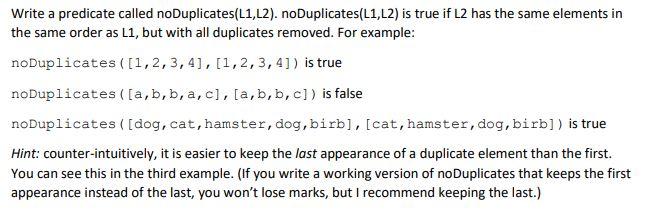
Write a predicate called noDuplicates (L1,L2). noDuplicates (L1,L2) is true if L2 has the same elements in the same order as L1, but with all duplicates removed. For example: noDuplicates ([1,2,3,4],[1,2,3,4]) is true noduplicates ([a,b,b,a,c],[a,b,b,c]) is false noduplicates ([dog, cat, hamster, dog, birb], [cat, hamster, dog, birb]) is true Hint: counter-intuitively, it is easier to keep the last appearance of a duplicate element than the first. You can see this in the third example. (If you write a working version of noDuplicates that keeps the first appearance instead of the last, you won't lose marks, but I recommend keeping the last.)
Step by Step Solution
There are 3 Steps involved in it

Get step-by-step solutions from verified subject matter experts
 Study Help