







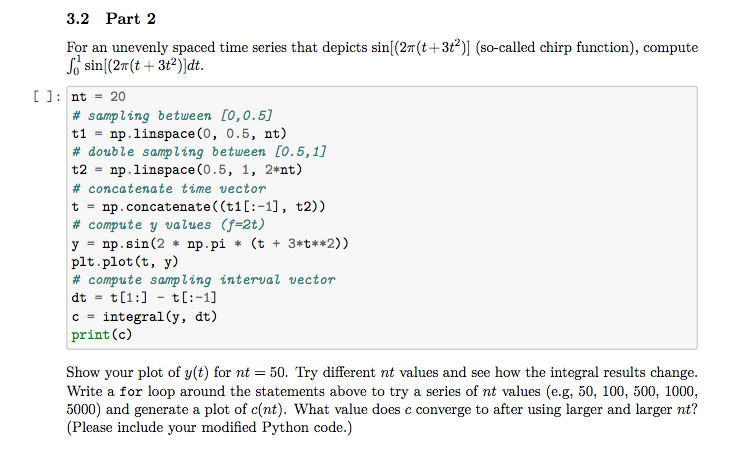
Question: Answer in Python code. For an unevenly spaced time series that depicts sin[(2(t+3t2)] (so-called chirp function), compute 01sin[(2(t+3t2)]dt nt=20 # sampling between [0,0.5] t1=np. linspace
 Answer in Python code.
For an unevenly spaced time series that depicts sin[(2(t+3t2)] (so-called chirp function), compute 01sin[(2(t+3t2)]dt nt=20 \# sampling between [0,0.5] t1=np. linspace (0,0.5,nt) \# double sampling between [0.5,1] t2=np.linspace( (0.5,1,2nt) \# concatenate time vector t=np concatenate ((t1[:1],t2)) \# compute y values (f=2t) y=npsin(2nppi(t+3t2)) plt.plot (t,y) \# compute sampling interval vector dt=t[1:]t[:1] c= integral (y,dt) print (c) Show your plot of y(t) for nt=50. Try different nt values and see how the integral results change. Write a for loop around the statements above to try a series of nt values (e.g, 50, 100, 500, 1000, 5000) and generate a plot of c(nt). What value does c converge to after using larger and larger nt ? (Please include your modified Python code.)
Step by Step Solution
There are 3 Steps involved in it

Get step-by-step solutions from verified subject matter experts
 Study Help