







Question: Answer in python remaining_payments() Parameters The balance of the credit card (that amount in the account that has not been paid off yet; you can
Answer in python
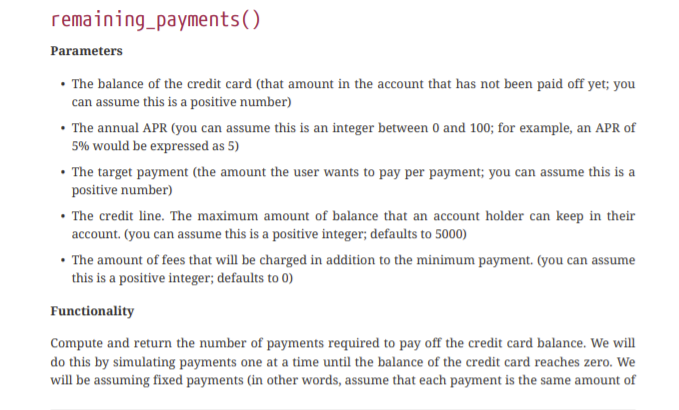
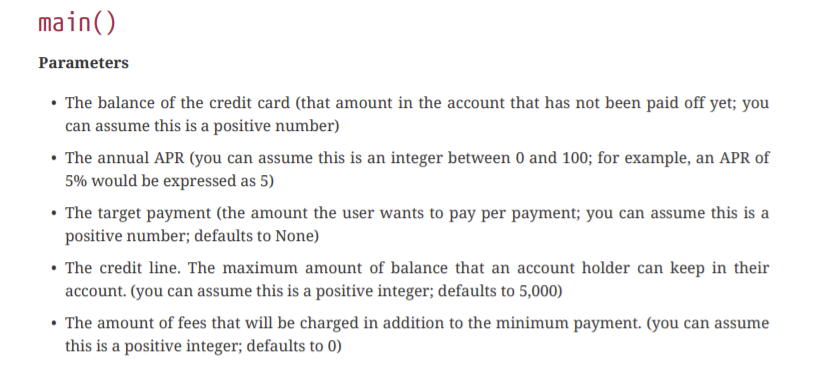
remaining_payments() Parameters The balance of the credit card (that amount in the account that has not been paid off yet; you can assume this is a positive number) The annual APR (you can assume this is an integer between 0 and 100; for example, an APR of 5% would be expressed as 5) The target payment (the amount the user wants to pay per payment, you can assume this is a positive number) The credit line. The maximum amount of balance that an account holder can keep in their account. (you can assume this is a positive integer; defaults to 5000) The amount of fees that will be charged in addition to the minimum payment. (you can assume this is a positive integer; defaults to 0) Functionality Compute and return the number of payments required to pay off the credit card balance. We will do this by simulating payments one at a time until the balance of the credit card reaches zero. We will be assuming fixed payments in other words, assume that each payment is the same amount of main() Parameters The balance of the credit card (that amount in the account that has not been paid off yet; you can assume this is a positive number) The annual APR (you can assume this is an integer between 0 and 100; for example, an APR of 5% would be expressed as 5) The target payment (the amount the user wants to pay per payment; you can assume this is a positive number; defaults to None) The credit line. The maximum amount of balance that an account holder can keep in their account. (you can assume this is a positive integer; defaults to 5,000) The amount of fees that will be charged in addition to the minimum payment. (you can assume this is a positive integer; defaults to 0) remaining_payments() Parameters The balance of the credit card (that amount in the account that has not been paid off yet; you can assume this is a positive number) The annual APR (you can assume this is an integer between 0 and 100; for example, an APR of 5% would be expressed as 5) The target payment (the amount the user wants to pay per payment, you can assume this is a positive number) The credit line. The maximum amount of balance that an account holder can keep in their account. (you can assume this is a positive integer; defaults to 5000) The amount of fees that will be charged in addition to the minimum payment. (you can assume this is a positive integer; defaults to 0) Functionality Compute and return the number of payments required to pay off the credit card balance. We will do this by simulating payments one at a time until the balance of the credit card reaches zero. We will be assuming fixed payments in other words, assume that each payment is the same amount of main() Parameters The balance of the credit card (that amount in the account that has not been paid off yet; you can assume this is a positive number) The annual APR (you can assume this is an integer between 0 and 100; for example, an APR of 5% would be expressed as 5) The target payment (the amount the user wants to pay per payment; you can assume this is a positive number; defaults to None) The credit line. The maximum amount of balance that an account holder can keep in their account. (you can assume this is a positive integer; defaults to 5,000) The amount of fees that will be charged in addition to the minimum payment. (you can assume this is a positive integer; defaults to 0)
Step by Step Solution
There are 3 Steps involved in it

Get step-by-step solutions from verified subject matter experts
 Study Help